

Courageous Citizenship - Part 2
Newsletter # 453 - May 11, 2026

Heidi Burgess and Guy Burgess
In Newsletter 452, we introduced Braver Angels' new concept of "Courageous Citizenship" and explained why we think this idea is so important. We also lay out a set of thought patterns and behaviors that we think courageous citizens should engage in, if they want to help build a stronger and healthier society in the United States. (Here we mean civic health, not just physical health.) In this post, we continue on with that discussion, explaining more about the courage that courageous citizens need, and give the example shared earlier by Harry Boyte about how this was done so well in the past by participants in Martin Luther King's civil rights movement. Following Kenneth Boulding's First Law: "If it exists (or if it happened before), it must be possible," we think the lessons of the 1950s and 60s civil rights movement have a lot to say about why courageous citizenship could help us now, and about what we all should do now to be "courageous citizens."
Courage
Doing the work we described in the last newsletter takes real courage — not the popular fiction kind of courage in which heroes (who are usually using violence) are always successful and ultimately lauded for their efforts.
Real courage entails a willingness consider the possibility that one may have been wrong, and that, if so, one should admit those errors and change one's behavior accordingly. (This is something that psychologists have long recognized as being so painful that we avoid it, if at all possible.) Part of what makes this so painful is that it frequently involves challenging norms of the groups to which one belongs. This means that courageous citizens must be willing to do unpopular things that threaten their relationships with people and communities that are really important to them. They may find themselves repeatedly having to patiently explain to skeptical audiences what they are doing and why. They are also likely to have to answer charges that they are compromising their group's core beliefs in ways that give "aid and comfort" to "the enemy" (the other side).
They may also have to endure more than criticism. In our hyper-polarized society, it has become common for people who do not wholeheartedly support the left's progressive "party line," to be subjected to any of a wide range of "cancel culture" sanctions. A parallel thing happens to those who are not adequately supportive of the right's orthodoxies (they just don't call it the cancel culture, but, for instance, they accuse people of being "RINOs"--"Republican in Name Only" and ostracize them on that basis). Such sanctions can threaten an individual's social standing, their livelihoods, and, sometimes, their physical security. Take a moment to think about all of the people who were canceled for daring to highlight another side of a story. Or, think about government officials who have had their actions unjustly vilified – officials who must now take precautions to protect themselves and their families from violent threats or actual attacks. Or, consider the way in which the No Labels' effort to offer voters a moderate choice between the extremes of the left and right in 2024 was suppressed.
Being a courageous citizen can be dangerous, and ultimate success is by no means assured — it depends upon how many people have the courage to be courageous citizens in the face of difficult challenges. It may seem too risky, and it may seem unlikely to succeed. But we believe in Kenneth Boulding's "First Law": "If it exists, it must be possible." Only a slight rephrasing creates "If it existed in the past, it must be possible." And it did exist in the past: just look at the courageous citizenship practiced by the followers of Martin Luther King. And look at how successful they were! (Their efforts did not make racism go away, but the 1964 Civil Rights Act and the 1965 Voting Rights Act brought about huge improvements.) And as dire as things look now; they must have looked far worse to Blacks in the 1950s. Harry Boyte, a scholar and trainer who has long focused on citizenship and nonviolence, participated in that movement back in the 60s, and told us about it in his latest interview.
Civil Versus Civic Citizenship
Last January, when we talked with Harry, he pointed out that there are two meanings of the word "citizen" that need to be distinguished. One is "civil citizenship," which is a legal term, meaning that one is a legal citizen of the United States. There are few responsibilities of civil citizenship, beyond obeying the law. In the U.S., you aren't even required to vote!
The second meaning, Harry explained, is "civic citizenship," which is a way of engaging with one's neighbors, community, state, and country. It involves working to maintain and support our communities, actually putting in the time and effort to work with our neighbors and fellow citizens (legal or not) to create the healthy communities and a nation we want to live in. This second meaning, Harry observed, "is at the heart of American democracy, but it has almost entirely disappeared from use."
It's been kind of appalling that citizenship has shrunk in the last 20 years. George Bush made his campaign in 2000 about the call to citizenship, the communitarian service version, which is important. Barack Obama, in 2008, said citizenship is "us all doing our part. “All hands on deck,” was a slogan [he used], along with “yes we can” and “I'm running to revitalize citizenship. Government can't solve complex problems by itself." Those campaigns were high-profile. But since then, the language of citizenship has largely disappeared from public discussion. Horizontal or civic citizenship has been replaced with vertical citizenship — this notion of legal status [which, of course, is what Trump is stressing.]
Courageous Citizenship in the U.S. Civil Rights Movement
Having come of age in the 1960s U.S. civil rights movement, Harry saw civic citizenship being widely practiced and taught among the black followers of Martin Luther King. Back then, participation took tremendous courage. Civil rights marchers were routinely attacked with viscous dogs, fire hoses, and police batons. But they were not deterred. They kept on marching, nonviolently, until their calm and respectful demeanor won the day, and the Civil Rights Act of 1964 and The Voting Rights Act of 1965 were passed. America was transformed by their efforts. A majority of Congress, but also a majority of Americans, recognized that Blacks deserved the same rights as Whites — they were people (and citizens) equally deserving of respect.
In an earlier interview that Harry did with us, he told a story about how his father worked with Martin Luther King in the civil rights movement and, in 1963, was with King for his "I Have a Dream Speech." So was Harry, then 18 years old:
I put my sleeping bag on dad's hotel floor and heard King practice his "I Have a Dream" speech in the room next door. The march was very powerful for me, because I was an angry kid. I didn't know any other white kids that I could talk to about desegregation. And my teachers were afraid to talk about it. There was a climate of fear in the South in the '50s and '60s. But the calm and the demeanor and the dignity of the marchers was what really impressed me. I thought, "Where did they learn to do that?" This was really the first expression of nonviolence on a large scale that I'd ever seen. And of course, it was also growing out of Montgomery, the bus boycott, and the sit-ins and the beginnings of the citizenship schools across the South, which taught nonviolence. It had a big impact.
Harry went on to teach in those citizenship schools. In our January 2026 interview with him, he explained:
We had about 900 citizenship schools. Tens of thousands of people went through them. Andy Young [leader of the Southern Christian Leadership Conference and close confidant to King] called them the leadership base of the whole movement. And I think that's probably true in communities across the south. Citizenship was far more than legal status. It was about a new sense of what King called “somebody-ness,” dignity, pride, self-worth. . ... Citizenship schools taught nonviolence, but they also talked in depth about a different kind of citizenship. And people would have long conversations, very animated, energized conversations about what a citizen is.
Working with Braver Angels, Harry is hoping to once again make what he calls "civic citizenship," and what Braver Angels calls "courageous citizenship" a widely practiced endeavor. In an article forthcoming in the journal Freedom Schools: A Journal of Democracy and Community, Harry is proposing creating new "freedom schools" (in other words, "citizenship schools" adapted to the digital age. He reports that several efforts to create such schools are already happening in Texas and the U.S. Southwest. He wrote:
In a digital age characterized by widespread feelings of powerlessness, hopelessness, and loneliness, there also is a hunger for the kind of democratic experiences of agency widespread in the Freedom Movement, conveying positive liberty, while there is also a widespread sense of the need for a revival of productive, commonwealth building citizenship, far more than the shriveled consumer view that now dominates in both political parties. Careful planning and resource development will be essential. But a concerted effort could help to catalyze a civic renaissance, with foundations in a new generation of freedom schools.
Parallel Efforts
We have been learning about and trying to write about many parallel efforts which are now growing rapidly, much like the citizenship schools grew in the 50s and 60s. We talked to Rich Harwood whose efforts to help people follow a "New Civic Path" are, in many ways, a version of the citizenship schools Harry talk about. So, too, is the training that Better Together America (BTA) is doing with its "hub builders." (See our interview with Caleb Christen and Jacob Bornstein about BTA's progress.)
When I went to BTA's website to prepare for that interview, I saw that the words that first came up were "Re-imagining Democracy where you live." In preparation for our conversation, I sent Caleb and Jacob some questions, one of which was based on the fight-versus-bridge discussion we were writing about at the time. Jacob wrote an extensive answer which both relates to that topic (but didn't fit into the last post on that topic), but also relates to the notion of courageous citizenship:
Since 1994, the 20+ democracies that took an authoritarian turn and then turned back toward democracies, failed to sustain that turn around. Within 6 years, every one turned back toward authoritarianism. Fighting isn't going to solve this. While the broader movement needs people to fight, the successful and sustained movements I've studied also had those who created the "reasonable" path. [I read this "courageous citizens."] We see this in the civil rights movement, the marriage equality movement, and the women's suffrage movement. So, when it comes to what I call "better together" civic infrastructure or others may call the thriving together movement, we probably do need fighters, but we also need the transpartisans. We need to create an on-ramp for the many many millions of Americans who aren't getting their needs met by the established status quo. In order to break this pattern, we need positive vision, and to demonstrate how democracy can and should work better than we had it before. The only way we can demonstrate true shifts in outcomes that make people's lives better is at the local and state levels. Bridging alone was never enough. We've known that for some time. But, the skills of bridging to collaboratively problem solve, to bring partners together to do shared work? To demonstrate that we indeed are better together than we are apart? We need shared work that demonstrably makes people's lives better. [And that is courageous citizenship!]So often we focus on big national political issues. These definitely have their place. Unfortunately, they typically build the constituency off anger and othering. To build the constituency on shared experience, we need to do the hard work in place, and support the leaders who emerge from these efforts and believe in this collaborative work who have the community behind them. Without a huge upswing in investment, this is a long burn, and will be needed regardless of where our national politics take us.
Bottom line, we love the concept of "courageous citizenship," and think it is one that we all should try to emulate, whether we are a Braver Angel or not. The more of us who do this, the easier it will become for others to do this, the more successes we will have in changing relationships, changing people's sense of agency and meaning, and increasing the pressure (we hope) on leaders at the national level to start being courageous leaders as well.
__________
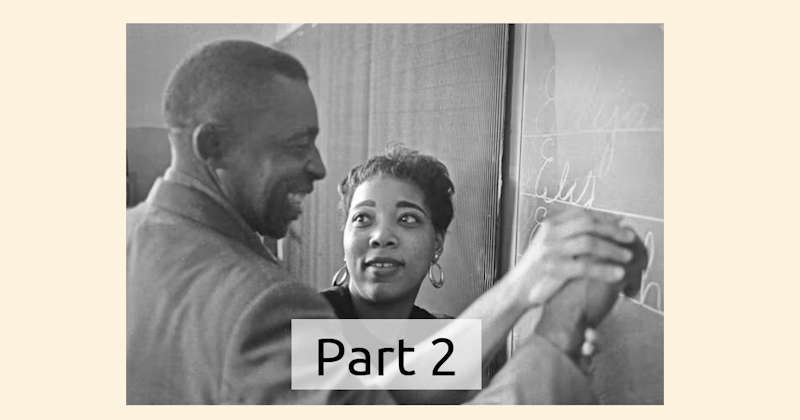
Lead Graphic: Dorothy Cotton teaches a student cursive in a Southern Christian Leadership Conference Citizenship Education Program class, Alabama, 1960s. This mattered because literacy tests were used to block Black citizens from registering to vote. Photo by Bob Fitch, Bob Fitch Photography Archive, Department of Special Collections, © Stanford University Libraries. Licensed CC BY-NC 4.0. https://therockwalltimes.com/2020/01/news/the-civil-rights-activist-so-close-to-martin-luther-king-jr-she-was-thought-of-as-his-other-wife/
Please Contribute Your Ideas To This Discussion!
In order to prevent bots, spammers, and other malicious content, we are asking contributors to send their contributions to us directly. If your idea is short, with simple formatting, you can put it directly in the contact box. However, the contact form does not allow attachments. So if you are contributing a longer article, with formatting beyond simple paragraphs, just send us a note using the contact box, and we'll respond via an email to which you can reply with your attachment. This is a bit of a hassle, we know, but it has kept our site (and our inbox) clean. And if you are wondering, we do publish essays that disagree with or are critical of us. We want a robust exchange of views.
About the MBI Newsletters
Two or three times a week, Guy and Heidi Burgess, the BI Directors, share some of our thoughts on political hyper-polarization and related topics. We also share essays from our colleagues and other contributors, and every week or so, we devote one newsletter to annotated links to outside readings that we found particularly useful relating to U.S. hyper-polarization, threats to peace (and actual violence) in other countries, and related topics of interest. Each Newsletter is posted on BI, and sent out by email through Substack to subscribers. You can sign up to receive your copy here and find the latest newsletter here or on our BI Newsletter page, which also provides access to all the past newsletters, going back to 2017.
NOTE! If you signed up for this Newsletter and don't see it in your inbox, it might be going to one of your other emails folder (such as promotions, social, or spam). Check there or search for beyondintractability@substack.com and if you still can't find it, first go to our Substack help page, and if that doesn't help, please contact us.
If you like what you read here, please ....





