

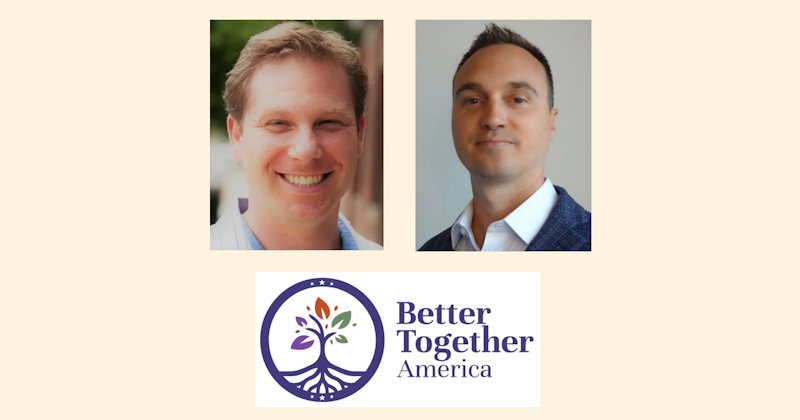
Jacob Bornstein and Caleb Christen Talk about Where Better Together America Has Been and Is Going
Newsletter #447 — April 20, 2026

by Heidi Burgess
On March 30, I (Heidi Burgess) talked with Caleb Christen and Jacob Bornstein about Better Together America. They, along with Vinay Orekondy are the three co-founders of BTA. Jacob is now the Executive Director, and Caleb is the Director of Hub Learning and Support. This was the second time I talked with each of them. I talked with Caleb (and Vinay) about 18 months ago when BTA was just getting started, and I talked to Jacob 11 months ago, but not so much about BTA as his collaborative problem-solving work, especially regarding water in Colorado. Caleb had recently sent out BTA's 2025 impact report, and I was really impressed with the progress that BTA has made since I last talked to Caleb, and since Guy and I attended their first "Civic Hub Accelerator Workshop" which took place in May of 2025.
Go to the Transcript and Video of this Interview
I started by asking Caleb and Jacob to give an overview of how BTA has grown since we last talked in September, 2024. Caleb noted that they had about nine civic hub builders at that time — "to call it a learning program," he said, "would have been a huge stretch." They then knew of several people who were doing "hub-like things" and they wanted to bring them together so they could learn from each other. By May 2025, they had closer to 50 people who were interested in the civic hub idea, and they got them all together in Denver for their first "Civic Hub Accelerator Workshop." Now, as Caleb explained, they have grown further.
In terms of communities, we now have roughly 40 in the network. In the first 9 to 12 months, it grew to around 29 communities, and now it’s continuing to grow toward 40. If you include the actual number of civic hub builders, the number is significantly higher. By my count, approximately 60 people have come through the training pipeline, either currently or in the past.
We’ve now really formalized the learning cohorts into an ongoing series of learning opportunities. That includes initial accelerator cohorts that meet for six months, and we’ve had quite a few people and communities come through those at this point. We’ve also started a rapid-onboarding version, a quarterly learning community call, and some more advanced focused cohorts. So we’ve really been able to grow the learning side of Better Together America into a fairly robust set of opportunities for civic hub builders across the country.
I asked them to explain what they meant by the terms "learning cohort" and "civic hub," for those who aren't familiar with those terms or BTA's work. Jacob explained the learning cohort idea first:
A learning cohort, or community of practice, is a group of people working on something similar. In this case, civic hubs are working on community-building, collaborative problem-solving, and combined action. Those are the three main things in our framework.
A learning cohort is a way for people doing that work to come together and learn from one another, ideally with enough structure to help accelerate their progress. We see ourselves as supporting something that is of, by, and for civic hubs. The question is: how do we help each other spread innovations and best practices, and accelerate the development of “civic hubness” in each of these communities or states?
Caleb added onto that by saying that
civic hubs are nonpartisan local networks and infrastructure meant to enable ongoing collaboration and ultimately support the community in doing those things Jacob pointed to [community-building, collaborative problem-solving, and combined action].
That matters on multiple levels, including that it creates a sense of co-ownership within the community—not just of the civic hub itself, but of the actions taken. The community has primary agency over what happens.
So, in some ways it may be a new paradigm, but it’s built on a lot of good things that were already happening in communities across the country. And the learning cohorts Jacob described are the opportunity for people to share the different things they’re trying locally.
So BTA is not coming in and building civic hubs from scratch. They are playing a supporting and networking role, helping people who are interested in starting or improving or enlarging their civic-hub-type organization and activities to do so, with the support of others.
When I asked if and how they were interfacing with other organizations that were doing similar things, they explained that they were working closely with several. Braver Angels, for instance, has a new initiative called Citizen-Led Solutions, and under that rubric a number of the BA alliances have become civic hubs and have joined the BTA network. And BTA has sent people to Richard Harwood's trainings for his New Civic Path, and they are starting to work together too. But alliances or other community organizations don't have to change their name to say' Better Together America Civic Hub" to be part of the BTA network. "We’re not very prescriptive about that," Caleb said. But, he continued:
There are, however, a few basic tenets they ultimately need to adopt and move toward. One is being nonpartisan, which is a pretty low-hanging fruit. Another is being co-owned, so it’s not ultimately controlled by a single organization or person. Of course, somebody has to initiate it, so it often starts that way. And they need to be dedicated to pursuing the community-building and community-led solutions as Jacob has been describing.
When I asked them about their "north star" — what they ultimately wanted to accomplish, they talked about scaling up this movement so it can reach everyone in the United States.
From BTA’s perspective, local plus local plus local equals national impact. If we want everyone in the country to have the opportunity to thrive, we need a network in which communities don’t have to reinvent the wheel every time. They can learn from one another, and we can eventually overlay measurement so we can see what works in different places. So, what we’re trying to do is build the supportive network, along with the tools, resources, and measurement, to accelerate this work on the ground so that everyone can thrive.
Civic hubs, they explained, can vary greatly in size, ranging from some that are at the neighborhood level, to small rural towns, major metropolitan areas, county and multi-county regions, and all the way up to several states. One of the more advanced hubs is in a small town of about 3,000 people named Sisters in Oregon.
They had already formed a very community-building-oriented effort [before BTA connected with them], and that’s really the strength of what they do. If you look at Citizens for Community –their website--and the visioning exercise they went through, it’s an incredible amount of community-building activity for a town that small.
Recently, they had wildfires sweeping through the town, and because they already had those relationships and connections in place, they were able to rally nonprofits, community leaders, and residents to provide mutual aid to people who were affected. It’s a really strong example of how community-building and civic hubs can propel and support follow-on community action.
And they were able to learn from a much larger civic hub outside of Los Angeles which had earlier dealt with a devastating wildfire.
So Kellen in Sisters was able to call Scott in Topanga and ask, “How did that work? What worked? What didn’t? What can I learn?”
So there was an immediate exchange of information from Scott to Kellen, which let them put those lessons to work locally. Their response was more effective because they didn’t have to learn everything from scratch. That’s one of our favorite examples of how innovations can spread through a resilient network.
At the other end of the spectrum, Jacob described North Carolina's statewide hub. This hub was started by Leslie Garvin, who runs an organization called North Carolina Campus Engagement.
She still has her regular role, but she’s able to incorporate statewide hub-building into her job description, which is exciting. They started with an assessment at the statewide level, essentially asking, “What is our civic health?” The answer was, “Oh my gosh—it’s near the bottom everywhere.” So they created three strategy groups: one around community-building and engagement, one around collaborative problem-solving capacity, and one around how to move toward action.
When we met Leslie, all of that was already happening, even though they didn’t yet have the language of “civic hubs.” Then she said, “Oh my gosh, this maps perfectly onto what we’re trying to do.”
They recently held what I believe was their second statewide summit, and they’re really advancing the conversation about how to improve civic health across the state. They’ve involved a lot of partners, and Leslie has now also begun supporting, I think, three local civic hubs in North Carolina.
So for us, statewide groups tend to have two primary missions. One is to host a statewide collaborative table for advancing civic health and thinking through the state’s needs. The other is to help support or initiate local civic hubs throughout the state.
They also talked about civic hubs in large metropolitan areas: Los Angeles, Oakland, and the Washington DC area. But then Caleb talked about Montrose, Colorado.
It represents a different demographic—something like 25,000 people—and because many of the other examples are especially strong in community-building. Montrose is a good example of how there are different on-ramps into forming a civic hub.
In their case, they had support from a national network, and they started with a series of citizen assemblies that identified important issues in their community—issues that people were energized to work on together. After the national organization’s support had run its course, some local community members came together and said, “We want to keep this going and keep finding solutions.”
Since then, they’ve followed up on and successfully implemented solutions around things like insufficient homeless shelter capacity. They’ve also addressed some education-related and childcare needs. What’s especially interesting, though, is that things like citizen assemblies can be expensive and time-consuming. So they’ve been very innovative in asking: how can we design deliberative processes that are shorter, less expensive, and something we can train local facilitators to run? They’ve been doing some cutting-edge work in figuring out how to help a community find solutions more affordably and sustainably.
Jacob further explained:
The childcare project was the initial one, and Unify America paid for that. So that was more like a full-scale civic assembly or citizens’ assembly, which cost a lot of money.
But the later efforts—on parking on Main Street and on the winter homeless shelter situation—have been much lower-cost. The same is true of the LA civic assembly work. They’re finding donated spaces, working to get affordable food, lowering the rates they pay participants, and still finding that people show up. They’re also still getting a diverse cross-section of the community.
Those kinds of innovations are really important not just for civic hubs, but for the field as a whole. What does it take? Can volunteers serve as facilitators? How much training do they need? Or do we need paid facilitators? These are the kinds of questions civic hubs are grappling with.
We’re there to support that work, but we’re not taking credit for what’s happening in North Carolina, Montrose, or LA. Some version of this work would be happening anyway, but fewer people would know about it, and fewer would be connected through a network, without Better Together America.
So we want to be clear: we’re not taking credit for the work of the civic hubs. They’re doing amazing work. We’re providing a supportive environment where they can share what they’re doing, accelerate it, and get some coaching. But they really own what’s happening on the ground, and we’re cheering them on and saying, “Did you hear what they did in Montrose? Did you hear what they did in LA or North Carolina?” We’re helping make those connections so people can learn from one another.
I asked where they see this all going, and they said they were hoping to continue to grow, especially with the process that they call "rapid onboarding" for people who are already doing this kind of work. They are planning to do a state-level cohort for all the states that are already in the network.
That also allows us to bring in new states like Minnesota, which has been doing great work for years, fairly quickly, and help define the state-level model while letting those states learn from one another about what’s possible. That’s exciting because it lets us deepen the work while also bringing new people into the network. At the same time, we’re continuing the accelerator workshops and recruiting more groups into those, expanding our partnerships as we go.
We are also really working on building relationships with national networks that can support hubs or become part of hubs. That includes facilitator networks, performing artist networks, veterans networks, business networks, faith networks—existing groups on the ground that may not think of themselves as civic hubs, but might absolutely see themselves as part of a civic hub. That expands the reach and impact of the work in those communities.
And they provide one-on-one coaching to all BTA members who need advice.
The other big piece is shared measurement. We have a strong shared-measurement framework, but we’re still figuring out how to help people participate in it effectively. Some hubs are amazing at it, but it’s hard work, and the technology we have right now is still clunky. So we’re working on that too. ... We’re also trying to incorporate measurement into the learning cohorts so that more hubs participate, and making sure we're linking to other measurement efforts happening in the field.
Caleb added:
Since a lot of the hubs are still in the early stages, we’re also thinking hard about how to meet them where they are. We talk about measuring impact, but at the beginning, that may just mean measuring whether they’re taking the right steps and moving in the right direction.
We want measurement to be easy enough that it doesn’t distract them from actually building the hub and taking action. So we’re also exploring credentialing or badging systems—not just to make it more fun or create incentives, but to help them identify the things they ideally should be measuring and how we can support them in doing that.
So yes, that’s definitely still a work in progress. But we think hub formation itself is pretty predictive of eventually getting to outcomes. So there are measures around that too: number of partners, whether the hub coordination team has formed, whether it’s meeting, whether it’s choosing topics, and so on.
One of the things that I find so compelling about BTA's model — and we talked about that was that participation in a civic hub can get people out of the depression so many of us are suffering from. Far too many Americans (on all political sides) don't like what they see happening in America, yet they feel powerless to change it. And we've all read that loneliness is at epidemic levels in America. BTA hubs can address both problems — and more. They give people a sense of agency, a sense that they CAN make their own lives and their community better, and they can gain friendships in the process. "What's not to like?" as one of my friends often says.
Jacob agreed:
Some of what I’m about to say comes from my BTA Executive Director hat, some from my Mediators Foundation President hat, and some from my consulting hat, because I’ve been working for decades at the local and state levels in liberal places, conservative places, and mixed places.
What I’ve seen is that people are shocked when they discover they can actually reach consensus—not just across left and right, but across many kinds of differences. Oil and gas advocates and bike advocates. Housing developers and homeless shelter operators. These are very different perspectives.
And when people reach consensus, and then that consensus is translated into policy or collective-impact work on the ground, and you begin to see movement on real outcomes, that’s incredibly powerful.
At the national level, it’s very hard to know how I as an individual—or my neighborhood, or my community, or even my state—is supposed to affect national politics. But one way it can happen is by demonstrating the power of collaborative action. When people from different perspectives work together and examine a problem from all sides, the solutions are usually more durable, stronger, and have more political will behind them than they would if the “smartest people in the room” just designed the ideal answer by themselves.
So for me, this isn’t really about “bridge-building” as an end in itself. Bridging is a skill. You can use it for community-building, collaborative problem-solving, and helping people implement solutions across many partners. If you think of bridging only as shared understanding, then no, that’s not enough. But when you combine it with these other pieces that help a community actually thrive, then it becomes very powerful.
All of this is expanded upon, with other examples, in the full discussion, which you can watch, listen to, or read here.
Please Contribute Your Ideas To This Discussion!
In order to prevent bots, spammers, and other malicious content, we are asking contributors to send their contributions to us directly. If your idea is short, with simple formatting, you can put it directly in the contact box. However, the contact form does not allow attachments. So if you are contributing a longer article, with formatting beyond simple paragraphs, just send us a note using the contact box, and we'll respond via an email to which you can reply with your attachment. This is a bit of a hassle, we know, but it has kept our site (and our inbox) clean. And if you are wondering, we do publish essays that disagree with or are critical of us. We want a robust exchange of views.
About the MBI Newsletters
Two or three times a week, Guy and Heidi Burgess, the BI Directors, share some of our thoughts on political hyper-polarization and related topics. We also share essays from our colleagues and other contributors, and every week or so, we devote one newsletter to annotated links to outside readings that we found particularly useful relating to U.S. hyper-polarization, threats to peace (and actual violence) in other countries, and related topics of interest. Each Newsletter is posted on BI, and sent out by email through Substack to subscribers. You can sign up to receive your copy here and find the latest newsletter here or on our BI Newsletter page, which also provides access to all the past newsletters, going back to 2017.
NOTE! If you signed up for this Newsletter and don't see it in your inbox, it might be going to one of your other emails folder (such as promotions, social, or spam). Check there or search for beyondintractability@substack.com and if you still can't find it, first go to our Substack help page, and if that doesn't help, please contact us.
If you like what you read here, please ....





