

Courageous Citizenship - Part 1
Newsletter # 452 - May 7, 2026

Heidi Burgess and Guy Burgess
First, an Announcement
On Wednesday May 20, the Council on Tech and Social Cohesion is hosting its 2026 Global Expo: one event, eight hours, two segments (one in Kyrgyzstan and the second in Washington, DC) designed to reach audiences from San Francisco to Jakarta. The event will bring together technologists, civil society, researchers, regulators, and peacebuilders to mark a shift the field has been building toward for a while — moving away from harm mitigation and toward the intentional design of technology that fosters trust, collaboration, and peace.
Across the day speakers will explore how platforms (from social media to gaming) are rethinking design for healthier outcomes, how regulation and research are reshaping incentives, how civil society and peacebuilders are using tech to build trust in real-world contexts, and how deliberative tools and AI are transforming participation and decision-making. Guy and I are going — hope many of you will too!
The essentials:
- Date: May 20, 2026
- Two segments with full time-zone breakdowns on the page
- Co-hosted with: Search for Common Ground (Bishkek, Kyrgyzstan) and the Alliance for Peacebuilding (Washington, D.C.)
- Online via Zoom, with limited in-person options at both host locations
- Register & full agenda: https://www.techandsocialcohesion.org/expo-2026-register
Braver Angels' Courageous Citizenship
In September of 2025, Braver Angels revised their mission statement to go beyond de-polarization and bridging to something more fundamental: what they call "courageous citizenship." As their then-new CEO, Maury Giles, explained in a November 23, 2025 email to members:
Years ago, I worked with Southwest Airlines. They famously insisted they weren’t in the airline business, they were in the freedom business. That simple shift in identity guided everything they did, from the way flight attendants greeted passengers to the way executives made decisions.
Lately, I’ve been thinking about that clarity of purpose because Braver Angels is at a similar moment of definition. For nine years, we have understandably described our amazing work with terms like “bridging” and “depolarization.” These are both true, it’s what we do in the same way that Southwest flies people across the country in planes.
But our purpose is simpler, truer, and far more powerful: Braver Angels is in the courageous citizenship business.
By courageous citizenship, we mean the intentional effort to engage in human connection the Braver Angels Way: contend without contempt, listen with dignity, and work where values overlap. Relationships. People. Dialogue. Action. [bold in original]
We like that concept a lot, but see it, perhaps, in a somewhat broader way than the way Maury described it in his email. So we thought discussing what it means to us would be worthwhile.
Democracy is Not a Spectator Sport
We've said frequently in the past that "democracy is not a spectator sport." I thought Guy made that line up, but clearly not — I was surprised to see a sign with that message sitting on the front lawn of a neighbor's house recently, and I have since found out that you can buy T-shirts and hats with that message too.
Despite its commercialization, the basic idea is something many of us seem to have forgotten. Most of us say we "like" or "believe in" democracy, but we engage in it as if we are rooting for our favorite team. We cheer whenever we win an election, a Congressional vote, or a judicial decision; we moan and groan when we lose.
This is the same way people tend to think about rival sports teams and their supporters. While these thoughts are usually just good-natured rivalry, they can (especially when people have had too much to drink) cross the line into open hostility and sometimes violence. Rooting for the home team (and booing home team players when they play badly) is a widely enjoyed hobby (one that even has the virtue of often crossing political divides within otherwise politically divided communities).
What makes these sports rivalries benign is their low-stakes nature. If your team loses, there will always be the next game or the next season. The outcome doesn't really affect your vital interests (unless you're a highly paid superstar).
Big problems, however, arise when we treat high-stakes political conflict in similar ways.
Unfortunately, apart from voting in occasional elections and sometimes sending money to candidates, far too many people treat citizenship as if it were just another hobby. They buy, wear, and display politically themed "swag," and put up signs that declare their political orientation. They also sometimes make snarky signs and go to "No Kings" rallies, if they are Democrats, or go to Trump / MAGA rallies if they are Republicans. This is all easy stuff to do, and it is fun. These events are much like parties with good friends. There's music, sometimes food, costumes, and lots of people who think the same way all around us, making us feel as if everyone is on our side, that our ideas are right and virtuous, and that we are fighting the good fight. Most importantly, we are helping "our team to win!"
But how, exactly, is this helping things? Are we changing anyone's minds? Are we doing anything to build the kind of broadly-based political movement needed to diffuse the hyper-polarized political pendulum (with its narrowly decided elections, radical policy shifts, and sense that everything we care about is continually in jeopardy)? Are we convincing Trump that he is wrong in what he is doing and should change policies? Are Democrats learning that they were wrong to not do more to address the plight of the "left behind" voters who became Trump supporters?
We don't think so. The signs at the NO Kings marches we have seen are so in-your-face that it seems very unlikely that they will convince any Trump voters or Trump himself to change their minds. They are much more likely to double down, look at pictures of the marchers in the news and think, "See? They are really crazy!" (or deluded, or evil, or some other invective.) "We really have to do all we can to oppose them." Democrats, of course, respond in similar ways to the inflammatory pictures that inevitably come out of Trump rallies.
So, all we are doing is convincing ourselves that we are right, and they are wrong, and we are convincing them of that too, but in the opposite way. We aren't being challenged to open our minds or hearts to new ideas, to consider if, or how, we might be wrong, or if there might be any way to collaborate with them to advance our goals (which we may even share with them, though we'd never think to ask). Our recent series of common ground posts suggests that we are walking away from a lot of collaborative opportunities. All we are doing is walking down the street with friends who agree with us. There is not much courageous about that!
Courageous Citizens Embrace the Great Reframing
As an alternative to being a citizen hobbyist, we believe that we all need to become courageous citizens, even if we don't belong to Braver Angels. Courageous citizens reframe our problem. They realize that "the enemy" is not "the other side," but rather, the destructive way we engage with one another. And they work to change that. (In Newsletter 385 we called this "The Great Reframing.") Courageous citizens open their minds and their hearts to people who think differently than they do. They try to find out why they think differently, and consider honestly whether there is any merit in the other person's views. If they find that there is some merit to the arguments of the other side, courageous citizens are willing to change their own minds. If there is an overlap of interests, they are willing to work together to pursue shared goals.
Courageous citizens also recognize that citizens don't have to agree on everything to be valued and respected members of society. So, they treat everyone with respect, even those who get so caught up in the hyper-polarization spiral that they act in inappropriate ways. Courageous citizens "focus on the problem, not the people" (to paraphrase Fisher, Ury, and Patton in Getting to Yes.) When their fellow citizens engage in dishonest, disrespectful or other bad behaviors, courageous citizens challenge those behaviors. But they still treat the people with respect, and they don't dismiss them, thinking that they are irredeemably evil.
Further, we would argue, courageous citizens think for themselves. They consider news and opinions from a wide variety of sources — sources that represent a full range of perspectives. They take the time to really learn about the issues they care about, not just assume, without examination, that their social media feeds are are correctly reporting the whole story. They only advocate for issues or policies when they know what they are advocating for and why, not just because that's what their friends are doing or "their side" tells them to do. And, they do all of this with a sense of humility that recognizes that their understanding of any particular issue is inevitably limited.
Further, courageous citizens should be willing to go against the flow to stand up for their country and democracy first, and their party (if they have one) second. If they see their party doing something that isn't fair, they don't accept it as necessary "because the other side does the same thing." Rather, they speak out against such anti-democratic actions. Many Democrats we know got tired of Michelle Obama's advice: "When they go low, we go high." But if both sides "go low," how long is it going to take before democracy is lost? (Not long!) Far better to "go high," and work for the trust of people on the other side, so, perhaps, they will begin to call out their own side for going low, or failing that, might come over to your side because you have made it more comfortable there.
This is, unfortunately, easier said than done. If one side employs unscrupulous, but effective, tactics for which there are no readily available "high ground" countermeasures, the other side is likely to respond in kind. This is, of course, what has been happening in the ongoing battle to see which side can gerrymander most effectively. But whenever possible, courageous citizens will try hard to "go high."
Courageous citizens do advocate for the issues that they care about. However, they do so in ways that rely upon constructive confrontation strategies — strategies that firmly oppose the use of unscrupulous and anti-democratic tactics by both political opponents and allies. They also rely on a more constructive power strategy mix that minimizes the use of coercive force, while emphasizing mutually beneficial trade-offs and persuasive appeals that explain why the things that they are advocating for are in everyone's best interest. This is what we have, in other contexts, referred to as power-with, rather than power-over, approaches to democracy.
This may sound naive, but it has been done and has worked before. We'll talk about that in the next newsletter.
__________
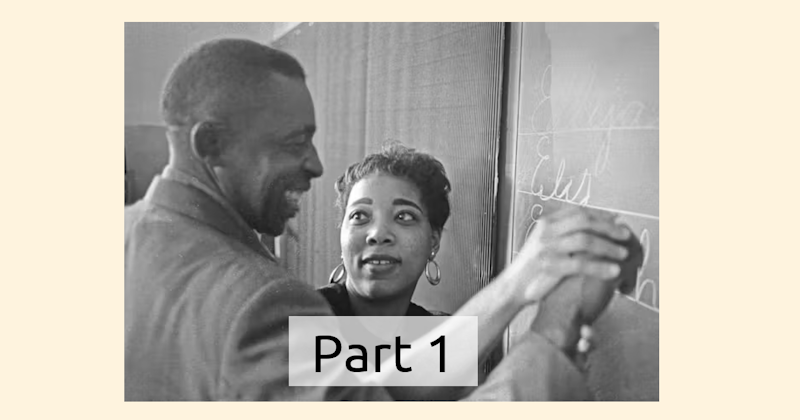
Lead Graphic: Dorothy Cotton teaches a student cursive in a Southern Christian Leadership Conference Citizenship Education Program class, Alabama, 1960s. This mattered because literacy tests were used to block Black citizens from registering to vote. Photo by Bob Fitch, Bob Fitch Photography Archive, Department of Special Collections, © Stanford University Libraries. Licensed CC BY-NC 4.0. https://therockwalltimes.com/2020/01/news/the-civil-rights-activist-so-close-to-martin-luther-king-jr-she-was-thought-of-as-his-other-wife/
Please Contribute Your Ideas To This Discussion!
In order to prevent bots, spammers, and other malicious content, we are asking contributors to send their contributions to us directly. If your idea is short, with simple formatting, you can put it directly in the contact box. However, the contact form does not allow attachments. So if you are contributing a longer article, with formatting beyond simple paragraphs, just send us a note using the contact box, and we'll respond via an email to which you can reply with your attachment. This is a bit of a hassle, we know, but it has kept our site (and our inbox) clean. And if you are wondering, we do publish essays that disagree with or are critical of us. We want a robust exchange of views.
About the MBI Newsletters
Two or three times a week, Guy and Heidi Burgess, the BI Directors, share some of our thoughts on political hyper-polarization and related topics. We also share essays from our colleagues and other contributors, and every week or so, we devote one newsletter to annotated links to outside readings that we found particularly useful relating to U.S. hyper-polarization, threats to peace (and actual violence) in other countries, and related topics of interest. Each Newsletter is posted on BI, and sent out by email through Substack to subscribers. You can sign up to receive your copy here and find the latest newsletter here or on our BI Newsletter page, which also provides access to all the past newsletters, going back to 2017.
NOTE! If you signed up for this Newsletter and don't see it in your inbox, it might be going to one of your other emails folder (such as promotions, social, or spam). Check there or search for beyondintractability@substack.com and if you still can't find it, first go to our Substack help page, and if that doesn't help, please contact us.
If you like what you read here, please ....





