The Thanksgiving / Holiday Spirit — an Antidote to Our Hyper-Polarized Politics
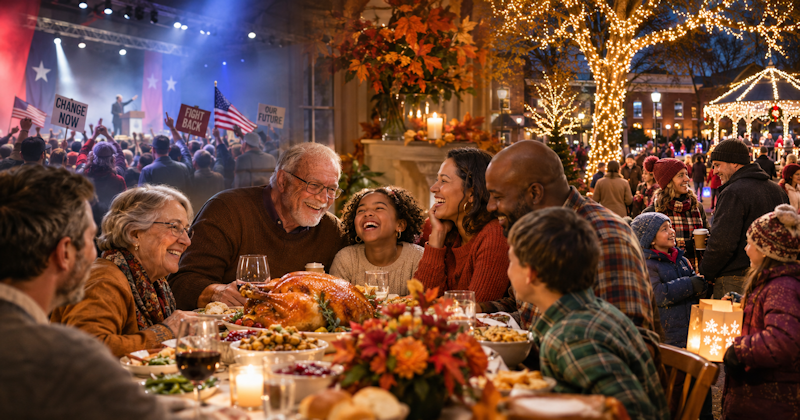
Newsletter #507 — Nov. 24, 2026

Overview
The community values that surround Thanksgiving and the upcoming holiday season offer a hopeful reminder that that that our society has powerful, deeply-embedded values that offer us a pathway for escaping our destructive, hyper-polarized politics. After an election season focused on all of the things that are wrong with our society, and all of the complaints we have about one another, the upcoming holidays offer a chance to start repairing the dysfunctional aspects of our civic culture. The holiday's emphasis on gratitude, charity, and the celebration of mutually supportive relationships has the potential to offer us more than just a temporary respite from our acrimonious times. Over the next two years, we have a chance to build a post-Trump, post-woke politics capable of reuniting and strengthening the United States in ways that will enable us to take advantage of the abundant opportunities that exist ,while also weathering the looming storms that could easily engulf us.
We have been traveling and thinking a lot about what the election results mean for the broader effort to diffuse our hyper-polarized politics and revitalize democracy. With this post, we want to offer our initial thoughts about what a conflict and peacebuilding perspective brings to the larger debate over how the election changes things. In doing this, we've been struck by important lessons to be learned from the sharp contrast that exists between the acrimonious way in which Americans thought about one another in the context of the election, and the way in which the upcoming Thanksgiving holiday is asking us to think about the communities in which we live.
The Holiday Spirit
Since the bitterness of our hyper-polarized politics is something that we've written about extensively, let's start by thinking about Thanksgiving. As the name suggests, Thanksgiving is a time set aside for us to remember and to give thanks for all the good things we have — both our interpersonal relationships and our material comforts.
In recent years, it has also become a time in which we increasingly find it hard to separate our political animosities from the goodwill that the holidays are supposed to cultivate. This has some people in our field to offer advice about how best to handle political tensions when they arise amid holiday celebrations. While many have focused on how to have constructive conversations across difference (see, for instance, this, this, and this), in a past essay of ours, we focused on the importance of prioritizing the maintenance and strengthening the relationships around which the season's celebrations revolve. We suggest celebrants reserve tense political conversations to times when people have the time, energy, and willingness to constructively engage with one another. Forcing what are usually difficult conversations on when people who aren't ready, we think, is a formula for painful and destructive encounters.
Thankfulness Amid Struggles
While most of us are pretty good at focusing on the easiest and most enjoyable aspects of the coming holidays (food, family, and friends), we tend to have more trouble with the thankfulness part, especially when we start to think about the larger and deeply divided communities in which we live.
At this larger level, too many of us think they don't have much to be thankful for. We may be suffering from health issues, financial or job issues, and/or social issues, such as loneliness. (As Bobby Milstein recently pointed out in our discussion with him, "national well being [in the U.S.] has fallen to levels not seen since the Great Recession and the early months of the COVID-19 pandemic ... and a growing share of Americans are now classified as "suffering," rather than "thriving" or "struggling." (He defines "struggling" as does Gallup in the report he is citing as not doing well now, but still expecting to do better in the future, while "suffering" is not doing well now, and not expecting to do well in the future either.") Reinforcing this trend is a grievance-focused political culture in which we are encouraged to think of ourselves as victims and to blame others (primarily the other political party) for our difficulties. Increasingly, we also tend to think of our economic and political systems as being rigged in ways that deny us a fair chance to get ahead.
While there are certainly many things that are going wrong and many problems and inequities that demand attention, it also seems clear that our focus on grievances is blinding us to the things that are working — things that have to be actively nurtured and protected if they are to survive. Even those who are suffering have positive things in their lives to be thankful for.
There is another side of Thanksgiving that is worth remembering and celebrating. While there is obviously a material side to Thanksgiving — the holiday meal — it's important to remember that we are really thanking the people that made that meal possible. As individualistic as American society is (when compared to more "community-oriented" societies), we still are all dependent on each other. We go to the store and expect to find food. We expect to find power for our houses and cars. We expect the Internet to work and the planes to fly. Annoyed as we are, when those systems fail, we should be thankful that they work almost all of the time and appreciate the efforts of those that made this possible. We also need to do our part to help make these systems function. We aren't just consumers. In our professional and civic lives, we play critical roles in producing the goods and services that our community relies upon. And, we need to play those roles conscientiously.
Thanksgiving's History
As we delved more deeply into the history and meaning of Thanksgiving, we found that protecting ourselves from this tendency to be overly negative was a major consideration when the holiday was founded. When we asked ChatGPT to offer what it thought was a consensus opinion about Thanksgiving's meaning and reason(s) for its founding. It answered:
Thanksgiving is an American holiday devoted to gratitude—for the harvest, for the good things in life, and for the people and communities that sustain us. But its history is more complicated than the familiar story of Pilgrims and Native Americans sharing a meal.
ChatGPT went on to say that the holiday's origin has three distinct roots. The first was harvest celebrations which were held both in Europe and among Native Americans, long before Europeans came to American shores. Second was the Thanksgiving of 1621, at which 50 English colonists from Plymouth, Massachusetts celebrated a successful harvest with a 3-day feast which was celebrated with 90 Native Americans. Amid today's astonishing affluence with its wide array of inexpensive and delicious foods, it is hard to imagine just how much of a struggle it was to grow enough food and the importance of a successful harvest. In these simpler agrarian times, Thanksgiving was a celebration of a summer of hard work and promise of surviving the winter. (ChatGPT of course also noted that the peaceful relationship between the settlers and the Natives did not last long, as competition, conflict, and war soon replaced comity between the European settlers and the native population.)
Third was the actions of George Washington and later Abraham Lincoln, who made Thanksgiving a national holiday. Again quoting ChatGPT,
In 1789, Washington proclaimed November 26 to be a national day of thanksgiving and prayer. He encouraged Americans to express gratitude for their independence, the new Constitution, and the establishment of a national government. It was not yet an annual holiday.
From 1827-1863, an influential magazine editor, Sarah Josepha Hale campaigned tirelessly to establish a national Thanksgiving holiday, believing that such an annual celebration could help unite Americans across regional, religious, and political differences.
Finally, in 1863, in the middle of the U.S. Civil War, War, President Lincoln proclaimed the last Thursday of November a national day of thanksgiving. The proclamation emphasized gratitude for the nation's blessings despite the devastation of war, while calling for healing and restoration of peace.
These developments marked the transition from an agrarian celebration for small communities into an effort to recognize and celebrate the extraordinary accomplishment of building a democratic society that was able to offer a viable alternative to the tyrannies that had plagued almost all of human history. In the midst of the Civil War, Lincoln's proclamation was an aspirational look ahead toward what he hoped the nation was on the path to becoming. T
hat call — gratitude for the nation's blessings, and a call for healing and the restoration of peace, seems particularly relevant right now, 163 years later. So, too, does a renewed effort to help unite Americans across regional, religious and political difference following a different, but fortunately much less catastrophic political schism.
The 2024 U.S. Midterm Elections
How does Thanksgiving's call to recognize and celebrate the good things apply to the just completed election? We ought to start by recognizing the obvious — Democrats think that they have a lot more to be thankful for than their Republicans counterparts (just as Republicans were more thankful for the outcome of the 2024 election). Still, we think that the most important reason to be thankful about this election was not which side won, but rather, that we had a successful election. Despite all the fears that the election would not be fair (which were actually felt on both sides) and would not be accepted by the losing party, the results were almost entirely definitive, and accepted by both sides. There wasn't violence at polling places, we haven't heard anything about large swaths of voters being turned away. And, there are relatively few disputed results. To their credit, those with fewer votes (my word processor yells at me if I use the word "loser") in almost all cases graciously conceded. Even Trump seemed to recognize (at least at first) that the results were fair. Instead of saying that he would fight the outcome, he said that he would work with the incoming Congressional majority (the Democrats).
Trump changed his tone later, of course, asking on his social media platform, Truth Social, on November 9 whether "anyone believed that this 'Election' was honest?" But unlike in 2020, he hasn't yet challenged the election results in court, nor have the candidates themselves — probably because most of the elections have not been particularly close. So, while there is still a danger that something disruptive could happen between now and January 3, when the new Congress is seated, it seems very likely that American democracy held strong. And for that we should all be grateful. Political chaos has been averted and one of our most cherished constitutional rights has been preserved — the right to "throw the rascals out" if we don't like the way in which our leaders are behaving in office.
Our Choice
We are now entering a period in which Republicans are likely to be fearful about what Democrats might do with their newfound power and Democrats are going to continue to worry about what President Trump will be able to do without Congressional approval. It seems likely that, with two more equal power centers, Democrats and Republicans will pursue an even more intense form of hyper-polarized politics.
Most likely, Democrats are going to try to expose the administration's many failings (both real and imagined) and the administration is going to try to block those efforts. Still, that's unlikely to be the big story. The big story (and the big opportunity) is going to be the battle of over what post-Trump politics is going to look like. Probably, it will be a battle between the continuation of hyper-polarized, us-vs-them politics and a more collaborative and mutually supportive form of politics built around the values that we celebrate during the holiday season.
The 2028 election will be the first Presidential election since 2012 that was not dominated by the polarizing presence of Donald Trump. On both the Republican and Democratic sides of the ledger, the race for the nomination is wide open (as is the race for a wide range of lower level public offices). During the next two years, we are collectively going to have to make one of the most important choices in our history. Are we going to go back to our ruthlessly competitive, hyper-polarized approach to politics, blaming the other side for all of our woes, working hard to prevent them from achieving any of their political objectives, and trying to impose our priorities and goals on people who don't want them? Or, will we can change course, and work to build a collaborative democracy that allows us to work together to solve our mutual problems.
This choice is most evident now, on the Democratic side, where there is intense debate over what the party should do with its federal and state level victories. Is it going to try to reinstate the progressive policies of the far-left — policies that were so deeply disliked that they played a major role in President Trump's victories? Or, is it going to try to pursue a less divisive strategy? Many Democrats believe that the election showed that voters want progressive policies, and what they need to pursue those policies in order to be successful. Others believe that a swing to the far left is just going to lead to two more years of hyper-polarization and gridlock with all our social, political, and economic problems getting worse. Supporters of this view, including us, believe that efforts to resurrect the left's most unpopular views would result in a powerful backlash.
Similarly, if the Republicans try to block all Democratic proposals (including those that offer reasonable compromises), nothing get done, and our many problems will continue to intensify. This could result in Republicans, quite rightly, being seen as as obstructionists, and they could suffer another landslide defeat in 2028.
The Gathering Storm
At the moment, the political conversation seems primarily focused on which party the voters think will do the best job of delivering on the promise of affordability and abundance. While there are certainly lots of promising policy proposals that could aid those who are currently struggling, there is, unfortunately, reason to believe that the future might not be as rosy as we would like. We might wind up focusing, instead, on how best to share sacrifice. If this disturbing possibility turns out to be true, the biggest reason for revitalizing and strengthening US democracy is to improve our ability to get through these tough times — times that may include continuing or intensifying war, as well as technological (AI) and economic calamities.
New technologies are giving major and minor powers, as well as terrorist groups like the Houthis, the ability to attack US and allied forces (as well as commercial shipping) with inexpensive drones that we don't have enough expensive interceptors to shoot down. We are also entering a dangerous new era in which various hybrid or gray zone tactics (including cyber warfare) are being used extensively. There is also increasing reason to believe that we are really going to have to limit our long-standing practice of solving short-term political problems by borrowing against the labors of future generations. There is, unfortunately, reason to believe that deficit spending and the popping of a several worrisome economic bubbles may leave us with far fewer resources than we would like to have.
More worryingly, Francis Fukuyama recently published an article in Persuasion entitled "The Midterms Just Made the World More Dangerous," arguing that "Trump's repudiation tells Xi, Putin, and Kim that their window to act is closing. And developers of AI continue to tell us (while they race ahead trying to make ever more powerful machines), that AI might kill off the human race (or at least empower geopolitical rivals and terrorists).
So this is not the time to be dilly dallying around playing political games. It is time to look at all the good things we have, what needs to be fixed or improved, and start working together with everyone available to pursue solutions. If Trump really will work with the Democrats, and the Democrats with him and other Republicans, we can start to close Xi's, Putin's, and Kim's window more quickly than two years. And, hopefully, we can figure out a way to reign in AI so that we can benefit from all its knowledge and speed, while preventing it from doing us grave harm.
The Power of Working Together
Key to avoiding, or at least limiting, the above calamities is, we think, the rediscovery of the time-honored wisdom that we celebrate each year at this time. From this foundation, we can then start working to build understanding and mutually supportive relationships with people on the other side. Then we can start finding ways to balance competing priorities and make real progress towards solving our many complex and difficult problems. The success and power of such efforts is being demonstrated frequently at the local level, with civic hubs, citizen assemblies, and other deliberative practices that are increasingly healing fraught relationships at the local level and developing solutions to local problems. This can be done at the federal level too — if we chose to change how we "do politics."
Based on research from organizations such as "More in Common," as well as this earlier post of ours, it's clear that, if both sides would work together, they could come up with a host of reforms, policies, and bills that would be widely accepted — and might even be able to earn Presidential support (or, if that fails, override a Presidential veto). Then we could really start addressing pressing problems such as: national defense, inequality, affordability, immigration, climate, energy, and AI.
The Wisdom of the Holiday Season
Going back to Thanksgiving, in addition to all the wonderful meanings ChatGPT shared above, we think this Thanksgiving should be a time when we all look carefully at the benefits we do get from living in America and in our particular communities and families. America has lots of problems, and it may not be as good as other countries in particular areas (health care and education, for example). But we are still freer than most other countries, and we are more prosperous than most other countries. The U.S. is still so attractive a place to live that thousands of people sought to come here every day — at least until Trump made it extraordinarily dangerous to do that.
If we don't appreciate the many benefits that we have, we are less likely to work to protect them. And there is a lot here that is worth protecting — and further improving, instead of trying to tear it all down and building something new from scratch (something America's most vocal critics commonly call for). The United States is the product of a 250-year effort to build a progressively better society. We should build on the hard progress that our predecessors have made and not assume that we can easily do better.
Another choice we need to make is whether to look backwards or forwards. A lot of us have been doing a lot of looking backwards — Trump promised to "Make America Great Again," a nostalgic slogan that recognized the good things that have been lost, but also neglected the bad things that must be dealt with. The left has been trying to remedy past grievous injustice, such as slavery, Jim Crow and (oddly) to a lesser extent, the murder and dispossession of Native Americans in ways that don't really acknowledge the substantial progress that has been made on these issues, and in divisive ways that try to hold people accountable for crimes in which they have played no part. If, instead, we can figure out how to work together going forward — to compensate for and remedy the injustices of the past — without denying a good future for everyone — we are much more likely to be able to attain that.
And maybe along the way, we can improve health care, education, climate, immigration — who knows! America and Americans have done astounding things over the last 250 years. And, we can still can — if we willing to abandon our hyper-polarized politics and relearn and strengthen the cooperative skills that have played such a big role in our past success.
The Christmas / Winter Holiday Spirit
Like Thanksgiving, Christmas has lost at least some of its meaning for many of us. While there is certainly an overly commercialized side of Christmas, it is also a time for celebrating important cultural values. When we again asked ChatGPT to reflect on the meaning of Christmas -- both religious and secular, it came up with a secular interpretation that both seems right (if a bit optimistic) and relevant to this essay. We also think that it's broadly reflective of the way in which the United States' other principal religious communities celebrate the holiday season. It wrote:
For Americans who are not religious, Christmas [and the holiday season] often retains much of its emotional and moral significance without the theological foundation. It is a time for families and friends to gather, renew relationships, remember shared experiences, and create traditions that connect generations. The excitement of children, Christmas music, decorations, special meals, and exchanging gifts give the holiday a sense of warmth and continuity.
Several themes are especially important:
Generosity: Giving gifts, donating to charities, volunteering, and helping people who are struggling.
Goodwill: Treating others with kindness, patience, and compassion, including strangers.
Belonging: Strengthening family bonds and a sense of community.
Hope: Looking toward a better future, particularly during the darkest season of the year.
Peace and reconciliation: Setting aside grievances, repairing relationships, and remembering what people share despite their differences.
This election and the still-looming storm clouds give us all the reason to cultivate and celebrate the spirit of Thanksgiving and Christmas now, throughout the holiday season, and on into the new year. Let's make our New Year resolutions to help America and Americans heal by working together to strengthen our relationships and working together to identify and implement solutions to our many problems.
——————————
* Just a note to those who look at our "em dashes" and conclude that this was written by AI. It wasn't. It was written by Heidi and Guy Burgess. Heidi just likes to use em dashes for emphasis. We are using AI for research, but we always cite it when we use it, and make it clear what is AI and what isn't, as we did at the beginning and ending of this essay. (The AI is indented, italicized, and cited.)
Please Contribute Your Ideas To This Discussion!
In order to prevent bots, spammers, and other malicious content, we are asking contributors to send their contributions to us directly. If your idea is short, with simple formatting, you can put it directly in the contact box. However, the contact form does not allow attachments. So if you are contributing a longer article, with formatting beyond simple paragraphs, just send us a note using the contact box, and we'll respond via an email to which you can reply with your attachment. This is a bit of a hassle, we know, but it has kept our site (and our inbox) clean. And if you are wondering, we do publish essays that disagree with or are critical of us. We want a robust exchange of views.
About the MBI Newsletters
Two or three times a week, Guy and Heidi Burgess, the BI Directors, share some of our thoughts on political hyper-polarization and related topics. We also share essays from our colleagues and other contributors, and every week or so, we devote one newsletter to annotated links to outside readings that we found particularly useful relating to U.S. hyper-polarization, threats to peace (and actual violence) in other countries, and related topics of interest. Each Newsletter is posted on BI, and sent out by email through Substack to subscribers. You can sign up to receive your copy here and find the latest newsletter here or on our BI Newsletter page, which also provides access to all the past newsletters, going back to 2017.
NOTE! If you signed up for this Newsletter and don't see it in your inbox, it might be going to one of your other emails folder (such as promotions, social, or spam). Check there or search for beyondintractability@substack.com and if you still can't find it, first go to our Substack help page, and if that doesn't help, please contact us.
If you like what you read here, please ....





