

Chip Hauss and The Burgesses Talk about His New Book: Peacebuilding Starts at Home
Newsletter #417 - January 21, 2026

Heidi Burgess and Guy Burgess
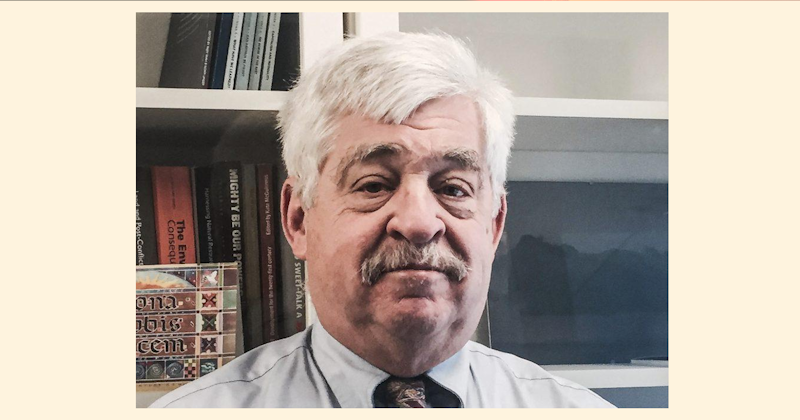
On December 18, 2025, Guy Burgess and I (Heidi Burgess) talked with Chip Hauss about his new book and movement of the same name, Peacebuilding Starts at Home. This book came out of the conflict resolution work Chip has been doing for years, most recently as the Senior Fellow for Innovation and an emeritus member of the Board of Directors at the Alliance for Peacebuilding and a visiting scholar at the Carter School for Peace and Conflict Resolution at George Mason University. We have been friends with Chip for over 30 years, and he was deeply involved in the creation of Beyond Intractability, on which he has several essays on Reconciliation, Apology and Forgiveness, Focusing on Commonalities, Democratization, Civil Society, and Educators as Peacebuilders, among others. We have highlighted some of the themes we talked about below. You can read/watch our whole discussion here.
After Chip talked about his background a bit, he explained why he decided to switch from writing academic books to writing a trade book. ...
The impetus for the book really is all AFP. When I joined the board 20 years ago, I always wanted us to work on issues inside the US, even though that's not where I spent my career. And we gradually realized that we had to do so. Shortly after Michael Brown was killed in Ferguson, Missouri, we had a meeting with members who had offices in Baltimore. And they didn't particularly get excited about working in the US. And I kind of didn't lose my temper, but I got frustrated. And I said, "How dare we tell people in Burundi or Botswana or Belfast or Bogota that we can solve their problems if we can't do it in Baltimore."
But as is AFP's wont, we never wanted to compete with our members. So we assumed that our members like Search for Common Ground and others that had projects in the US would be able to do the work that we felt needed to get done. But it turns out that as the situation in the US deteriorated over the decade since the incident in Ferguson, we found that our members didn't have the capacity to do large-scale work, paradigm shifting work in the US. We don't have the capacity either, but we decided that we had to seriously take the question on and fill in the gaps of what our members were doing.
Chip went on to explain the essence of the book:
The book begins with two things. It begins with an epigraph from Bob Putnam ...who looked out at an audience [at Georgetown University years ago] and said, "The future of the country is in your hands." He, of course, was right. No one in the audience really believed him. But the first sentence of the book is something like, "Peacebuilding Starts at Home is an invitation masquerading as a book."
So what we're trying to do with the book and with the movement that we're going to launch early in the new year is to give people on-ramps so that they can accept Bob's invitation. We want to truly make true the case that the future of the country literally, is in the hands of the Georgetown students who were in that room that night or the people who listen to this podcast or the people who pick up my book.
How do we reach "ordinary people," he asked, such as his relatives and neighbors who aren't peacebuilders and aren't academics? "We are developing a strategy," he says.
We are planning to reach upwards of 10 million people by the end of the decade, where they are, and help them see that Peacebuilding Starts at Home is something that literally starts at [their] home that they "can do." as Liz Hume puts it on our website, without taking graduate-level courses. The impact that they have at home, in their communities, with their families, in their workplaces can ripple out to the society as a whole.
... We're going to start with about 100 people who we know who have a pretty good sense of what Peacebuilding Starts at Home could all be about. And we will ask them in the course of the next six months to talk to at least 10 people they know and help them see that we need a new paradigm —in their own terms. I mean, David Sloan Wilson, who's an environmental biologist, is going to use a different language than I use. He's going to raise different issues.
Those 10 people should be ones who are committed to doing the same thing in the following six months. So we start with 100 people in January. We're at 1,100 on the 4th of July. If those 1,100 or some subset of them go out and get 10 more, we're at 10,000 plus at the end of the year.
And if you remember your exponential equations from high school, you get to millions quite quickly. And if we ask some of them to donate 10, 20 bucks a year, and only 10% of them do that, you also generate significant income to use to do other things like prototypes.
The second key element of the book is what Chip calls "the peacebuilding pivot, which is essential to make the first element—getting massive numbers of people involved—work out.
The peacebuilding pivot in the book is the realization that people may not be drawn necessarily to conflict resolution and peacebuilding per se, but they care about climate, care about racial discrimination, care about culture wars, what have you. We have to pivot toward them, and they have to pivot toward us. ...
One of the things I learned in writing this book is that there are a gazillion people, to be precise, out there doing very interesting work on climate, on pro-social activity, on evolution, on, you name the issue. They are doing very similar things to us. And we don't know them. And they don't know us. What surprised me, especially after we joined Rotary, is that many of them are pivoting toward us. And we have to pivot toward them. We have to think about making race relations, or climate change, or economic affordability, or what have you, central to what we do.
They're discovering that they can't do their work unless they do some conflict resolution, problem-solving-related kind of work in what they do. So, the most fun part of writing this book was getting to know all sorts of cool people. I'll just give you one example—a guy named Devin Thorpe, who is a retired investment banker who runs a website called Superpowers for Good and also helps people crowdfund investment in startups that work for social change.
I've gotten to meet all these really cool people. And what I'll be trying to do in the next months is to bring those two goals together. The reaching average everyday Americans by using people we are pivoting with.
Guy asked Chip how he deals with the fact that people approach these problems in very different ways. For instance, concerning climate, Guy asked: "How do you make peace between true believers of the existential climate crisis and those who are asking well, you could call them climate skeptics, not crazy climate deniers, but people who are asking some thoughtful, very hard questions [about whether our approaches to climate are effective or warranted]?"
Chip responded that the answer is "with difficulty, not quickly, gradually."
He then clarified that he is not in the quick response to an immediate crisis business:
My whole strategy... works on the assumption that the crises that we face right now are not going to bring the system to a crashing end in the next six months, two years, five years, what have you. So if you are convinced that we need immediate action, whether it is to undo the damage that Joe Biden did or to undo the damage that Donald Trump is doing, if that's your perspective, I'm not your answer. If, however, you work on the assumption that we do have some time, then you can begin to build the kinds of relationships I implied a few minutes ago.
Let's use the example of climate. There are people on the right who are doing really interesting things in reaching out to people that are frequently referred to as "climate skeptics" or "climate deniers." The most interesting and famous of whom is a woman named Katherine Hayhoe, who is a world-class climate scientist who is also an evangelical Christian, and her husband has, last I knew, an evangelical church in Lubbock, Texas because Katherine had been teaching at Texas Tech.
And if you know your Texas geography, which I don't, Lubbock, Texas is in the heart of oil country. An anti-climate culture. But what Katherine's been able to do in the evangelical and ranching communities around Lubbock is to talk about climate, not in terms of typical Al Gore left approaches, but looking at how climate is affecting the way Texans live now. Pointing out that Texas has the highest per capita use of alternative energy in the country. That it is in Texan's economic self-interest to speed up the transition away from fossil fuels and to take advantage of the solar and wind opportunities that exist in West Texas.
There's another guy who's a former Republican member of Congress from the upcountry of South Carolina, where they're explicitly trying to develop climate alternatives that appeal to conservatives. And those analogous folks exist across the board. ...
So again, if you're convinced that the world is going to hell in a handbasket between now and the midterm elections in 2026, I'm not your guy. But if you think about long-term strategies that work on the assumption that we actually have more in common than we realize, and we can build on what we have in common, I may be your guy.
Our discussion then turned to the question of vision, and whether or not it was either possible or desirable for "home peacebuilders" to share a vision about the direction they want to move their community, state or nation. Guy asked whether Chip had "given any thought to a kind of unifying vision that we could say, 'Okay, let's all unite around these principles that both the folks on the left and the right could see as a different and much more promising way forward that they'd be willing to work toward.'"
Chip asked with a story about how he started the book.
I started the book with three videos, the first of which was put together by a bunch of Australians. It's called Australia Remade.
They went around Australia and did a listening tour, a real listening tour. They realized that the issues they were talking about, economic inequality, climate change, what have you, weren't getting enough traction. So they went around the country and they listened to people. And then they made about a two-minute video that they called "An Ordinary Paradise." And it is a vision of what all Australians could get around.
If you could change the narrator to an American voice, it would largely work here. It is not specific policy guidelines, but it's a set of goals. It's a country we want to live in. One of the lines in it is "we've been through a lot lately. This is what we could get behind." And this group in Australia has begun doing that in ways that would work in Australia, but wouldn't work here— like running independents in rank choice voting districts and things like that.
But the idea of the image, of the vision, the North Star in system speak, that you want to work toward is there. Actually, it should not be defined by intellectuals like the three of us, but to use the jargon of complexity science, it has to be emergent. It has to appear. It will come out of what the people bring together and decide what they want to do. And it probably will revolve around a world that provides decency and dignity and justice for everybody. It will revolve around a line we began developing around Gaza, but it's beginning to make sense everywhere, "status quo no more."
We need fundamental change and a world in which, using a line we started using at AFP 25 years ago, a world that "works for everybody." And it's what Rotary talks about. It's what other civil society organizations talk about. And it is not just peacebuilding. It is holistic.
We talked more about a world that "works for everybody."
One of the things that's missing in that two pages of questions you sent me and I finally realized I should have done more with in the book, is the sense that we have to ask a bigger question than any of the ones that you sent me.
It's important for people to begin to see that we live in a qualitatively different world than the one that the three of us grew up in. [Our current world] is defined by interdependence. ... if I win at your expense, in a world that is completely interconnected, in which "what goes around, comes around," is empirically accurate, in which my victory at your expense leads you to be pissed off at me and come back and get me directly or indirectly, we're not going to fix anything. Down the line, that suggests that if I want to win, I have to understand that a world of complexity and a world of systems thinking has to be the norm. And that's qualitatively different from the way those of us on the left and those of us on the right grew up. ...
When you look at the work of a guy like Dave Snowden, he talks about the way you deal with a complex environment. You don't come in with a solution that you know will work. You probe. You see what happens. You sense what happens. You respond. And with your North Star in mind, you keep building until you get closer to where you want to go. This is like Robert Ricigliano's work on more simple systems. You tack toward the North Stars.
We discussed, in a variety of ways, what that "North Star" might be.
Guy talked about our idea of the "Great Reframing."
We are trying to get people to understand that it's the hyperpolarized politics where we just hate each other, that is the real threat to our future. And that if we don't find a way to diffuse that, even if it involves making some gigantic compromises on our primary issue, we're going to be in real trouble.
Chip concurred, tacking back to complexity theory:
if you anchor your life in systems complexity theory and paradigm shift thinking, I don't see a way out of the dilemma that we're in without moving toward a paradigm that puts solving everyone's needs closer to the top of the list of priorities. Or as I put it in the book, most of the people solve most of their problems most of the time cooperatively.
Guy added the idea of Karen Armstrong's Charter of Compassion and the "Golden Rule"
I'm trying to think about what the paradigm shift we need really looks like and how it can be phrased in a way that people can understand it. Ideally, it will be a rediscovery of an idea that's already deeply embedded in the wide diversity of cultures that already exist in the country. And I find myself going back to Karen Armstrong's Charter of Compassion project, which basically recognized that all the great religious teachings of the world feature some variation of the Golden Rule as part of their core teaching.
And we've been thinking, and I think a lot of the popular mythology of democracy, is that it's a power-over set of institutions where people can get together and try to get enough votes so that they can force everybody else to do what they want. And that may all make sense.
But the real test, and we have a little exercise on BI that asks people this, is are you treating your political opponents the same way you would like them to treat you if they win? And if we can make the shift from just trying to overpower people to treating people the same way we'd like to be treated, we'd be in a lot better shape.
Chip agreed that "the golden rule is empirically correct." If I don't do unto you as I want you to do unto me, you're going to come back and get me. But, he pointed to Rotary's "Four-way Test" as his image of what the new paradigm should look like:
We joined Rotary about four years ago because peacebuilding is one of its core organizing seven areas of focus. And at every Rotary meeting, they say the four-way test, which has the germ of the new paradigm in it. You ask four questions of anything, of all we say and do. "Is it the truth? Is it fair to all concerned? Will it build goodwill and better friendships? And will it be beneficial to all concerned?" My sense is that those 20, words come close to being the guts of a new paradigm that is in keeping with the Golden Rule, which is found in all great spiritual traditions, as you said, Guy, and is also consistent with a world in which everything I do affects everyone and everything else indirectly.
As always happens in our newsletters about interviews, we are out of space. To see these topics fleshed out some (though clearly we didn't resolve anything conclusively, other than, perhaps, we need a new complexity-based paradigm to deal with current problems), please go to the video and transcript for the full interview!
Please Contribute Your Ideas To This Discussion!
In order to prevent bots, spammers, and other malicious content, we are asking contributors to send their contributions to us directly. If your idea is short, with simple formatting, you can put it directly in the contact box. However, the contact form does not allow attachments. So if you are contributing a longer article, with formatting beyond simple paragraphs, just send us a note using the contact box, and we'll respond via an email to which you can reply with your attachment. This is a bit of a hassle, we know, but it has kept our site (and our inbox) clean. And if you are wondering, we do publish essays that disagree with or are critical of us. We want a robust exchange of views.
About the MBI Newsletters
Two or three times a week, Guy and Heidi Burgess, the BI Directors, share some of our thoughts on political hyper-polarization and related topics. We also share essays from our colleagues and other contributors, and every week or so, we devote one newsletter to annotated links to outside readings that we found particularly useful relating to U.S. hyper-polarization, threats to peace (and actual violence) in other countries, and related topics of interest. Each Newsletter is posted on BI, and sent out by email through Substack to subscribers. You can sign up to receive your copy here and find the latest newsletter here or on our BI Newsletter page, which also provides access to all the past newsletters, going back to 2017.
NOTE! If you signed up for this Newsletter and don't see it in your inbox, it might be going to one of your other emails folder (such as promotions, social, or spam). Check there or search for beyondintractability@substack.com and if you still can't find it, first go to our Substack help page, and if that doesn't help, please contact us.
If you like what you read here, please ....





