

At 250, America Needs Civic Parenting, Not Just Civics Classes
Newsletter # 462 - June 15, 2026

Heidi Burgess and Guy Burgess
I (Heidi) just recently discovered Julie Silverbrook's article on Civic Parenting that was originally published in the Fulcrum on May 5, 2026. It is a wonderful article, which seemed very relevant to our series on courageous citizenship (see Parts 1, 2, 3, and 4), so I wrote Julie and asked her if we could reprint it here with attribution. She said "yes," so here it is. Put in our words, this article is about the way parents can (and should) teach their children to be "courageous citizens."
Julie, by the way, is Chief Content and Learning Officer at the National Constitution Center and host of the new podcast Civic Parenting.
At 250, America Needs Civic Parenting, Not Just Civics Classes
by Julie Silverbrook
From the founding, Americans understood that a republic depends on the character and judgment of its citizens. In the years after the Revolution, that insight took shape in what later came to be called “republican motherhood,” the belief that the success of the new nation required raising children with the virtue, knowledge, and discipline necessary for citizenship. The concept reflected the limits of its time, assigning that responsibility narrowly to mothers. But it also captured a deeper truth. Constitutions do not sustain themselves. Self-government endures only when each generation is prepared to understand, value, and uphold its principles.
For much of our history, preparing young people for citizenship was a shared responsibility. Families, schools, and civic institutions reinforced one another, creating a culture where civic learning was woven into daily life.
Today, that balance has broken down.
We have steadily placed more responsibility on schools to prepare young people for citizenship, even as we have reduced the space devoted to civic learning within them. At the same time, the broader ecosystem that once supported this work has weakened. In some communities, these institutions have disappeared altogether, creating what researchers describe as “civic deserts.” In others, they still exist but are no longer central to daily life. Participation in community organizations, religious institutions, and even cultural spaces like museums and historical sites has declined, leaving fewer shared spaces where people regularly encounter one another, engage across differences, and connect to our civic story.
Research from the Brookings Institution estimates that 60 percent of rural youth and 30 percent of urban and suburban young people now live in areas lacking these traditional civic institutions. Civic learning has steadily diminished in schools, even as expectations for what schools should deliver in preparing citizens have grown. Fewer than one-quarter of eighth graders perform at or above proficiency in civics, and many adults cannot name all three branches of government.
We are asking schools to do more, with less, while the institutions that once reinforced that learning have grown weaker or more distant from everyday life. It is an imbalance we can no longer ignore.
The responsibility once described as republican motherhood now belongs to all of us. Parents, caregivers, and families of every kind share in preparing the next generation for life in a constitutional democracy. This is the work of civic parenting.
Civic parenting is not a formal program. It lives in the ordinary rhythms of daily life. It is the intentional practice of welcoming children into the American story and helping them develop the habits that self-government requires.
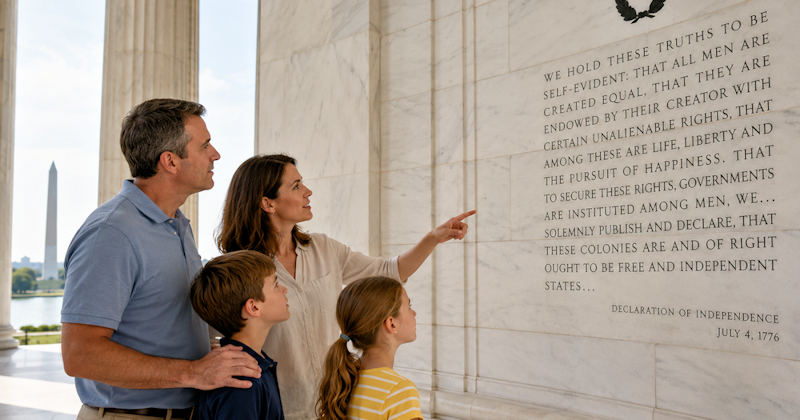
When a parent reads a book about the American Revolution with a child, that is civic formation. When a family visits a museum or attends a historical program together, that is civic formation. When a parent asks a child to take responsibility at home, that is civic formation. When a parent encourages a child to explain their thinking or works through disagreement with patience rather than dismissal, that too is civic formation.
These moments may seem small, but they are where the habits of citizenship begin. Listening. Reasoning. Exercising restraint. Engaging across difference. These are not learned in a single civics class. They are developed over time, in families, schools, and communities.
If we want a citizenry capable of self-government, we must rebalance the system.
That means continuing to support teachers and schools, while also recognizing that they cannot carry this responsibility alone. It means rebuilding the connections between classrooms, homes, and communities. It means creating accessible entry points that spark curiosity and invite participation. And it means meeting families where they are, with tools and experiences that make civic learning part of everyday life.
Institutions have a role to play here, not as replacements for families, but as partners. At the National Constitution Center, we are working to support this effort by creating pathways that begin with moments of curiosity and lead to deeper constitutional learning, whether in classrooms, online, or around kitchen tables.
The nation’s 250th anniversary this year is not simply a moment to look back. It is an invitation to decide what we will carry forward. It marks the beginning of a civic decade leading to the Constitution’s 250th anniversary in 2037, a period that calls for reflection, renewal, and recommitment.
It should be the decade we correct this imbalance. A decade that makes civic parenting a cultural expectation, not an afterthought. A decade that restores a founding understanding that families, schools, and civic institutions must work together to prepare each new generation for self-government.
This work is not beyond reach. It requires intention. And it can be meaningful and even joyful. When families are supported in it, the impact is profound. It strengthens the nation by preparing citizens capable of self-government. It helps young people develop judgment, curiosity, and civic confidence. And it deepens connections within families themselves.
The Constitution promises the blessings of liberty to “ourselves and our posterity.” That promise depends on what we choose to pass on.
The civic decade calls us to meet that responsibility together and to make civic parenting not the exception, but the expectation.
——————————
Lead Photo Credit: ChatGPT created that picture!
Please Contribute Your Ideas To This Discussion!
In order to prevent bots, spammers, and other malicious content, we are asking contributors to send their contributions to us directly. If your idea is short, with simple formatting, you can put it directly in the contact box. However, the contact form does not allow attachments. So if you are contributing a longer article, with formatting beyond simple paragraphs, just send us a note using the contact box, and we'll respond via an email to which you can reply with your attachment. This is a bit of a hassle, we know, but it has kept our site (and our inbox) clean. And if you are wondering, we do publish essays that disagree with or are critical of us. We want a robust exchange of views.
About the MBI Newsletters
Two or three times a week, Guy and Heidi Burgess, the BI Directors, share some of our thoughts on political hyper-polarization and related topics. We also share essays from our colleagues and other contributors, and every week or so, we devote one newsletter to annotated links to outside readings that we found particularly useful relating to U.S. hyper-polarization, threats to peace (and actual violence) in other countries, and related topics of interest. Each Newsletter is posted on BI, and sent out by email through Substack to subscribers. You can sign up to receive your copy here and find the latest newsletter here or on our BI Newsletter page, which also provides access to all the past newsletters, going back to 2017.
NOTE! If you signed up for this Newsletter and don't see it in your inbox, it might be going to one of your other emails folder (such as promotions, social, or spam). Check there or search for beyondintractability@substack.com and if you still can't find it, first go to our Substack help page, and if that doesn't help, please contact us.
If you like what you read here, please ....





