

Harry Boyte: Civic Organizing Beyond Advocacy, Protest, and Community Organizing -- Part 1
Newsletter # 479 - August 10, 2026

A couple of months ago, Harry Boyte responded to our posts on Courageous Citizenship and Government (this, this, and this) by observing that there is an important difference between advocacy and "public work" that we didn't clearly distinguish. We asked if he would be willing to write something for BI that explained that difference, and this is the first of what turned into two essays on that topic.
For those who don't know Harry, he is a co-founder of the Institute for Public Life and Work at Augsburg University in Minneapolis, Minnesota, where he is now an Emeritus Senior Scholar. He founded and for 20 years directed and co-directed the Center for Democracy and Citizenship (CDC) at the University of Minnesota’s Humphrey School of Public Affairs (which moved to Augsburg in 2009). As a young man he worked in the citizenship schools sponsored by SCLC, Martin Luther King’s organization. Drawing on these experiences, he established the youth civic education initiative called Public Achievement, which now greatly informs his work with Braver Angels and its Civic Scholars Council, which he co-chairs.
Civic Organizing: Beyond Advocacy, Protest, and Community Organizing - Part 1
by Harry C. Boyte
The new Braver Angels Civic Scholars Council charter, supporting the Braver Angels' (BA) focus on courageous citizenship, charges the council to equip Braver Angels members to become ambassadors for inclusive, empowering and large ideas of citizenship. This aim is to help BA members take public leadership roles in communities and local institutions.
This will mean pushing back against widespread legalistic definitions of citizenship, which are used to weaponize citizenship, dividing people into “citizen” versus “noncitizen.” Legal definitions are an element of citizenship, but as I have described earlier in Beyond Intractability, such reduction to “civil” citizenship neglects empowering “civic” citizenship — how people work with each other to build thriving communities.
Civic citizenship traces back to the shift from “subject” to “citizen,” which occurred during the American revolution and its aftermath. Alexander Dallas, an immigrant to the new society, captured the appeal of citizenship: “Citizenship is equality; allegiance is the badge of inferiority; Citizenship is freedom; allegiance is servitude.”
It was a simple-sounding shift, but as Johann Neem (a member of the Civic Scholars Council) describes in his book, Democracy’s Schools: The Rise of Public Education in America, it involved enormous changes in identity and practice and took many forms of education to achieve. To renew such citizenship in our time will require change methods today different from advocacy, protest, and community organizing. We need what can be called “civic organizing” in institutions and elsewhere.
Civic Organizing
The concept of "civic organizing" emerged during the early years of our civic engagement work with a project called the Project for Public Life at the Humphrey Institute (now School) for Public Affairs. It informed our partnerships. Two associates, Peg Michels and Tony Massengale, developed the Midwest Active Citizenship Initiative using civic organizing as the framework. They showed that it can work with groups as diverse as the Citizen League, a respected nonpartisan policy group, and Kowalsk's, a local group of supermarkets.
We began our civic engagement project in 1987 with the aim of revitalizing the public spirit and civic identity of local institutions, qualities which I had seen in the civil rights movement as a teenager and young adult working for Martin Luther King’s organization, SCLC. Local civic organizations, like the thousands of Rosenwald schools and libraries, were centers of power and civic development, as Robert Ceresa, a colleague on the Council, has shown in his essay published in the Harvard Social Impact Review.
To address this challenge of combining culture change, as well as change in institutional structures, we used the idea of every day “citizen politics,” cross-partisan problem-solving, and the creation of common goods. These activities required negotiating differences, a politics far different than partisan politics. Citizen politics was adapted from the most effective community organizing I had studied, especially the Industrial Areas Foundation network. I believed that such politics could change local institutions.
Civic organizing and its citizen politics are relational, empowering, down-to-earth, and oriented to problem-solving and creating things of public value. Such politics is rooted in local civic life, stressing grassroots democratic action. It puts citizens at the center. It emphasizes that the most important task in a troubled world is developing the civic muscle of whole communities. Citizen politics is also elevating, reviving the idea conveyed by the Supreme Court Justice Felix Frankfurther’s statement that “In a democracy the highest office is the office of citizen.”
We developed the idea of public work as we sought to translate citizen politics into institutional change and civic repair. A group of institutions in Minneapolis/St.Paul – the College of St. Catherine, Minnesota Cooperative Extension, St. Bernards Elementary School, Augustana Nursing Home, ARC, a low-income Black parents group concerned about schools, and several others – wanted to revitalize the civic identities of their institutions and organizations, not simply to undertake civic activities.
We soon realized that institutional civic identity required “making work more public.” For instance, cooperative extension agents shifted from thinking of their work as service-delivery to developing community capacities for public action. St. Bernards’ principal, Dennis Donovan, a close associate in our work, challenged teachers and other staff who asked him to address their concerns to come up with their own ideas for action. Donovan became a supporter, not a fixer. The Cooperative Extension, St. Bernards and others sent teams to regular learning conferences in the Twin Cities where people shared lessons from challenges and successes in different environments.
Public Work
Public work — sustained, uncoerced effort by a mix of people who create things of lasting civic or public significance — makes work more public in several different ways. Work is done in more open and “public” fashion. It is undertaken by a mix of diverse people — “a public.” It is filled with public purpose. Public work is an approach to citizenship in which citizens are co-creators, builders of the common world. They are not simply voters and helpers on the side who fit into that world, or protesters who oppose it. Democracy, itself, is a way of life, built through civic labors. It is far more than just elections.
The concept of public work proved to be a powerful idea in many settings, including nonprofits, faith communities, schools, local businesses, local government, as well as colleges. Public work emphasizes the importance of sustained relationship-building, which goes against the grain of professional cultures based on information. Pope Francis brilliantly described the problem in his climate encyclical, Laudato Si, calling it the “technocratic paradigm,” which affects nearly all of modern societies:
The basic problem…is the way that humanity has taken up…an undifferentiated and one-dimensional paradigm [that] exalts the concept of a subject, who, using logical and rational procedures, progressively approaches and gains control over an external object.
Maria Avila, after a decade of community organizing explains in her book, Transformative Civic Engagement, how she found the difference with institutional organizing when she became Director of Community Engagement for Occidental College in Los Angeles. In a college setting, she encountered the technocratic hierarchy of knowledge power: many people’s opinions simply didn’t count, especially if they didn’t have formal credentials. She overcame this by “building something based on people who [are] clear about their interests and passions, the things that matter to them deeply and enough to sustain their involvement over time.” This was different from the “predominate culture of wanting quick, concrete, predictable results . . . [that] undervalues process and relationality.” In her public work, everyone had something to contribute.
Making work more public leads institutions to look outward, stressing the civic possibilities of work and workplaces, including faith communities, schools, businesses, unions, nonprofits, and government agencies. Public work requires and develops citizen professionals who build and sustain such settings. It involves free spaces where citizens learn to work across differences in uncoerced intellectual environments. It creates community wealth, including schools, public spaces, and libraries, as well as music and healthy civic norms and values—a commonwealth of public usefulness and beauty. Citizen politics and public work are antidotes to hopelessness and irresponsibility. Public work expands concepts of citizen, democracy, and the engaged institution. It highlights work and worksites as places for citizen action.
The Center for Democracy and Citizenship and its partners generated many stories. Here is one:
Public Achievement
From its beginning in 1990, Public Achievement (PA) the youth civic education and empowerment initiative that I founded in St. Paul, Minnesota with the mayor, Jim Scheibel, and a diverse team of educators, addressed a different set of questions than conventional civic education. The emphasis was developing young people’s civic identities, civic habits, and civic agency, not increasing the numbers of voters, success on standardized tests scores, or changes in policies. We asked the questions: Can civic agency grow on a significant scale? What are the pitfalls? What lessons might be drawn from the Public Achievement experiences for democracy building efforts generally?
PA aimed to cultivate grassroots capacities, confidence, and the public identity of “citizen” as the foundational agents of democracy. It eventually spread to communities across the United States and more than 20 countries. Its offshoots took many other forms.
Public Achievement differs from the predominant civic education focus on knowledge (with its emphasis on government) and skills (with its emphasis on changing public policies and problem solving, narrowly understood). Most broadly, it challenges the idea of democracy as an institutional system of government and elections. It puts citizens at the center as civic producers or co-creators.
In Public Achievement, young people work as teams on issues they choose. They make a public contribution, using nonviolent and legal means.They tackle issues ranging from bullying, racism, gang violence, drugs, and sexual harassment to playground improvements, curricular changes, and better school lunches. Teams are coached by adults, often college students, who help them develop public strengths and talents. They use concepts which challenge conventional views. For instance, young people are described as citizens who are “co-creators” of schools and communities, not citizens waiting to vote. Citizen Politics is about creating a world of shared resources, not simply fighting over scarce resources. This involves a generative understanding of power as “power to,” not simply power over others’ actions.
This chart compares civic action in different frameworks of civic education.
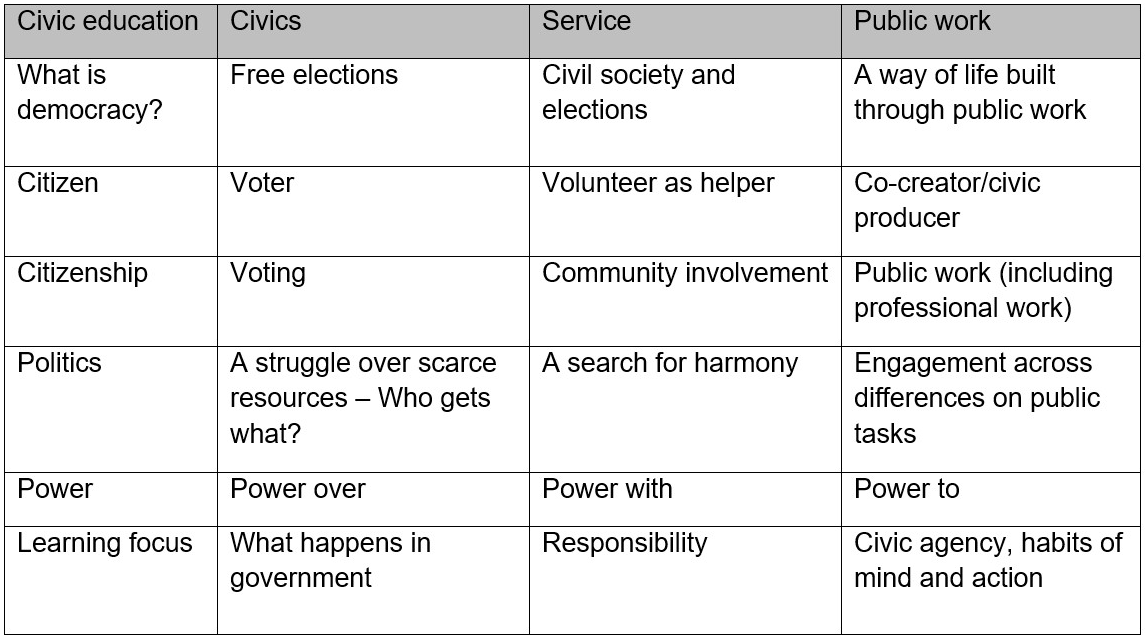
Civics and service have a lot to contribute, but the public work frame adds questions of identity, culture, and the meaning of democracy. It also highlights the civic potential and roles of teachers, support staff, and school leaders to promote and sustain youth civic empowerment through their work – to become “citizen teachers,” “citizen staff,” and “citizen administrators.” The difference between PA as a set of skills and PA as a philosophy of democracy creates tension and opportunities.
Citizens as civic producers
Public Achievement teaches new ways of looking at politics, citizenship, power, and democracy. An iconic story of Public Achievement, told around the world, is about teams of fifth, sixth and seventh graders at St. Bernard’s Elementary School in St. Paul, (the first real home of Public Achievement) who worked for five years to build a playground in a neighborhood that adults had thought too dangerous.
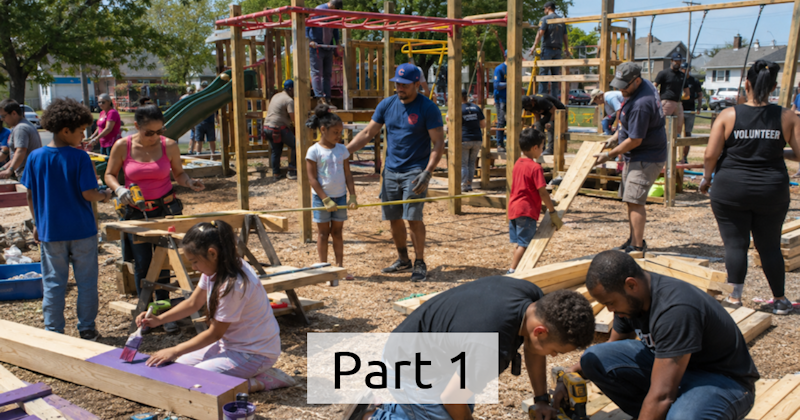
In the late fall of 1998, just as snow began to fall, the lot donated by Saint Bernard’s Catholic Parish to children to build a playground filled early one morning. Children, teachers, and neighbors joined with college students and a few professors and staff from the University of Minnesota to assemble the playground. Some adults helped children put together swing sets. Others dug sand pits. Churchwomen served refreshments. At the end of the day, all dedicated the playground with a plaque etched with drawings of cat feet: “PAWS: Public Achievement Works.” The incoming governor, Jesse Ventura, visited the new playground on February 26 and in his State of the State address the next week recognized five team members with the Governor’s Award for a Better Minnesota for “reforming Minnesota every day through their good works.” Joe Lynch, an eighth grader at Saint Bernard’s who accepted the award for the group, was portrayed in Ventura’s flamboyant style as a “citizen hero prevailing against all odds.”
Years later, Alaina Lynch, Joey’s sister who also worked on the playground, remembered the overall lesson. “It was a ‘no-brainer’ to have a playground for kids instead of an old lot, but that didn’t mean that making it happen was straightforward,” Alaina explained. She learned about city politics. “Public Achievement opened my eyes to the processes of government—petitions, connecting with the city council, commenting, obtaining permits. [These were] not things I would have thought about as a ten- or eleven-year-old otherwise.” She also learned about neighborhood politics. “I learned there are multiple sides to every idea. Even something that seemed straightforward to me could have negative ramifications from another point of view.” For her, the gang issue was “not a huge concern". But others saw it differently. “We had to demonstrate that we had a plan for mitigating any risk—a fence, with the playground closed after certain hours.” She learned about different perspectives and compromise.
The teams got the parish council on their side. They negotiated zoning changes with city officials. They raised more than $60,000 from local businesses in the North End Business Association and other groups. To accomplish these tasks, the children learned how to interview people, write letters, give speeches, and call people they didn’t know on the phone. They worked to understand the views of adults they originally thought were opponents. They mapped power, did research, and negotiated. Throughout, they had a sense that their efforts were public work, suggested in the name young people chose for the park: Public Achievement Works. They also learned political concepts—power, interests, and politics itself. “For most of my life, I’ve wanted to get involved with politics,” said Jeremy Carr, a pioneer of Public Achievement. “When [Public Achievement] came around and I found I could do the stuff I wanted to change—and got adults to treat me seriously—I got excited.” This also was the opportunity the principal, Dennis Donovan, was looking for. “We wanted kids doing citizenship-type things,” he said. “More than just reading to other little kids.”
In Public Achievement, power is not simply “power over” but “power with,” the view advanced by Beyond Intractability, the capacity to act with others of different views and interests to shape the world around us. “I got a lot of empowerment from Public Achievement,” said Tamisha Anderson twenty years later. Tamisha, an African American student at Saint Bernard’s, worked on a team trying to change clothing rules. “We didn’t get white shoes, but we got the uniforms changed. It was empowering to know that your voice matters, regardless of what color or size or age you are.” The lessons stayed with her. “I use [the example of] ‘the little train that could’ to this day with kids I talk to. I push them to stay involved, even though they get knocked down.”
Public Achievement participants learn and practice politics that is different from partisanship. Zach Baumann, of German American background who became conservative as an adult, worked for several years on the playground. “We had neighborhood meetings. We worked with the city to get the zoning changed and interacted with local business leaders to try to get some money. We met with the county commissioners.” Zach said he learned to be accountable, which was “a huge deal for people that age. You were letting down your team if you dropped the ball. We knew we had to rely on each other to get things done.” He learned to work across differences. “Civic involvement has a stereotypically liberal quality in a lot of the media, but it’s about conservative values, taking responsibility for what’s going on, contributing how you can to improve to improving your world, not about asking somebody to do something for you.” He understood that there were different views. “I didn’t care what someone else’s thoughts on immigration were. We were trying to get the playground. That’s one of the biggest things Public Achievement can bring: the ability to put aside your differences for a common goal. You don’t have to like the person to work with them. Standing up and walking out of the room isn’t going to accomplish anything.”
In St Bernard’s, the practices of Public Achievement became part of broad culture change, in which teachers, support staff, and involved parents also developed new ways of working together and thinking about the world and themselves in the world.
Please Contribute Your Ideas To This Discussion!
In order to prevent bots, spammers, and other malicious content, we are asking contributors to send their contributions to us directly. If your idea is short, with simple formatting, you can put it directly in the contact box. However, the contact form does not allow attachments. So if you are contributing a longer article, with formatting beyond simple paragraphs, just send us a note using the contact box, and we'll respond via an email to which you can reply with your attachment. This is a bit of a hassle, we know, but it has kept our site (and our inbox) clean. And if you are wondering, we do publish essays that disagree with or are critical of us. We want a robust exchange of views.
About the MBI Newsletters
Two or three times a week, Guy and Heidi Burgess, the BI Directors, share some of our thoughts on political hyper-polarization and related topics. We also share essays from our colleagues and other contributors, and every week or so, we devote one newsletter to annotated links to outside readings that we found particularly useful relating to U.S. hyper-polarization, threats to peace (and actual violence) in other countries, and related topics of interest. Each Newsletter is posted on BI, and sent out by email through Substack to subscribers. You can sign up to receive your copy here and find the latest newsletter here or on our BI Newsletter page, which also provides access to all the past newsletters, going back to 2017.
NOTE! If you signed up for this Newsletter and don't see it in your inbox, it might be going to one of your other emails folder (such as promotions, social, or spam). Check there or search for beyondintractability@substack.com and if you still can't find it, first go to our Substack help page, and if that doesn't help, please contact us.
If you like what you read here, please ....





