
What Do Courageous Citizens Do With/About Government Part 3 - A Personal Story
Newsletter # 466 - June 25, 2026

Heidi Burgess and Guy Burgess
This is the sixth in a series of newsletters on Braver Angels' notion of courageous citizenship.
- Our first Courageous Citizenship newsletter explained and expanded upon Braver Angels' term and explained why we think the concept is so important.
- In the second newsletter, we explained more about the courage that citizens need to be effective, and gave the example shared earlier by Harry Boyte about how this was done so well in the past by participants in Martin Luther King's civil rights movement.
- The third newsletter and fourth newsletters looked at how citizens can and should interact with government.
- The fifth newsletter in this series was a guest newsletter by Julie Silverbrook on "Civic Parenting."
Now we are going back to the question of how citizens can work with government, even when they do not see the government as being immediately forthcoming or helpful.
To offer practical, real-world example of how citizens can work within the system even when "the system" is not workling the way you want, I (Guy) would like you to tell a personal story about my multi-year effort to influence the way in which Boulder, Colorado manages its prized Open Space and Mountain Park (OSMP) system. I share the full story in this video (which is an updated version of a lecture that I routinely gave to my conflict and peacebuilding students). This newsletter contains an excerpted version of the story, along with commentary and a few details I didn't put in the video. Since the video is a good bit different, we think think that is also worth a watch/listen (or you can read the transcript.)
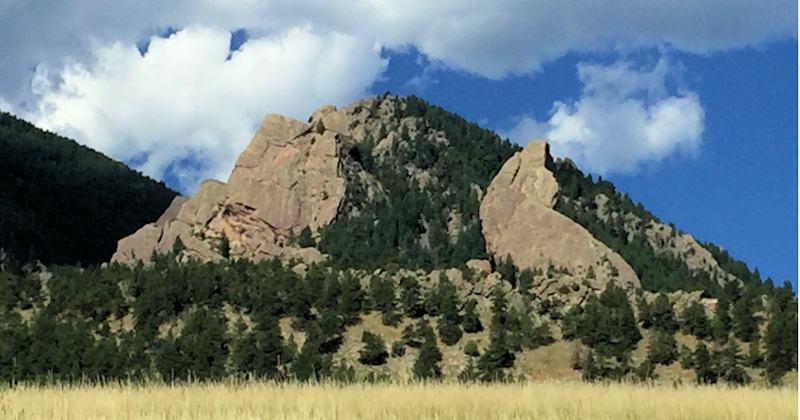
Heidi and I have lived in Boulder, Colorado since the late 1960s, taking one year off to do post-docs at M.I.T. One of the main reasons we stayed so long — probably the main reason — is because we cherish Boulder's Open Space and Mountain Parks (OSMP) system and the lifestyle that it makes possible. Boulder lies in a spectacular valley where the Great Plains meets the Rocky Mountains. Unlike many communities, Boulder has, from its earliest days, worked hard to preserve, rather than develop, its spectacular surroundings. The resulting OSMP system (with its over 155 miles of trails) is, in many ways, worthy of national monument status.
We live about a mile away from the nearest trail so daily exercise hikes have long been part of our routine. That's even how I write: I dictate into my phone as I walk. I then use AI to transcribe the dictation which I then edit. I find it much harder to write at a desk! Heidi uses open space differently — it is her therapist. Many of her friends wonder how we stay sane, spending so much time focusing on the darker sides of politics and conflict. She uses open space as an escape, focusing on the flowers and birds, the sky, the forest, and the mountain backdrop. It's our "happy place," as Heidi's friends put it. And we try hard to go there every day.
The story I want to tell starts back in the 2010s, when a sign first appeared blocking one of my favorite trails, saying that the trail was now reserved for nearby homeowners only. This was a previously public trail from a public street to publicly owned OSMP land. The homeowners association was trying to use their ownership of this small strip of land between the street and open space to effectively deny anyone but their members access to this particularly spectacular piece of of the OSMP system. What followed from this relatively minor and simple frustration was an experience that taught me a lot about citizenship. The goal of this post and accompanying video is to share some of what I learned.
The lessons from this experience are widely applicable, as it tells a lot about how local decision making works in our democracy. I have similar story about the six years I spent deeply involved in school politics at the middle and high school levels. Others who have been engaged in such controversies can doubtless tell similar stories as well. This is especially true for those who were able to successfully influence the system. Those who get frustrated, give up, and disengage, not surprisingly, are much less likely to make a difference.
Here I tell the story, in terms of the lessons I learned.
Lesson 1: Try to Understand the Other Side's Perspective
After the sign appeared, I called a few of the people I knew who lived nearby (and hence were members of the homeowners' association.) and I asked why they felt a need to put up that sign. They explained that parking was getting to be a problem — so many people were parking in front of their houses to go on a hike that they and their visitors sometimes couldn't park in front of their own houses. Noise and litter were getting to be problems too.
I could understand these concerns. We, too, live right across the street from a big city park, and our street gets all parked up on the weekends, and sometimes on weekdays as well. And we get litter in our yard. Still, we figure that putting up with such behavior is part of the price of living next to a popular public amenity.
This neighborhood association, however, did not agree. (There is reason to believe they were primarily concerned with monopolizing access to this particular area because, when I raised the possibility of constructing a visitor parking lot in a hidden area to service these trails, they they objected streneously.)
So, that's the first lesson I learned: it helps to find out the reasoning behind your opponent's behavior. You don't have to agree with them — I certainly didn't. But I better understood where they were coming from. I could also understand why, since they owned a short stretch of land between the street and open space, that they thought they had the right to close it. Still, to me, this didn't seem fair to other Boulder citizens who had been paying for this open space for many years. So, I decided to lodge a complaint.
Lesson 2: Appeal to Responsible Authorities
I didn't just walk away angry and decide that this was another reason to conclude that democracy didn't work. And though I thought about simply ignoring the sign, daring them to have me arrested, I decided that wasn't likely to be a good strategy, because they probably would, and I wouldn't win. That would be trespassing. So, I decided to go to the department that manages the open space, assuming that this was something OSMP wouldn't condone. First, I called a park ranger and complained. I quickly learned this was a "system level" policy matter that he wasn't authorized to address. He suggested that I contact the OSMP Director's Office. I did.
This is where I discovered that what looked like a simple access issue for one trail was actually part of a much wider and deeper philosophical dispute over the proper balance between environmental preservation and open space access and recreation. I learned that the preponderance of opinion within environmental community had concluded that OSMP properties were being "loved to death," and strenuous measures were needed to reduce access. OSMP administrators, it turned out, thought that homeowner's association action was a positive step in that direction (since the only people who would now go to this area were relatively few local homeowners).
Though I could understand this point of view, I still thought that it was deeply mistaken. (Why is a long story, but briefly, if people don't have access to nature, they won't have the incentive to protect it, and political pressure to develop it is more likely to succeed. I also believed that the environmental threat was nowhere near as serious as it was being portrayed. Evidence of human presence is not the same thing as environmental damage. We had lots of stories of instances in which humans were able to coexist with the natural environment just fine.)
Lesson 3: Don't Be Afraid to Take Your Issue to the Broader Public
At this point I dicided to go to the city newspaper and tell them that "I had a story they might be interested in." And I was right! They were interested. A reporter came and interviewed me, and they took my picture next to the No Trespassing sign. It went on the front page of the newspaper — this was before smart phones and social media, so it was a time when people actually read the newspaper.
This was when I started to get a better sense of just how big of a story (and a dispute) this was. I got contacted by many other people, who had similar (or related) concerns. Their favorite trails (other trails) were being closed off too. The City was starting to build, instead of its older, beautiful trails, what I call "cattle chute trails" — trails between two fences, usually right near the road, that keep hikers and/or bikers right on the periphery of open space, not out in the open areas themselves.
I found out that this was happening more and more. 90% of the land purchased by the Open Space Department between 1967-1976 was open to public access. Only 52% of lands purchased in the following decade was open to the public . For lands purchased in the decade after that, the accessible percentage was down to 30%. And, for lands purchased between 1997-2006, it was down to about 4%. By 2010, increasing numbers of Boulder citizens recognized that we weren't buying open space, we were buying closed space! They concluded that if they didn't fight, more and more land was likely going to be declared off limits.
So, I decided to join the Boulder Area Trails Coalition (BATCO) — a coalition of hikers, bikers, runners, climbers, dog walkers, and equestrians who were concerned about maintaining access to open space. And, BATCO ended up joining a newly-formed organization called the Boulder Outdoor Coalition which was an effort to build even stronger political force. Members included the Action Committee for Eldorado--a climbers' organization, the Boulder County Horse Association, the Boulder Mountain Bike Alliance, the Boulder Trail Runners, FIDOS (Friends Interested in Dogs and Open Space), the Flatirons Climbing Council and the Rocky Mountain Hang Gliding and Paragliding Association.
Lesson 4: Control Internal Disputes
The Coalition did have internal conflicts: the hikers didn't like bikers (and some didn't like dogs.) (I was among that group, as I have been bitten several times while hiking the trails. But a majority of hikers in Boulder seem to have dogs, so I recognized a dispute I couldn't win. The bikers didn't like much of anyone else because they felt that the others had successfully lobbied in the past to close most of Boulder's trails to bikes. But we all realized that we shared more common interests than opposing interests, and it was worth our while to compromise with each other and cooperate to make as strong a case as possible to keep the trails we all cherished accessible.
This was particularly true because the preservation side of the dispute — the people who advocated the closure of as many trails as possible — had been well organized for much longer than we had. They had been working politically to elect like-minded council members, who then selected like-minded Open Space Board of Trustee Members, who then set the policy for the Open Space staff to follow. So we were swimming upstream. But access to open spaces was such a critical part of our lives that we weren't willing to give up. So we continued to look for ways in which we could persuade the city to change policies.
Lesson 5: Contend Constructively
Heidi and I have been advocating for something that we call "constructive confrontation" for a long time. Constructive confrontation takes the lessons from the conflict resolution and peacebuilding fields and applies them to advocacy. It calls for treating the opposition with respect, listening (and seriously considering) their interests and needs, and seeking, wherever possible, ways that you can work together to attain mutual goals.
This was fairly easy within our own coalition; it was a much more challenging task with the preservation-minded organizations (and the homeowners associations) that were anti-access. We were advocates for a reasonable, balanced approach — the kind to approach that, in most other cities in the United States, would have had us labeled as "environmentalist." We cared deeply about the health of our natural environment. We wanted our mountain parks to be healthy environments for all the creatures and plants that lived there. We just thought it was possible for that to happen, and still have people around. If a good case could be made that human presence was threatening something, we were all for protecting it. So, for instance, the climbers have not fought the closure of many climbing routes to protect nesting raptors — they respect the environment too, and choose to climb elsewhere during raptor nesting season.
All we asked was that the preservationists considered our need for access to areas where we were not doing harm. And we thought we had good reasons, not just for us, but, as I indicated earlier, ultimately for the continued protection of the whole system. People who don't go out in the parks don't necessarily understand how valuable they are and might be willing to let them be developed for valuable goals such as affordable housing, for instance, sometime in the future. So, we argued, access was actually necessary for preservation, not opposed to it. We also argued that the impact of a particular recreational use needed to be evaluated on a case-by-case basis. At the time, environmentalists were defining a healthy environment as simply the absence of human presence. We thought we should do better than that.
Lesson 6: Take Advantage of Public Participation Opportunities and Work Your Way up the Political Power Hierarchy
One of the first things that the Boulder Outdoor Coalition did was start looking for ways in which it and its members could participate in (and hopefully influence) the OSMP decision-making processes. We learned that there are mandated public participation opportunities — opportunities that we decided to start taking advantage of. After all, as one of my new-found allies was fond of saying, "The world is run by those who show up."
Since OSMP administration was making policy decisions we disapproved of, the first obvious question was, who is in a position to tell it to revise it's governing philosophy? We learned that overall OSMP policies are set by a Board of Trustees and there are public participation opportunities at Board meetings. After attending a few such meetings, it was clear they were strong supporters of OSMP's increasingly strenuous environmental protection policies.
So, we asked how he Board members were selected. We learned that they are appointed by the City Council for five year terms, with one person being appointed each year. So we decided to try to convince the Council to balance OSMP's trustees by selecting more pro-access members. Unfortunately, most members of the Council were also still quite supportive of policies that prioritized preservation.
So, we decided to try to make access questions a major issue in the upcoming City Council election. To do that we interviewed Council candidates and selected and campaigned for those we thought would be most supportive. This required a major effort to explain why we thought that the environmental benefits of the current generation of access restrictions did not justify their adverse quality-of-life impacts.
These are just some of political power options we considered. More are explained in the accompanying slideshow/lecture.
Lesson 7: Collaborate When You Can
Slowly, after several years of contention, the Open Space Department realized that the Boulder Outdoor Coalition was not going away. It had stong and increasing public support, and it wasn't being unreasonable. And, the same was true for the preservationists. So, OSMP decided to pursue a consensus building process with all the interest groups involved. There was some haggling about who would be involved, how it would be run, and such things, but it finally was formed and settled down to work.
I wound up serving on what came to be called the Community Collaborative Group. It took a lot of time. We spent two years once or twice a month, four hours each night, plus field trips, and homework, going through and thinking about how to balance access and environmental protections on pretty much every foot of every trail in the system. It was an often acrimonious, difficult negotiation process that nobody was very pleased with. But it did balance everyone's interests. And if the test of doing this right is everybody being sort of equally uncomfortable, it did a pretty good job. Eventually, we did come up with a final set of recommendations that everyone at least grudgingly agreed to. A lot of people were unhappy about it — we all had to give up a lot of things we wanted. But we all, also, got a lot of things we wanted. And we all agreed, after two years of haggling (which followed several prior years of fighting before the process started) that this was the best we were likely to be able to do.
Lesson 8: It's Not Over 'til It's Over
Even when you go through a collaborative process like this, you're still going to have to defend the agreement. The recommendations still had to be approved by the City Council. And people who were not involved in the process, who did not understand the necessity of tradeoffs, who did not see all the data that we saw, argued against it at the City Council meetings. All the fights were fought over again. But the City Council understood the nature of the process we had completed. They understood that we had examined all the issues in great depth and came up with what was, indeed, likely to be the best compromise possible. So, ultimately, they approved our recommendations, and the agreement. To its credit, it has now held for over a decade. (While, there continue to be disputes, those disputes have been relatively minor with nowhere near the animosity that was common in the earlier era.)
Lesson 9: Stay In It for the Long Haul
The big lesson in all this is that effective courageous citizenship requires a long-term commitment. While the involvement of specific individuals may wax and wane over time, it is important that interest groups remain continuously and actively involved. Public policies result from the outcomes of a seemingly endless series of disputes — disputes that may be resolved through agreement, Board of Trustees actions, Council decisions, lawsuits, elections, or other processes. Defending group interesst requires continual involvement in all these areas. This is why democratic citizenship is invariably a group process that requires individuals to work together to support one another.
Lesson 10: If Want Democracy to Work, You Have To Work at Democracy
This is how democracy is supposed to work — at least at the local level. Ideally, the federal level should work this way too, but there are so many more stakeholders, so many more competing interests, that copying this model at the national level is difficult, but probably not impossible. Not everything is as contentious, as difficult, as was open space management was in Boulder. Open space is just so integral to what Boulder is, and to who Boulderites are. So the process we went through to assure its protection and its access for generations to come was a hard-learned lesson in how to do democracy right.
Our Community Collaborative Group took an enormous amount to time and effort. And the issues were so numerous, so complex, with so many different stakeholders, that it would probably take that long if it were being done today. But a lot of innovations are happening in public participation that are enabling much shorter processes to work on simpler problems. Deliberation processes, such as the ones described by Martin Carcasson and Jacob Bornstein, and citizen assemblies are usually much shorter than our process was. . (Actually, Jacob worked on water conflicts in Colorado, which probably are even more contentious and took even longer. But his story is another good lesson in democracy done well.)
So, these processes still take effort. And they are often initiated by citizens themselves who, like I did long ago, saw a problem they wanted to fix. Courageous citizens take responsibility for solving their own problems. They don't expect other people to solve them for them. But they do so constructively, working with people on all sides of a dispute, to work out a solution that works for as many people as possible, not just for "their side." Because that’s what Courageous Citizenship is all about.
Please Contribute Your Ideas To This Discussion!
In order to prevent bots, spammers, and other malicious content, we are asking contributors to send their contributions to us directly. If your idea is short, with simple formatting, you can put it directly in the contact box. However, the contact form does not allow attachments. So if you are contributing a longer article, with formatting beyond simple paragraphs, just send us a note using the contact box, and we'll respond via an email to which you can reply with your attachment. This is a bit of a hassle, we know, but it has kept our site (and our inbox) clean. And if you are wondering, we do publish essays that disagree with or are critical of us. We want a robust exchange of views.
About the MBI Newsletters
Two or three times a week, Guy and Heidi Burgess, the BI Directors, share some of our thoughts on political hyper-polarization and related topics. We also share essays from our colleagues and other contributors, and every week or so, we devote one newsletter to annotated links to outside readings that we found particularly useful relating to U.S. hyper-polarization, threats to peace (and actual violence) in other countries, and related topics of interest. Each Newsletter is posted on BI, and sent out by email through Substack to subscribers. You can sign up to receive your copy here and find the latest newsletter here or on our BI Newsletter page, which also provides access to all the past newsletters, going back to 2017.
NOTE! If you signed up for this Newsletter and don't see it in your inbox, it might be going to one of your other emails folder (such as promotions, social, or spam). Check there or search for beyondintractability@substack.com and if you still can't find it, first go to our Substack help page, and if that doesn't help, please contact us.
If you like what you read here, please ....





