

Mónica Guzmán Explains Why Curiosity is a Super Power (and More)
Newsletter # 483 - August 25, 2026

Heidi Burgess and Guy Burgess
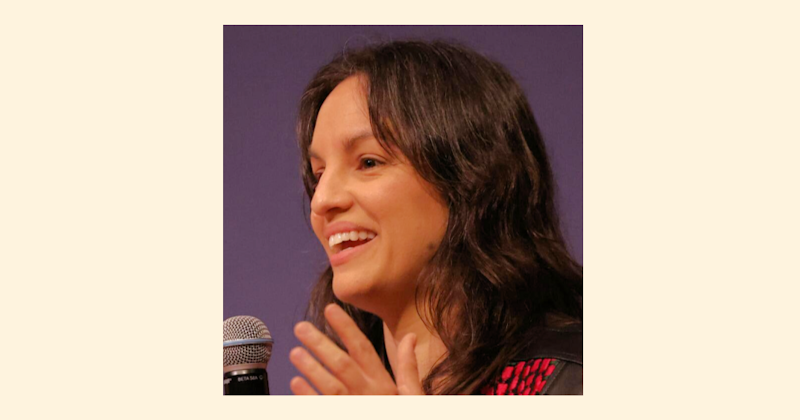
On August 14, 2026, Guy and I were delighted to talk with Mónica Guzmán, whom we have known about and admired for a long time, but we have never before met her.
Mónica describers herself as "a bridge builder, journalist, and author who lives for great conversations sparked by curious questions." She is the author of a best-selling book: I Never Thought About It That Way: How to Have Fearlessly Curious Conversations in Deeply Divided Times and is the founder and CEO of Reclaim Curiosity. She is an advisor and debate chair at Braver Angels; and is the host of “A Braver Way” podcast, which she recently restarted.
She received an honorary doctorate degree from Wheaton College, and completed study and research fellowships at the Nieman Foundation for Journalism at Harvard, the Henry M. Jackson Foundation, and the University of Florida. A Mexican immigrant and dual US/Mexico citizen, she lives in Seattle with her husband and two kids and is the proud liberal daughter of conservative parents. Read more about her and her work at moniguzman.com.
This conversation happened when Hanna Hertel, who works with Mónica, wrote us, asking if we'd advertise Mónica's podcast, “A Braver Way,” in our Newsletter. Heidi jumped at the chance, but went further, asking whether Mónica would do an interview with us about the podcast, her book, and other aspects of her work. And she agreed! So I am a bit embarrassed that we didn't get around to talking about her podcast (except for descriptions of two particular episodes) until the very end. I'll try to fix that oversight by talking about it first here.
Mónica started A Braver Way in 2023, in the run up to the 2024 election, and it ran every week until shortly after the election.
Now Mónica has restarted it in the run up to the 2026 election. BUT it isn't a political podcast, at least not exactly. It is more a podcast about how we manage ourselves and our emotions and our relations with others in the context of very divisive and heated politics.
For instance, the first episode of the new series, which aired on June 5, is entitled "" It focuses on the pressures we all feel to "take a stand" or "keep the peace." "How do you know the difference between the move that feels right, and the one that is right?" Mónica talks this over with her conservative friend and fellow bridge builder April Lawson. Among the questions they explore are:
- How do I avoid using “peacemaking” as a cover for a lack of courage?
- What’s the line between humanizing someone … and enabling them?
- When it comes to division in my community, my family, and my country: What will I wish I had done when my grandchildren ask what I did?
Another episode was with Axel Bouchon who set up connected phone booths in very progressive San Francisco, California and very conservative Abilene, Texas. They invited passersby to stop in and have a conversation with a person in the other city, who was, most likel,y on the other side. How could this be fun, you might wonder? They report that it was! And lots of people did it.
But I didn't start our conversation with that — I started, as I usually do, by asking Mónica about her background, and how she ended up doing what she does now. She said that she was guided by two paths, a professional path and a personal path, of which the personal was more powerful.
She is part of a politically divided family of Mexican immigrants. She came to the U.S. when she was five, lived first in Texas, and then in New England.
My parents became citizens — they took the naturalization test and passed around the year 2000. I was 17, so I became a citizen then too. And as soon as they could vote, they went Republican. I went Democrat real fast. So hilarity ensued in the Guzmán household growing up.
The conversations we'd have for a while were tense and heated, but they didn't feel all that painful until the 2016 election came along. Then it got really intense. Our ability to accept each other's beliefs was tested — and I'll be honest, it was mostly my ability to accept their beliefs. We got into some real, real heated conversations! But we were able to stay in them. I got to the point where I could really understand where they were coming from, and they could too, with me — it wasn't all one way.
Mónica saw the same tensions boiling over around the country, saw people hurting each other or ending relationships altogether, and she thought that there must be a better way to engage these hot button issues.
This is where her journalism career came in. As a journalist, she said:
I learned really quickly how easily I can get people wrong. I would go up to a source I was interviewing thinking I already knew the story and just needed a quote, but every time I asked questions and questioned my own assumptions about what somebody was all about, I would learn the truth of who they were — because you have to get close enough to understand someone to actually understand them. I learned that lesson over and over again. ...
So all of that led me to the book — it sort of poured out of me. And when I first discovered the organization Braver Angels, the nonprofit, I couldn't believe it. I thought, "I didn't think this could exist, and it exists." So I had to get involved.
Since then, she said, she's learned that
there's this whole universe of people, communities, and grassroots movements to help each other with this all across the political divide. We're so far from done with this work; we're just getting started. But it gives me a lot of hope, and it gives me a ton of fuel. It helps me meet incredible people. It helps make sure I'm not stuck in silos, because it's very important for me to see the world as it is, not the way I imagine it to be.
So [she asked]— how do we open our eyes wider when the world wants us to stay in our lane? That's what all this work is about.
I (Heidi) tossed that question right back to her, observing that
many people aren't interested in opening their eyes wider, or they're scared to, because they're afraid of getting shut down, either from the person they're being curious about or from their peers who say, "Well, why would you want to listen to them?" You talk about fearless conversations, but these conversations are scary!
Mónica quickly agreed. So, I asked, "How do we help people get over their fear?" She responded:
That's the million-dollar question — that's exactly the question I've been most focused on since the book came out. I don't think my book actually did enough about that, because you started that question by saying "some people don't want to open their eyes wider." And I'd say, if asked, everyone would say they want to know the truth.
[But] what happens is two things. One, we think we already know the truth — that's certainty. That's what I think my first book ended up emphasizing: when we think we know, we won't think to ask. And boy, do the assumptions we make cover up questions we could ask frequently these days. That's one of the reasons someone will tell you, "What do you mean? My eyes are open very wide, thank you very much! I've seen everything I need to see. Now I need to act! I need to do these things, and I don't want to talk anymore, I don't want to learn anymore, because there's nothing to learn over there anymore" — that kind of thing.
[As I (Heidi) was listening to this, my mind went to our "Fiddling While Rome Burns" conversations and David Eisner's "Citizenship Under Friendly Fire" Essays.]
The fear, though, is really the biggest thing. Back to your question — how do you help people get over the fear?
My first response, as I think about it, is that it really starts by aiming curiosity within. I think there's a lot about our culture today that is about interiority. It's almost been therapized, our contemporary culture — even our movies. Now the hero is always crying and thinking about themselves. It didn't use to be that way.
But I think there's a reason for that. And I think it's because of all kinds of things about our communication landscapes and technologies, and how we've revolutionized how many people we can connect with. It's also given us this opportunity to see reflections of ourselves in our conversations with others, to wonder if we'll be judged for something we believe.
And then our divisions come in and make that so much more consequential. We all need to belong, we all need to be understood. But it's a scary, turbulent world. All of that, I think, has conspired to create this landscape where one of the biggest mistakes we can make is not wondering about our own emotions, our own nervous system — what is triggering us, and why. ... But the only way through it — you can't avoid the fear, you have to learn from it. You really have to ask, "What makes me afraid? Can I look at that fear deeply to understand what's really going on?"
Because if you don't question that, and something triggers you, now you are on an autopilot you didn't set up. You lose your agency, and you'll end up saying or doing something you'll probably regret. I can't tell you how many people tell me that kind of thing — "When I look at what I posted on Facebook, I can't believe it. I don't know what came over me."
Alternatively, Mónica said, we just don't say anything. That, she pointed out that staying silent
gives more ground to the vocal edges of things, raising the stakes and the temperature for everybody. It's a vicious cycle wherever you go.
We talked a lot about how to talk to people we disagree with in a respectful way, when to do it, and when not to. Should you do it with family? When? How? With friends? With strangers? Again, when and how?
She talked about two of her podcasts, one recent, one in the past. The recent one was with her friend Travis Tripodi. She explained that she'd been nervous about doing this for months.
I initially didn't want to do it. It's me openly disagreeing about current-event issues that really bother me with my friend Travis Tripodi, who's way on the other side of me politically, and him bringing the issues and headlines that bother him most to me.
We've been testing this for months, since Trump took office again, actually. One thing he and I absolutely agree on is that the world needs more models of this — good-faith conflict.
What does it look like? It's possible. People can be fully honest, say it all fully and freely, without fear. I say in that episode, "I'm so mad right now" — because of something he believed, that he wouldn't come with me on something. But I was able to name it. I said, "I'm so mad right now," and we actually laughed about it. He said, "I think that was our biggest fight yet." And I said, "Yeah, you're right — and I kind of loved it."
She went on to observe that:
We forget something my friend Sam Rechek said on the podcast once: "disagreement can be fun." It actually can. I think the more we're stuck in this place of either screaming bloody murder at each other or avoiding each other — and those two things are the things that get elevated — we just don't have faith anymore that there's a middle ground where people just hash it out. And if it doesn't go well, you forgive each other. You apologize. If you hurt each other—you say “sorry about that,” and you come back later. There are all these little ruptures you can quickly stitch up. That's most of it, actually — most of it is not a nightmare at all. If you just bother to try, find the right person, find the trusting relationship, and give it a shot.
It's a lot more difficult when you're afraid that person is really out to get you. Travis and I are not out to get each other. We really do try to learn from each other, so we're very honest with each other.
And she says, that kind of conversation transforms you.
It's not just the psychology of people feeling heard and then being more receptive to other ideas, though that's true. But there is also something I haven't quite figured out how to articulate. Maybe you've run into this and can tell me about it. What I observe over and over is that when people engage in this process of putting it all on the table, giving themselves the time, the way they approach the issue to begin with — the way it looks to them — starts to transform. It transforms in a way that can only happen because they're talking to somebody who sees it a different way. Suddenly, everything they thought they could or couldn't accept, they have a different angle on. It's like taking a prism and looking at it from this side, then that side — it gains more dimensionality. That transformation of how the issue looks ends up changing you a little bit.
It's through that transformation that the most beautiful kind of compromise happens — where we've heard each other out totally, and now some of the stuff that stressed us out, that we thought we'd never accept, but when you put it that way, it actually seems okay, especially if the people involved are okay with something we didn't expect them to be okay with.
Now I'm future-casting in my mind, imagining the world with a little more color — filling it in with the actual beliefs of the other side, rather than what I projected onto them. It turns out there are actually multiple ways to have a good world, not just the one I came in with. So now I've constructed this other one — let's go with that. We can get there. It's that process of transformation that's so necessary — but you have to actually be together to make that work.
We talked more about compromise because that's often seen now as a "dirty word" and a bad thing to do. But it is not just cutting what you want or get in half. "We look at it a little too cognitively," Mónica observed
There's an emotional aspect [to it too.] In a way, you can think of this other kind of compromise we're trying to flesh out as less about the exchange of items in a rational sense, and more about people trying to figure out how they can all feel good about something. Is there something we can all feel good about? The act of finding things I can feel good about is a transformative thing that happens when you complexify issues. It's as much about feelings as it is a transaction — an account of things, a percentage, all on a spreadsheet. That's not what this is.
I do worry that because our world is constructed today such that everybody's billboarded everything — meaning I can go look at your tweets, Facebook posts, Instagrams, everything you've written — it's easier for me to think, "Look at all the material I can review from this organization, this advocacy group, this activist community. I already know what they believe. I don't need to be in the room with them to figure it out. It's all right there." That's wrong. That's actually not true. How we message stuff to the public and how we truly believe and think about something are two different things. So the conversation is the place of the most complexity. When we tell ourselves we don't need the conversation because we've got volumes of material we've already read, that's not actually telling you what you need to know.
We also talked about journalism, particularly why journalists and the media, more broadly, isn't trusted anymore, and what journalists can do about that.
And we finally talked about the podcast at the end. Mónica explained:
The shortest way to say what it [the Braver Way podcast] is out to do is to help people meet division with strength.
What is strength? That can vary. One way I think of it is staying grounded and engaged in dangerously divided times — hearing and being heard, that's strength. Staying curious when it's hard, that's strength. These are things that, when you look a couple levels down, you realize we need to do better at. None of us want to be hijacked by our own emotions. None of us want to do things that rupture relationships we value, because we just didn't know how to handle a certain situation. All the skills kind of fall underneath that for me.
Episodes come out every other Friday, and she has guests every week.
I bring on fascinating people who've either demonstrated courage in bridging divides or shed light on insights we desperately need. I'm also trying experiments, like the conversation I mentioned earlier with my friend Travis, who's a conservative libertarian — we just take the news and go.
There's a text line, and an email address — we respond to everything. It's a community as well, because I certainly don't know these answers, I'm as curious as everybody else, I'm just trying to find them. It's "better together," right? So everybody come in — if this sounds fun and interesting and useful for you, let's figure it out.
We've run out of space here, but I hope you'll check out our full interview with Mónica, and then head on over to the Braver Way Podcast! It is fascinating, and yes, good fun!
Please Contribute Your Ideas To This Discussion!
In order to prevent bots, spammers, and other malicious content, we are asking contributors to send their contributions to us directly. If your idea is short, with simple formatting, you can put it directly in the contact box. However, the contact form does not allow attachments. So if you are contributing a longer article, with formatting beyond simple paragraphs, just send us a note using the contact box, and we'll respond via an email to which you can reply with your attachment. This is a bit of a hassle, we know, but it has kept our site (and our inbox) clean. And if you are wondering, we do publish essays that disagree with or are critical of us. We want a robust exchange of views.
About the MBI Newsletters
Two or three times a week, Guy and Heidi Burgess, the BI Directors, share some of our thoughts on political hyper-polarization and related topics. We also share essays from our colleagues and other contributors, and every week or so, we devote one newsletter to annotated links to outside readings that we found particularly useful relating to U.S. hyper-polarization, threats to peace (and actual violence) in other countries, and related topics of interest. Each Newsletter is posted on BI, and sent out by email through Substack to subscribers. You can sign up to receive your copy here and find the latest newsletter here or on our BI Newsletter page, which also provides access to all the past newsletters, going back to 2017.
NOTE! If you signed up for this Newsletter and don't see it in your inbox, it might be going to one of your other emails folder (such as promotions, social, or spam). Check there or search for beyondintractability@substack.com and if you still can't find it, first go to our Substack help page, and if that doesn't help, please contact us.
If you like what you read here, please ....





