

Dismal Epiphany: America is Already in a [Gray Zone] Civil War
by Heidi Burgess
February 11, 2022
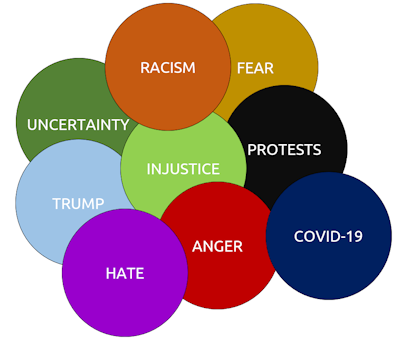
I little over a year ago (from November 2020 - February 2021), as I was redesigning my graduate-level course on Reconciliation that I teach at the Carter School for Peace and Conflict Resolution, Guy and I wrote eight blog posts on reconciliation. The first one came out on November 22, 2020 just after Joe Biden was elected President of the United States. In his victory speech Biden said, "I pledge to be a President who seeks not to divide, but to unify — who doesn’t see red and blue states, but a United States... And who will work with all my heart to win the confidence of the whole people,”[1]
Fifteen months later, that doesn't seem to be working out as well as he, and many others of us, had hoped. Why not?
As I teach in all my courses, and stress in much of my writing here, there is no one answer, as the conflicts we study are all very complex and every result has multiple causes. But, there certainly are hints: ever-rising polarization between the Left and the Right both at the leadership and the grassroots levels. That is driven by social and traditional media fostering totally different (sometimes totally opposite) narratives about "truth." Widespread distrust in government is being driven actual government missteps, augmented substantially by bad-faith actors who are trying to prevent government from being effective at anything. On top of that, we are still suffering from the pandemic which is continuing to strain the economy and social relationships, and fuel partisan distrust and disgust even more.
| A year later, we are still debating the significance of January 6, 2021. The Democrats say it was an attempted coup; the Republic National Committee say it was "just legitimate political discourse." |
As if that weren't enough, shortly after Biden's victory speech, on January 6, 2021, we witnessed the attack on the U.S. Capitol. Over a year later, we are still debating the significance of that day. Democrats see it as an extremely serious attempt to overturn the election—an attempt to destroy democracy in the United States. The Republican National Committee on February 4, 2022, declared that the events of the day were "just legitimate political discourse." In a similar vein, an astonishing 80% of Republicans think that Donald Trump won the election, and hence Biden's position is illegitimate. The Republican leadership is firmly in this camp, and is taking every step possible to assure such a "steal" doesn't happen again: by gerrymandering districts to assure safe seats, changing voting laws at the state level to (they hope) inhibit Democratic constituencies from voting, and running Trump-supporting candidates for state secretaries of state, whose role is to certify each states' vote counts.
Democrats are doing all that they can to oppose these measures: gerrymandering their own safe seats, supporting the National Popular Vote Interstate Compact which is designed to guarantee that the Presidency will go to the candidate who receives the most popular votes without having to overturn the electoral college (a move that would favor Democrats, and even going so far as allowing non-citizens to vote, as is now the law in New York City. At the same time, Democrats are moving even further left, trying to push their progressive agenda as hard as they can while they have (meager) control of Congress and the Presidency.
| Taken together, Democrat and Republican maneuvering does not bode well for political reconciliation, nor for a functional U.S. democracy moving forward. |
This does not bode well for political reconciliation, nor for a functional U.S. democracy moving forward, unless the Democrats win a larger majority in Congress in 2022 or find a way to actually work with Republicans (and Republicans to work with). But historically, the party holding the Presidency looses substantial numbers of Congressional seats in the next Congressional elections, and vast majority of pundits I have read expect that to be the case. Plus, Biden still will not be considered a "legitimate president."
| Hybrid or "gray-zone" warfare includes any hostile actions taken by state or large non-state actors that falls short of conventional military attacks but still is intended to do substantial harm. |
In addition to teaching my course on Reconciliation and working on BI, I am currently participating in Project Seshat which has brought together a large international group of conflict resolution experts and security experts to examine the nature of and possible responses to "hybrid warfare" and "gray zone conflict" in the U.S. and around the world. This is a concept that was foreign to many of us when we started the project, but we are learning a lot. One thing we have learned is that there is very little agreement on what constitutes gray-zone conflict or hybrid warfare, but generally, it includes any hostile actions taken by state or large non-state actors that falls short of conventional military attacks (the military term is not "kinetic,") but still is intended to do substantial harm. Interfering in another country's elections is a now well-known example. So, too, is infiltrating public or private computers to steal data, demand ransoms, break infrastructure or public services; using social media to set populations against each other, sowing distrust, hatred and fear; interfering with the supply of critical products (such as COVID vaccines or masks), and stealing intellectual property. Guy further explains that gray-zone or hybrid warfare tactics include "the whole range of power strategies that are seen as so illegitimate that they have to be employed secretly. The big thing is keeping the intensity below the level that would provoke a large-scale military response."
| All the dystopian elements that are evident in Afghanistan, Syria, and Yemen are also present at the regional and local level in the US: acts of violence, constant litigation, non-stop intense political lobbying, foreign involvement. |
One of my teams in this project (each of us is in several) was looking at a case study of "state devolution" in Syria, Afghanistan, and Yemen. In our discussions, Peter Adler, observed that all the dystopian elements that were evident in those conflicts were also present at the regional and local level in the US. As an example, he explained that he has been working for two years with community leaders in the Klamath River Basin (in California and Oregon, USA). He wrote in one of his documents for Seshat:
Members of this little group [his Klamath group, not his Seshat group] have been meeting periodically to find long-term collaborative solutions to the many challenges that vex sovereign Klamath Basin tribes, commercial salmon fishers, irrigators, farmers, ranchers, and County, State, and Federal officials.This is a 30+ year “water war” that seems to defy grand solutions and is riven with deeply felt historical injustices and constant ideological attacks on opponents. It has had acts of violence, constant litigation, and continuous intense political lobbying. I don’t know for certain, but I am guessing there may be foreign involvements which at the moment remain invisible to me.
| Adler's poll showed that many conflict resolution experts think we are at high risk of civil war, though fewer thought we were in one already. But were they thinking of "gray zone" or "hybrid war?" If one includes that category, the argument that we are already in a civil war is quite strong! |
Peter also observed, and I agreed, that the elements of state devolution seen in Syria, Afghanistan, and Yemen were present in the wider political polarization we currently see in the United States. He, along with many others are thinking that the United States is not far away from a civil war that could potentially look a lot like the wars currently going on in those three countries. In an effort to determine if others were as alarmed as he was, Peter sent out an informal poll to his many colleagues, asking whether or not they thought the U.S. was currently in, or at high risk of civil war. As you will see in his article about this poll, many people thought we were certainly at a high risk of war, though fewer thought we were currently in one.
But, I realized, that was probably because most people were thinking of normal "kinetic war" with guns, tanks, bombs, etc. If we think about "gray-zone war," it seems persuasive to me that we are currently in a second civil war, even though most of us don't even realize it. All the fake news and other misinformation that is being spread by both sides (though I think more of this is being done by the Republicans) is certainly a gray-zone warfare tactic. Trying to undermine the legitimacy of the electoral process or manipulating the vote count is a gray zone tactic. Allocating COVID treatments in ways that favor particular political constituencies is a gray-zone tactic. Does all of this cross some invisible line into "war?" It is hard to say when guns, bombs, and tanks aren't involved, but it certainly can be argued that in terms of gray-zone conflict—that we have crossed that line.





