

July 4, 2026: an Occasion for Recommitting Ourselves to the Pursuit of the Democratic Ideal - Part 1
Newsletter # 468 - July 2, 2026

Heidi Burgess and Guy Burgess
Our Fourth of July post, like so many of our others, has gotten so long that we have divided it into two posts. Here is the first one; the second half will come out tomorrow.
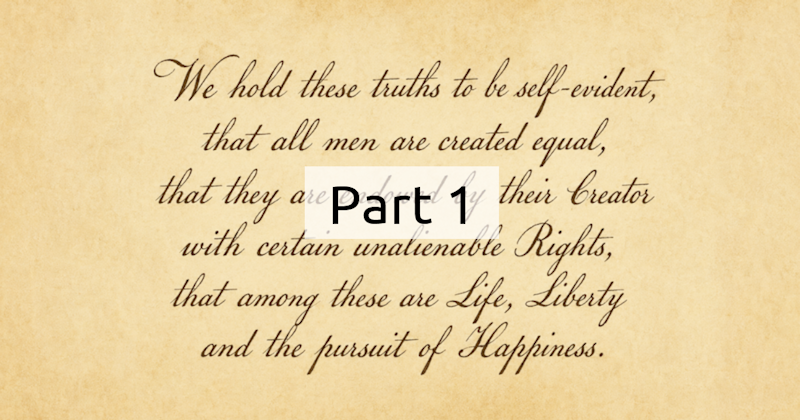
This Saturday is the Fourth of July — America's Independence Day holiday. As all Americans know, but some of our non-U.S. readers may not, this is a particularly notable holiday, as it is the United States' 250th birthday.
A year ago we posted a newsletter noting how divided America was over what America stands for, and how or if the 4th of July should be celebrated. In keeping with our observation that AI's large language models are especially good at listening to and reporting on society's aggregate opinions, last year we asked ChatGPT what it thought Americans believed about the holiday." We asked: "Can you tell me what progressives think about celebrating the 4th of July in the United States?" and "Using a similar style, can you tell me what conservatives think about celebrating the 4th of July in the United States?" Today, a year later, we asked ChatGPT if "the attitudes you found then are largely similar now, as we approach America's 250th birthday. Are we still as divided about our history? What about our future?" ChatGPT responded yes...
The basic pattern from last year still holds, and in some respects it is sharper as the 250th approaches. The shorthand remains: many conservatives treat July 4 as a straightforward celebration of national founding, freedom, sacrifice, and continuity; many progressives treat it as a day for mixed celebration and critique, with emphasis on who was excluded from the promise of 1776 and what remains unfinished. That is very close to the progressive/conservative split described in your 2025 newsletter.
It went on to say:
A June 2026 Reuters/Ipsos poll found that 64% of Republicans, but only 27% of Democrats, planned to display an American flag or bunting outside their home on July 4. It also found that 65% of Republicans, but only 24% of Democrats, described the Fourth as “a day where I celebrate the United States of America.” Democrats were more likely to describe it as a day for friends and family, a day off work, or just another day. Republicans were also more likely than Democrats to wear red, white, and blue, attend fireworks, attend parades, and otherwise take part in the more traditional patriotic rituals.
More hopefully, however, ChatGPT noted that
A UMass Amherst poll found that 74% of Americans, including 76% of Republicans and 79% of Democrats, still say there is more that unifies Americans than divides them; 59% say the Declaration still guides the country in meaningful ways; and 57% say the country has made important progress toward the Declaration’s ideals.
It also citied Gallup’s 2026 American Dream study which found that
a majority in all partisan groups say the [American] Dream is unfinished: 57% of Republicans, 60% of Democrats, and 59% of independents. Republicans are more likely to say it has succeeded; Democrats are more likely to say it has failed; but the largest group across all three sees it as incomplete, rather than either triumphant or dead.
And an AP-NORC poll which found that
Americans continue to attach overwhelming importance to core civic freedoms: 87% say freedom of speech is important to U.S. identity, 86% say the same about the right to vote, and 80% say the same about freedom of religion. The conflict is over which rights are most threatened and by whom: Democrats are more likely to see voting rights and free speech as under major threat, while Republicans and independents are more likely than Democrats to see gun rights as under major threat.
There is also considerable agreement about America's future, but that agreement paints a pretty grim picture.
Reuters/Ipsos found that 38% of Americans do not believe the U.S. will still exist as a single country 250 years from now, including 40% of Democrats and 26% of Republicans. The same poll found that 64% agree American democracy is in danger of failing, including 85% of Democrats, 60% of independents/others, and 50% of Republicans. It also found that 77% expect political violence to increase over the next five years.
ChatGPT concludes that
We are still as divided about our history, and probably more anxious about our future. But there is still a latent shared civic language: freedom, voting, democracy, constitutional rights, the American Dream, and the idea of an unfinished project. The problem is that the same words now point to very different perceived threats. ...
The 250th could therefore become either another performative battlefield or a rare opportunity. A constructive framing would not ask Americans to choose between celebration and criticism. It would say: the United States is worth celebrating because its ideals have repeatedly inspired people to correct its failures; it is worth criticizing because those ideals still matter. That framing is much closer to the “unfinished American Dream” consensus than to either triumphalism or rejection.
As we continue to struggle over a seemingly endless series of conflicts about how we should think about the United States' past, we found ourselves thinking back to one of the wiser things we learned early in our career in the conflict resolution field. This is the idea that, if people really want to just keep fighting over the past, there is relatively little that the conflict resolution field can do to help them. If, on the other hand, they are willing to focus on building a new, more positive future, there are a lot of ways in which we can all work together to make this a reality.
This suggests that our 4th of July celebrations would be more constructive if we focused on asking "where do we go from here?" We can keep on fighting about what is going wrong, and who is to blame, or we can start focusing on working together to fix our many problems and build a better future.
We can see clearly what happens if we keep on fighting — in earlier writing, we have likened that process to a broken pendulum. In the physical world a pendulum swings a little less far each time, the friction of the air diminishing the swing, until the pendulum is at rest in the center of its arc. In our hyper-polarized politics, however, the pendulum seems to be violating the laws of physics and swinging ever further with each cycle. During the presidencies of George H.W. Bush and Bill Clinton, political oscillations were much closer to the center, George W. Bush was farther right than is father (H.W.), and Obama was farther left than Clinton. Trump, during his first term, was certainly more extreme (though on a new populist dimension that did not track directly with the past liberal/conservative oscillations). Sharply reversing things, Biden took us to in a new more progressive (rather than liberal) direction. Today, in his second term, Trump is pursuing an even more extreme agenda — though, again, that is even further removed from traditional conservative principles. Where do we go next? Centrists certainly are not on the ascendency — they are usually denounced as "soft" or "wishy-washy" or even "treasonous."
Nothing gets fixed when we swing back and forth between these unstable victories. Whatever one side accomplishes, the other side undoes. Compromise is rare, collaborative solutions are all but non-existant, leaders are unable (or unwilling or uninterested in) solving our fundamental problems. The American population grows increasingly frustrated, alienated, fearful, and hateful of those on the other side. They increasingly feel as if they have no agency, so say in political affairs. More and more distrust elections, distrust our leaders, our institutions, our media, our scientists. The end result is a collapse in support for democratic norms and institutions — a collapse that is opening the door to all sorts of dystopian possibilities.
While we might hope that people can at least agree that pendulum politics isn't going to solve our problems, we can't, alas, even agree on that. Far too many people still think that intensifying our hyper-polarized politics so that their side can, ultimately, decisively defeat the other is the way out.
Churchill and Santayana
A big part of what makes these pendulum swings possible is that we've increasingly lost track of the underlying stake that we all have in the preservation, defense, and improvement of democratic norms and institutions. As we have tried to understand the mechanisms behind this trend, we have found ourselves going back to a recent and quite insightful David French essay built around two classic quotes that together tell us a lot about our predicament. The first is Churchill's famous observation that "democracy is the worst form of government, except all those other forms that have been tried" and Santayana's reminder that "Those who cannot remember the past are condemned to repeat it."
What makes Santayana's observation so relevant this is the fact that so many people (including, especially, those on the progressive left) have come to the conclusion that history is little more than a worthless effort by the oppressors of the past to sugarcoat their domination of others. This sadly has been accompanied by a large-scale repudiation of Western civilization (and the role of the United States' democratic experiment in that history). In its place, we are increasingly told that the only reliable source of information is our personal "lived experiences" (and maybe the experiences of our close friends and associates).
This brings us to Churchill's reference to democracy as the "worst form of government." For those young enough to have escaped the horrors of World War II and the horrors of Soviet and Chinese communist expansionism, the lived experience of U.S. democracy in recent decades has, admittedly, left people with lots to complain about. (We have certainly joined in the chorus of people highlighting democracy's many deficiencies.)
While these deficiencies are certainly quite real and significant, they also have a decidedly "privileged" tinge to them. Life for those who complain most vociferously is actually pretty good when compared with other parts of the world and other periods of history. The violence associated with microaggressions is really very different from barbaric forms of violence routinely visited on those unlucky enough to live under brutal authoritarian regimes in places like Iran, Russia, North Korea, China, or much of the developing world. It is these horrors and lack of opportunities that accompany them that explain why so many people want to immigrate to the United States.
In other words, before condemning democracy, its critics should spend more time looking outside their immediate lived experiences to the experiences of people who have had to live under "all of those other forms of government that have been tried" — forms of government that Churchill knew were far worse. We need to remember that, despite our many differences and difficulties, there are bigger things that should hold us together and that we should work toward preserving and improving.
We will explore what these are tomorrow.
Please Contribute Your Ideas To This Discussion!
In order to prevent bots, spammers, and other malicious content, we are asking contributors to send their contributions to us directly. If your idea is short, with simple formatting, you can put it directly in the contact box. However, the contact form does not allow attachments. So if you are contributing a longer article, with formatting beyond simple paragraphs, just send us a note using the contact box, and we'll respond via an email to which you can reply with your attachment. This is a bit of a hassle, we know, but it has kept our site (and our inbox) clean. And if you are wondering, we do publish essays that disagree with or are critical of us. We want a robust exchange of views.
About the MBI Newsletters
Two or three times a week, Guy and Heidi Burgess, the BI Directors, share some of our thoughts on political hyper-polarization and related topics. We also share essays from our colleagues and other contributors, and every week or so, we devote one newsletter to annotated links to outside readings that we found particularly useful relating to U.S. hyper-polarization, threats to peace (and actual violence) in other countries, and related topics of interest. Each Newsletter is posted on BI, and sent out by email through Substack to subscribers. You can sign up to receive your copy here and find the latest newsletter here or on our BI Newsletter page, which also provides access to all the past newsletters, going back to 2017.
NOTE! If you signed up for this Newsletter and don't see it in your inbox, it might be going to one of your other emails folder (such as promotions, social, or spam). Check there or search for beyondintractability@substack.com and if you still can't find it, first go to our Substack help page, and if that doesn't help, please contact us.
If you like what you read here, please ....





