

Envisioning a New U.S. Civic Culture: A Coalescing of Ideas
Newsletter # 428 - February 25, 2026

Heidi Burgess and Guy Burgess
Of all the things we have read recently, four of our colleagues' recent blog posts really jumped out at us as particularly insightful and important (and mutually aligned).
- One was an "Invitation to a New Civic Future" co-authored by thirteen different authors*, and published on Connective Tissue.
- The second was "The Decline of the Republic–and Philanthropy’s Role in It" by Daniel Stid of the American Enterprise Institute, and publisher of the Substack Art of Association, (who was also one of the thirteen authors of the invitation),
- The third was "As America Turns 250, It’s Time to Begin Again" by Richard Harwood, President and Founder of the Harwood Institute, and
- The fourth was "Rethinking sovereignty in practice: directions of travel over finish lines" by Anne Leslie, a cybersecurity expert with IBM.
The similarities between all of these essays, but particularly the first three, were striking. But each added an element (or two or three) that the other ones missed. So we thought it would be useful to highlight what we saw as the key ideas from all three in the same place — which is here.
Anne's post on Rethinking Sovereignty isn't so clearly aligned with the first three: it is on estuarine mapping—a concept she gleaned from Dave Snowden. Anne applies it to cybersecurity, but it also relates to depolarization, visioning, and the creation of a new civic culture. We will review Anne's post and show how it relates to the ideas we discuss here in second essay, coming soon.
Connective Tissue's "An Invitation to a New Civic Future"
Sam Pressler, a co-founder of Connective Tissue, introduced this invitation by writing:
I’ve been helping gather a group of local civic practitioners over the past year to imagine the shared civic life we’re called to grow together at the start of this generational moment of renewal. This open letter is our attempt to articulate a vision for a new civic future — where people feel agency over their lives, where neighbors are connected through relationships of trust, and where communities have the power to shape their own futures — and our invitation to begin shaping it with us. Whether you’re rooted locally or approaching this work nationally, we invite you to read the full letter and join us by signing on.
We hope you will read the full letter, but we also want to highlight the key points here.
The essay starts out by saying that "new seeds of civic renewal are beginning to take root" in local communities. These seeds can grow, or they can be captured by distant actors, nonprofits, and funders who are not accountable to the local people. "They may not intend harm, but they do [harm], by shifting attention, power, and resources away from the local communities, and displacing local stewardship, rather than strengthening it."
This group of thirteen people asked themselves, "What kind of shared civic life are we called to grow together?" Their answer: "One where people feel agency over their lives, where neighbors are connected through relationships of trust, and where communities have the power to shape their own future."
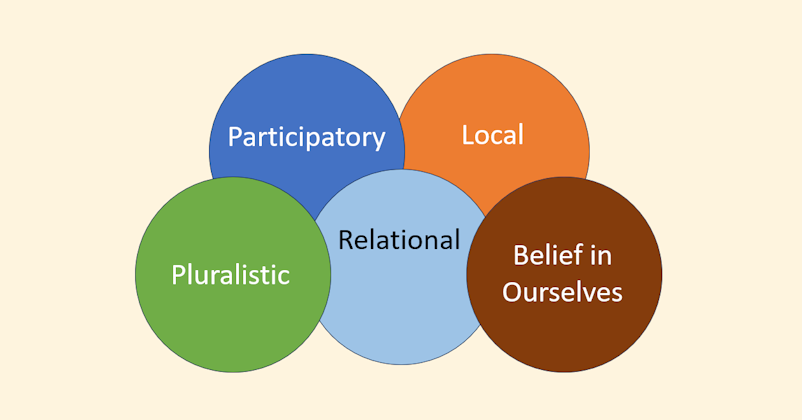
They then present five foundational principles for cultivating such a future. Those are:
- Participatory: We must approach residents as active members expected to shape their community’s future, not passive clients to be served. [Note the similarity here to Harry Boyte's notion of civic/horizontal citizenship.]
- Alive: We must embrace the joy, culture, and full humanity that make civic life worth living, not the logic of the machine. [Note the similarity with Joan Blades' observation that bridging needs to be fun.]
- Proximate: We must root renewal in the people who live in the places they serve, not distant groups and leaders.
- Relational: We must treat relationships and interpersonal trust as ends in and of themselves, not means toward other ends.
- Generational: We must commit to the work, relationships, and structures that outlast us, not the quick fixes or silver bullets.
They end by asking readers to join them:
Our civic life can only be renewed by us choosing to build something that lasts in the places that hold us. This isn’t a call to join an organization or sign up for a program. We’re not trying to sell you some new solution. We’re simply inviting you to sign onto this letter and join us in committing to a new civic future (no title, grant, or organization necessary).
They then make specific entreaties to
- people already working in community-based civic renewal to "not lose faith,"
- the millions of Americans yearning for a sense of agency to start by applying these principles in their own lives,
- national organizations to help promote localism, and
- philanthropy, to step back from managing communities, and trusting them instead. Build real relationships with people stewarding their particular places, and invest in them for long enough to see what emerges," the letter advises.
The letter ends:
Regardless of where you sit, if you see your work in this vision, we invite you to join us by signing onto this letter.
We see signing on to these values as an act of civic aspiration. A way of saying: “The future can be like this.”
But, it can also be seen as an act of civic commitment. A way of saying: “I’ll work to make it so.”
We hope you will read the details on the original letter, and join us in signing it and beginning to work in your own way toward helping it be fulfilled!
Daniel Stid's "The Decline of the Republic–and Philanthropy’s Role in It"
Daniel Stid, who was one of the drafters of the letter quoted above, recently published a related post on his Substack, the Art of Association. This is the second of a two-part series on "the mounting challenges facing republican government in the United States and how they intersect with civil society." The first part was the "good news," Stid said, in which he wrote about the protestors and observers who stood up to and eventually repelled the Trump Administration's ICE and CBP assault on Minneapolis. The second post in this series, though turned to "the bad news." In this second post he explained:
I focus on the growing inability of our national governing institutions to make and administer laws in ways that serve the public interest, reflect and sustain enduring majorities, and respect individual rights.
As we will see, there is plenty of blame to go around for this set of developments. My focus here, however, is to pull the camera back and consider how many philanthropic funders—and the advocates and activists they support—have compounded the problems of republican self-government that we face.
If these civil society actors truly care more about the health of democracy in America than advancing their particular policy preferences, as most would claim they do, they can always change course. I conclude by proposing several course corrections that would benefit our republic if they made them.
Given that few of us remember much about civics anymore, Stid starts by reminding his readers "how the national governing institutions of our republican system are meant to work when functioning well." To do this, he cites Alexis de Tocqueville's Democracy in America, published in 1835. Although de Tocqueville is now most often quoted as highlighting the importance of civil associations and democratic mores, Stid points out that that notion is based on a more fundamental one. Stid quoted de Tocqueville:
“What one understands by republic in the United States is the slow and tranquil action of society on itself. It is a regular state really founded on the enlightened will of the public. It is a conciliating government, in which resolutions ripen for a long time, are discussed slowly, and executed only when mature.”
So de Tocqueville argued that conciliation and moderation were key if such a large and diverse polity would be able to survive. As Stid explained, de Tocqueville wrote that the large American republic was viable —
provided the governing majority and the national government it animated recognized that they were not, “all-powerful. Above it in the moral world are humanity, justice, and reason; in the political world, acquired rights.” Should the majority not recognize these limits, Tocqueville warned, it would jeopardize republican government.
This assessment was based on de Tocqueville's travels in the U.S. in 1831-32. At the time, he saw two forms of instability that threatened the new state. The first was "frequent shifts in policy as political majorities changed." The second was "instability at the constitutional level."
Tocqueville worried that surface-level instability, if sufficiently chronic and severe, could drive citizens to question the value of republican self-government altogether. In that event, he speculated, Americans would likely turn to the elective despotism of an all-powerful president. ...
Nearly two centuries later, Tocqueville’s warning appears prophetic. The United States has become an executive-centric polity marked by chronic instability in major federal policies. The presidency now dominates our political attention, generating constant agitation through all phases of the permanent campaign and unilateral executive actions. Congress, despite being the first branch of our constitutional system and the one meant to make its laws, now rarely serves as the institution in which policies are debated, reconciled, enacted, and legitimated through enduring majorities.
Stid asks who is to blame, and as he said earlier, responded that "there is plenty blame to go around." He blames the founders for failing to anticipate that the president, not Congress, would be the branch most likely to over-power the other two in the system of checks and balances. He blames citizens for selecting such poor leaders. But the bulk of the remaining part of his post blames philanthropy for "compounding the breakdown."
Philanthropic funders across the ideological spectrum play a critical role in underwriting nonprofits that seek to shape public policy. In doing so, many reinforce the problematic dynamics outlined above—sometimes inadvertently, sometimes quite intentionally.
These dynamics are most pronounced among large-scale national funders underwriting federal policy advocacy and more rapid-response, politics-adjacent activities (and not so much among community-based or direct service-oriented philanthropies whose work operates on a different register over longer time horizons). ...
These same networks have come to favor independent executive action over the coalition-building in civil society necessary to sustain broad legislative majorities. When aligned parties hold power in Washington, so-called “policy wins” via executive action appear faster, cleaner, and more decisive than the slow work of persuasion, negotiation, and accommodation across differing worldviews. Yet such victories are inherently fragile and easily reversed by the next administration, further intensifying polarization. ...
many funders pursue their policy preferences in an unfettered fashion while taking the health of the constitutional system and the civic culture that sustains it for granted. The costs of polarization, instability, and chronic executive overreach are externalized—borne by the polity rather than by the philanthropic actors whose funding decisions accelerate them.
Stid ends his piece by describing what philanthropy could do better.
If philanthropy is inadvertently helping to weaken republican governance, it can use the same degrees of freedom it enjoys to help strengthen it. Doing so does not require abandoning substantive commitments. It does depend on a deeper appreciation of pluralism as a governing condition in a republic—and a commitment, first and foremost, to do no harm.
- Responsible pluralism begins with recognizing that democratic stability is not self-sustaining. It depends on habits of restraint, institutional forbearance, and a willingness to accept partial victories...
- Responsible pluralism also means resisting ideological monocultures, welcoming dissent, and engaging skeptics as potential allies rather than adversaries.
- It requires not overestimating what can be achieved in one or two years, nor underestimating what can be accomplished over one or two decades, albeit via messier, incremental progress.... [Bullet formatting ours]
- Finally, responsible pluralism demands a different posture toward institutional power. Relying on unilateral executive action may be tempting, especially in moments of moral indignation, but it leads to fleeting gains, long-term instability, and deeper polarization. Durable majorities are harder to assemble precisely because they reconcile real differences. But policies grounded in such coalitions are more likely to command legitimacy, survive political transitions, and sustain the “slow and tranquil action of society on itself” that Tocqueville recognized as the hallmark of republican government in the United States.
The test before us is not whether we can win the next political battle, but whether we can recover the habits of restraint and conciliation that allow the citizens of a large and diverse republic to govern themselves over time.
These are wise words, not just for philanthropists, but for all organizations and people in them who are looking for the "quick fix" or the "unitary solution" that does things "my way" or "our way" when "our" represents, at best, half of the country, designating the other half as illegitimate or "enemies of democracy."
Richard Harwood: As America Turns 250, It’s Time to Begin Again
Richard Harwood echoed a similar theme in his letter that went out to his subscribers, and was published in The Fulcrum on February 15.
He started out by saying:
I know so many people are approaching America’s 250th anniversary with a sense of trepidation, even dread. Is there really anything to celebrate given the recent chaos and uncertainty we’ve been experiencing? Is productively reckoning with our history a possibility these days? And how hopeful will we allow ourselves to be about the future of the nation, its ideals, and our sense of belonging to something larger than ourselves?
Harwood draws his answer to those questions from civil rights activist James Baldwin:
Just as things looked darkest to Baldwin amid the struggle for civil rights, he refused to give up or submit or wallow in despair.
Instead, he wrote: “Not everything is lost. Responsibility cannot be lost; it can only be abdicated. If one refuses abdication, one begins again.”
This is the task before us today. To “begin again”—as individuals, as communities, as a nation. Today, we must begin the next 250 years. The good news is that people across our country are open, willing—and ready.
Harwood has been traveling all over the U.S. for the past two years, working on a campaign of renewal based on his book The New Civic Path. (We interviewed Richard in May of 2025 and you can read about his campaign and book here.) He writes:
I have witnessed a growing energy and hunger among Americans to rally around a new moral vision for our communities and society. This new moral vision includes:
- Reckoning honestly with our past while celebrating what makes Americans good and strong.
- Putting people—and a shared sense of humanity—at the center of everything we do.
- Establishing dignity and decency as foundational to a shared society.
- Focusing on our shared aspirations for connection, belonging, and mutual reciprocity.
- Coming together to take action on a set of shared concerns and issues that people are ready to work on together—like education and youth opportunities, senior care, affordable housing, mental health, and others.
- Restoring belief in ourselves and in our nation, and a practical path for doing so.
- Living a new patriotism.
- Starting locally.
Like all of the others we have quoted here, Harwood observes:
All across these United States, people are choosing hope over despair, healing over trauma, and progress over division. People are finding ways to reckon with our history while celebrating what makes America good.
We need to build on this by rallying more Americans to a new moral vision that helps us “begin again.” In doing so, we can forge a more promising start to our next 250 years.
We strongly agree, and are very glad to see so many people and so many movements working in what we call a "massively parallel fashion" to forge a new civic future. There is a great deal to be hopeful about if we look for it and participate in it. As James Baldwin advised, let's not abdicate our responsibility for building a better future to our leaders who clearly cannot and may not even want to. It is our responsibility — and within our power — to build it ourselves.
---
* The authors of "An Invitation to a New Civic Future" are: Savannah Barrett, Art of the Rural & Kentucky Rural-Urban Exchange; Pete Davis, Join or Die; Kate Hanisian, YMCA of Greater Cincinnati; Ash Hanson, Department of Public Transformation; Darryl Holliday, News Futures & Commoner Co; Liz Joyner, The Village Square; Naudy Martinez & Evan Vahouny, Falls Church Forward; Adrian H. Molina & Evan Weissman, Warm Cookies of the Revolution; Sam Pressler, Connective Tissue; Daniel Stid, American Enterprise Institute; and Richard Young, CivicLex
Please Contribute Your Ideas To This Discussion!
In order to prevent bots, spammers, and other malicious content, we are asking contributors to send their contributions to us directly. If your idea is short, with simple formatting, you can put it directly in the contact box. However, the contact form does not allow attachments. So if you are contributing a longer article, with formatting beyond simple paragraphs, just send us a note using the contact box, and we'll respond via an email to which you can reply with your attachment. This is a bit of a hassle, we know, but it has kept our site (and our inbox) clean. And if you are wondering, we do publish essays that disagree with or are critical of us. We want a robust exchange of views.
About the MBI Newsletters
Two or three times a week, Guy and Heidi Burgess, the BI Directors, share some of our thoughts on political hyper-polarization and related topics. We also share essays from our colleagues and other contributors, and every week or so, we devote one newsletter to annotated links to outside readings that we found particularly useful relating to U.S. hyper-polarization, threats to peace (and actual violence) in other countries, and related topics of interest. Each Newsletter is posted on BI, and sent out by email through Substack to subscribers. You can sign up to receive your copy here and find the latest newsletter here or on our BI Newsletter page, which also provides access to all the past newsletters, going back to 2017.
NOTE! If you signed up for this Newsletter and don't see it in your inbox, it might be going to one of your other emails folder (such as promotions, social, or spam). Check there or search for beyondintractability@substack.com and if you still can't find it, first go to our Substack help page, and if that doesn't help, please contact us.
If you like what you read here, please ....





