

Lorelei Kelly and Mónica Inés Espíndola: Two More Takes on Courageous Citizenship
Newsletter # 482 - August 20, 2026

Neither of the authors we are featuring today thought they were writing a piece on courageous citizenship. But they were.
Lorelie Kelly sent us a short piece introducing her new project running Local Impact Field Hearings a "new civic infrastructure to gather, organize, and preserve community knowledge so it can become part of the deliberations lawmakers use for making decisions." So while her project envisions structural change — a new process for collecting evidence — it also tells a story of courageous citizens who choose to take part.
Lorelei is now with the Public Good Group, where she helps design and implement strategies to strengthen civic knowledge and engagement (on a wide range of topics), and in turn enables democracy to be more responsive, productive, efficient and accountable. She has opne similar work before that, particularly focused on improving the functioning of Congress with programs at Georgetown University, the Beeck Center for Social Impact and Innovation, and with the Smart Congress Initiative.
Mónica Inés Espíndola sent us her piece, entitled "I Choose Peace," asking if we would be interested in adding it to our Peacebuilder Reflection section of BI. We said we were eager to do so, but also wanted to send it out in a newsletter, as it makes a very simple, but important point that many of us forget in the heat of the moment, when the conflict is ours, not someone else's. She is asking us, in essence, to be courageous citizens and to act the way we speak when we say "we want peace."
Mónica is an Argentine lawyer, mediator, and specialist in dialogue processes and peacebuilding. She holds a Master’s degree in Negotiation, Mediation, and Restorative Justice and has pursued studies in Peace Education. Drawing on her experience in judicial, family, and community contexts, her work explores peacebuilding as a human capacity and reflects on how dialogue and individual choices can transform the way people respond to conflict and create possibilities for peaceful coexistence.
Local Impact Field Hearings: A New Way to Move Democratic Functions Closer to the People
by Lorelie Kelly
Democracy depends not only on voting and representation, but on the capacity of communities to listen, speak, and remember together. Local Impact Field Hearings are a new model I am piloting in the states to move these critical democratic functions closer to the people most affected by public decisions. Developed in collaboration with Democracy Forward, the hearings create a structured, in-person setting where 5–8 community witnesses document the local impacts of federal policy through lived experience—what we call civic evidence. These hearings are modeled on congressional field hearings, but are community-centered, rather than member-led: elected officials can participate as witnesses and listeners, while the community retains the role of authoring the record. The goal is not to collect opinions or grievances, but to build a durable public memory of what is happening in a place, when it happened, and what people learned from it. For our current moment, former public servants make excellent witnesses, as they have the administrative knowledge that we will need to repair and renew the federal government. We are working with the Internet Archive, a federal depository library, to explore how this testimony can ultimately become part of the Congressional Record and a lasting civic archive for use by the public and lawmakers.
This approach is especially important in a period when communities are already mobilizing around disruption, loss, and institutional uncertainty. A Local Impact Field Hearing can transform that mobilization from resistance into demonstration: rather than simply protesting what is broken, communities can practice a different way of governing—gathering evidence, making knowledge visible, and creating a shared record that can inform decision-making and hold leaders accountable.
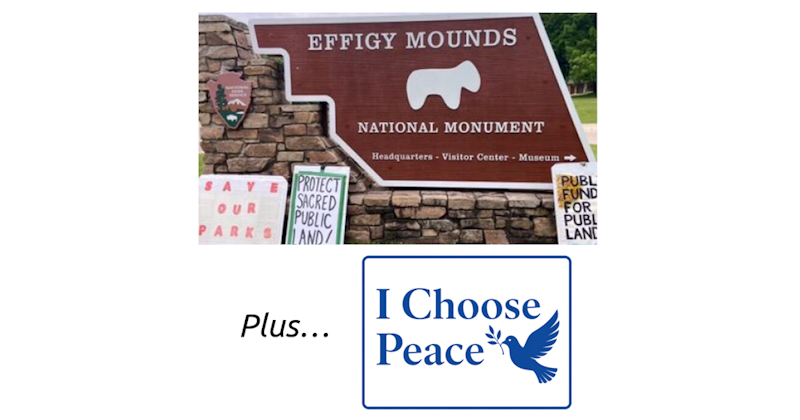
At Effigy Mounds National Monument in Iowa, for example, we gathered people who had been organizing locally for more than a year around threats to a public institution. We asked them not only to describe the harm, but to articulate what they hoped to preserve and build. In this sense, the hearings are both a listening infrastructure and a peacebuilding practice: they create a disciplined space for people with different experiences to construct a common account of what matters.
The larger ambition is to build a civic supply chain connecting lived experience to public memory and, ultimately, to community-informed lawmaking—strengthening democratic capacity by putting listening, voice, and memory back into the hands of the people.
If you’d like to organize a Local Impact Field Hearing, please connect with me on LinkedIn.
I Choose Peace: A Commitment Built Through Conflict
by Mónica Inés Espíndola
The Power of Three Words
“I choose peace.”
Three simple words. A statement of hope, a declaration of intention, and a way of expressing who we aspire to become. But perhaps these words carry a deeper challenge. What does it truly mean to choose peace?
Many people value peace, describing it as something desirable and necessary for individuals and communities to live together. However, choosing peace is not only about believing in it. It is about discovering what that choice requires from us when circumstances become difficult.
The words “I choose peace” become meaningful only when they ask something of us. As long as peace remains an aspiration, it is easy to embrace. But when conflict demands a response, those same words become a personal commitment. The question is no longer whether we value peace, but whether our choices continue to reflect that value when it becomes difficult.
Peace Beyond the Absence of Conflict
Peace is not simply something we hope for; it is something we continually build through our daily choices. Conflict is inseparable from human life, arising wherever people coexist, bringing along different needs, perspectives, experiences, and expectations.
Therefore, the goal of peace is not to create a world without disagreement. The deeper challenge is learning to navigate disagreement without losing sight of each other’s humanity.
The Moment of Choice
It is easy to choose peace when we feel respected, understood, safe, and when conversations are calm and perspectives are shared. But conflict changes everything. It tests not only our ideas, but also our identity, challenging how we see ourselves and how we see others.
When we are hurt, feel threatened, or believe confrontation is justified, that is when the choice truly begins. Conflict exposes the distance between what we believe and how we act. It confronts us with moments in which fear, anger, disappointment, or the desire to prevail can easily shape our response.
It is precisely in those moments that choosing peace becomes more than an ideal. It becomes a conscious decision about the kind of person we want to be. Peace is built in the moments when conflict gives us every reason to choose otherwise.
Peace as a Practice
Choosing peace does not mean denying pain, avoiding disagreement, or surrendering our values. It does not mean accepting injustice or ignoring harm. It means asking a deeper question: How can we respond to conflict without allowing conflict to define who we become?
Perhaps peace is not a quality that some people have and others do not, but rather a capacity that must be practiced. Every conflict presents a moment in which choices are possible. We can choose responses that deepen division, or we can remember that every person is more complex than the conflict in which we encounter them. This does not remove accountability or erase consequences; it recognizes that the way we respond helps shape the kind of world we create with others.
Every response to conflict leaves something behind. It can reinforce distrust and make future dialogue more difficult, or it can preserve respect and create conditions in which coexistence remains possible. The choice is rarely easy, but it is always significant because every interaction contributes to the future we are building together.
We build peace in ordinary human interactions:
- In conversations where we decide whether to listen or interrupt.
- In disagreements where we decide whether to understand or simply defend.
- In moments when we decide whether conflict will become a reason for permanent distance or an opportunity to choose a different path.
The Questions We Must Ask
Perhaps the question is not only: “Do I choose peace?” Most of us would answer yes. The deeper questions are: “What kind of peace am I building through the way I respond to conflict?” and “Will my choices build the peace I say I choose?”
These questions do not ask us to be perfect; they ask us to be aware. Because peace is not only something we desire, it is something we create. Every conflict gives us another opportunity to decide what kind of peace we are willing to build.
In the end, peace is the world we begin to create through the choices we make when conflict tests us.
Please Contribute Your Ideas To This Discussion!
In order to prevent bots, spammers, and other malicious content, we are asking contributors to send their contributions to us directly. If your idea is short, with simple formatting, you can put it directly in the contact box. However, the contact form does not allow attachments. So if you are contributing a longer article, with formatting beyond simple paragraphs, just send us a note using the contact box, and we'll respond via an email to which you can reply with your attachment. This is a bit of a hassle, we know, but it has kept our site (and our inbox) clean. And if you are wondering, we do publish essays that disagree with or are critical of us. We want a robust exchange of views.
About the MBI Newsletters
Two or three times a week, Guy and Heidi Burgess, the BI Directors, share some of our thoughts on political hyper-polarization and related topics. We also share essays from our colleagues and other contributors, and every week or so, we devote one newsletter to annotated links to outside readings that we found particularly useful relating to U.S. hyper-polarization, threats to peace (and actual violence) in other countries, and related topics of interest. Each Newsletter is posted on BI, and sent out by email through Substack to subscribers. You can sign up to receive your copy here and find the latest newsletter here or on our BI Newsletter page, which also provides access to all the past newsletters, going back to 2017.
NOTE! If you signed up for this Newsletter and don't see it in your inbox, it might be going to one of your other emails folder (such as promotions, social, or spam). Check there or search for beyondintractability@substack.com and if you still can't find it, first go to our Substack help page, and if that doesn't help, please contact us.
If you like what you read here, please ....





