

Harry Boyte -- Civic Organizing: Beyond Advocacy, Protest, and Community Organizing - Part 2
Newsletter # 480 - August 13, 2026

A couple of months ago, Harry Boyte responded to our posts on Courageous Citizenship and Government (this, this, and this) by observing that there is an important difference between advocacy and "public work" that we didn't clearly distinguish. We asked if he would be willing to write something for BI that explained that difference, and this is the second of what turned into two essays on that topic. The first essay described the concepts of "public work" and "civic organizing" and showed how they were different from advocacy, protest, and traditional community organizing.
For those who don't know Harry, he is a co-founder of the Institute for Public Life and Work at Augsburg University in Minneapolis, Minnesota, where he is now an Emeritus Senior Scholar. He founded and for 20 years directed and co-directed the Center for Democracy and Citizenship (CDC) at the University of Minnesota’s Humphrey School of Public Affairs (which moved to Augsburg in 2009). As a young man he worked in the citizenship schools sponsored by SCLC, Martin Luther King’s organization. Drawing on these experiences, he established the youth civic education initiative called Public Achievement, which now greatly informs his work with Braver Angels and its Civic Scholars Council, which he co-chairs.
Civic Organizing: Beyond Advocacy, Protest, and Community Organizing - Part 2
Addressing the Problem of Technocracy
by Harry C. Boyte
Putting experts and expertise on tap, not on top
The world is deluged with panaceas, formulas, proposed laws, machineries, ways out, and myriads of solutions. It is significant and tragic that almost every one of these proposed plans and alleged solutions deals with the structure of society, but none concerns the substance – the people. This, despite the eternal truth of the democratic faith that the solution always lies with the people. --Saul Alinsky, Reveille for Radicals 1946
Saul Alinsky here gave a vivid description of the way technocratic politics replaces “the democratic faith” with “myriads of solutions.” His alternative was drawn from the experiences of organizing the Back of the Yards organization in Chicago. Indeed, his first book, Reveille for Radicals, can be seen as a powerful statement of such organizing. For example, in his chapter on community traditions, Alinsky argues that the task of the organizer in any community is not to “convert” or divide along ideological lines. Rather, the organizer must engage in a deep process of listening to community values, traditions, mores, and habits. Community organizing, he said, is about bringing forth the democratic potentials that exist in any community.
I learned this democratic politics as a young man, working as a field secretary for the Southern Christian Leadership Conference (SCLC) from organizers like Dorothy Cotton, and Septima Clark, and Bayard Rustin who had been shaped by 1930s experiences. SCLC’s politics – full of alliance building and efforts to mine the symbols, images, and cultures of diverse democratic and religious traditions – was sharply different than the politics of caution typified by the NAACP, or the politics of polarization in the left wing of the movement.
The challenge today is to revive civic organizing skills, civic professional sensibilities, and the larger strategic framework of groups like SCLC and earlier movements and adapt these for a radically different age. There is no quick fix, but there are resources to build on.
In social theory, for instance, the concept of “social capital,” with its relational, communal associations has replaced an individualist and economic emphasis on “human capital.” In experimental psychology, new research emphasizes humans as unique agents of their own development. Thus, for instance, the late child development scientist Esther Thelen pioneered in developing a “grand unifying theory” of the field. Her approach was based on a relational, interactive, emergent understanding of complex systems and how to theorize them. In her view, the scientist herself is part of the equation. Theory grows not only from use of the scientific method, but also from a rich and interactive set of plural relationships, with “amateurs,” as well as other scientists. Thelen’s theory has challenged views of infants as passing through pre-determined “stages” of development to understanding infants to be experimental and self-realizing agents, profoundly relational and interactive with their context.
New theory challenges technocratic, one-size-fits-all interventions in development. The recent volume edited by Vijayendra Rao and Michael Walton, Culture and Public Action, drawn from UN and World Bank experiences around the world, is a case in point. Through case studies and cultural theory, contributors develop an overwhelming critique of technocratic and ideological approaches that have dominated development activities recently. They call for work that is respectful of, knowledgeable about, and skilled in negotiating local cultures in development literature and practice.
This shift is from “structural thinking” to relational “citizen thinking,” and from ideological politics to alliance-building politics. Structures and institutions are neither the solution to complex public problems, nor enemies. Rather, they need to be seen as resources with citizens at the center. Today’s categories like “conservative,” “liberal,” or “left” are most often counterproductive. We need detailed mappings, as Alinsky once put it, of what makes for “constructive democratic action” and what impedes or opposes such action.
The theory of public work and examples from Public Achievement spread across South Africa and then Africa after Marie Ström, Director of the democracy education efforts for the Institute for Democracy in South Africa, learned the framework as an international Humphrey Fellow from 2001-2002. She adapted Public Achievement and public work to the African context working with adults, where she witnessed striking shifts in how people understood themselves, each other, and democracy. In Burundi, where public work education was taken to villages, the adult educators with whom she worked spoke about the dramatic impact. Emmanuel Manwangu commented,
I was afraid that people at village level might get lost in the training, but even if it was a little challenging for them at the beginning, their minds were awakened and they very quickly came up to speed. Democracy started to become concrete for them—the power to take action on issues right where they live.”
Eusébie Nzorijana described a dramatic relocation of “politics” that decentered the concept and the practice:
At the beginning, some participants were uneasy about conducting interviews. ‘This is politics,’ they said. Later a participant said proudly, ‘I can do politics myself now!
Trainers reported remarkable change in themselves as well. Julienne Mukankusi said,
I had done research and training on democracy before this, but I had not lived it. Now I seen that a skilled citizen has more power than one can imagine.
Manwangu described shifts in the meanings of democracy and citizenship:
This course changes one’s understanding of democracy itself. Our language has changed. Citizens are at the center.
Addressing Teen Drinking Through Citizen Professionalism
Public work and citizen politics proved valuable to counter professional practice which uses mobilizing and advocacy approaches that predefine both problem and solutions. Indeed, complex problems, or “wicked problems,” are rarely discrete phenomena around which generic professional interventions can be mounted successfully. If one is attentive to overall community well-being, with a focus on organizing for culture change, “problems” come to be understood as interconnected. Lead poison in housing, for instance, may be tied to the jobs that require people to live in certain areas. Problems are also woven into the life of civic communities. They are different in every community, requiring distinctive approaches that take account of local cultures, with their unique histories, networks, capacities, and identities.
In Tomah, Wisconsin, in a collaborative project called Communities Mobilized for Change on Alcohol with the University of Minnesota’s department of epidemiology on teenage alcohol use, we found that a focus on public work transformed public health practices while developing new approaches to collaboration and public leadership development. The customary approach of public health, in which “evidence-based interventions” focus on policy change to deal with a particular health problem, shifted to strategies based on changing the civic culture.
To accomplish this shift, Jeanne Carls, the organizer in Tomah, created a strategy team with diverse groups and interests who had never worked together, and did not agree on the definition of “the problem.” Yet all agreed that something was wrong, after several teenage deaths in alcohol related incidents. Police, bar owners, merchants, church leaders, teenagers, parents, and public health professionals became involved. “You tell people that there are going to be many different people coming together who you may have thought would never be at the same table, but can see the need to work on the same issue,” Carls recounted. “It was like bringing lions to the table. People would sit across the table and never talk to each other directly, but they all had an interest in youth, and in Tomah.” Health care workers, city officials, and lay citizens worked to define what “the problem” entailed.
What emerged was a view of teenage alcohol use as inextricably tied to the civic culture of Tomah as a whole community. They realized that the annual festival, in which beer drinking was the central ritual for people of all ages, was both a symbol and wellspring of the town’s drinking culture. All were responsible for the “problem,” understood in this fashion. And many different groups would be required to change it. Such a change also entailed a shift in professional practices from one-way policy interventions to collaborative public work. “I bring some specific skills and knowledge, like how things are decided in city politics,” said Dave Berner, the city manager. “But many others make contributions as well.” Work on teen alcohol abuse resulted in Berner’s rethinking his job in far more civic ways.
Mike Huggins, on the city staff in Tomah at the time, later took the citizen professional approach in city management to Eau Claire, Wisconsin, up the river. The organization he catalyzed, “Clear Vision Eau Clair,” won national recognition as an outstanding example of citizen-led solutions, described in my co-authored book, Awakening Democracy through Public Work.
Translation
Other democratic organizers in modern times have seen the challenge similarly. As Isak Tranvik puts it, Vaclav Havel, a leader of the Czech freedom movement, drew on traditions of “honest and responsible work in widely different areas of life,” akin to public work. In Havel’s view, political institutions or ideology could not create a good society. “Life is something unfathomable, ever-changing, mysterious and every attempt to confine it within an artificial, abstract structure inevitably ends up homogenizing, regimenting, standardizing and destroying life.”
It is important to recognize the large obstacles to such perspectives in a world when state-centered theories of democracy and citizenship defined by formal political communities are overwhelmingly dominant, shaping the views of those labelled “citizens” and “noncitizens” alike. As the Swedish theorist Jonna Pettersson has observed, “The fields of critical human rights theory and cosmopolitan and multicultural citizenship theory [reproduce] the criteria for political subjectification [as] inclusion in the [formal political] community, leaving the political subject without any emancipatory power of its own.” Put differently, abstract theory focused on the state contributes to the segmentation and fragmentation of the civic field which David Eisner describes. (See also this and this.)
A state-centered view emphasizes the constitution as the fundamental question. A citizen-centered view emphasizes the constitution of a democratic people and the skills, habits, and mindsets which are essential as most important.
In 1939 John Dewey issued a challenge in this vein to those who believed that democracy rests on formal institutions. Beware, he said, of the “belief that [totalitarian] states rest only upon unmitigated coercion and intimidation.” As Melvin Rogers puts it,
For Dewey, democracy’s survival depends on a set of habits and dispositions – in short, a culture – to sustain it. Checks and balances do not have an agency of their own. A democracy is only as strong as the men and women who inhabit it.
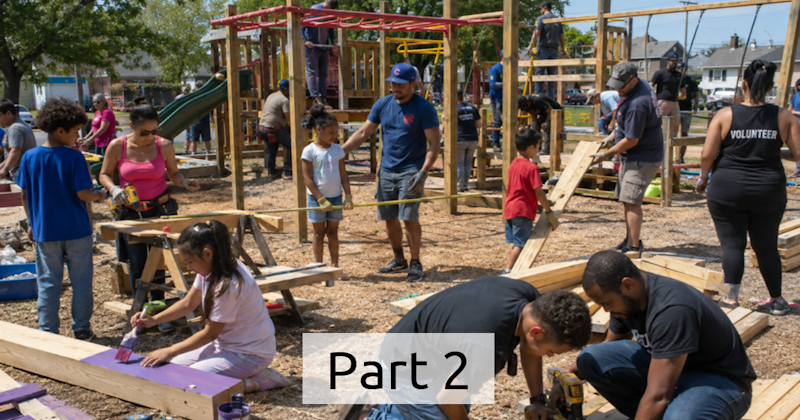
A citizen-centered view also asked the question, what larger goal can inspire and energize people with different ways of looking at problems and different ways of acting on them to work together. In St. Paul, building the playground was the aim. In Tomah, the challenge was the drinking culture.
In our time, there are many large challenges which can focus attention. Pope Leo’s new encyclical, Magnifica Humanitas, addresses dangers of AI and asks how such technologies be tools, not substitutes for human agency. He begins with the Biblical story of Nehemiah, the Old Testament leader who called the diverse people – 40 groups are named in the Bible – to work together on the challenge of rebuilding the walls of Jerusalem. As people rebuilt the walls, with Nehemiah joining in the work, they regrew their identity.
We need such stories to rebuild our democracy.
Lead Graphic Credit: ChatGPT created this.
Please Contribute Your Ideas To This Discussion!
In order to prevent bots, spammers, and other malicious content, we are asking contributors to send their contributions to us directly. If your idea is short, with simple formatting, you can put it directly in the contact box. However, the contact form does not allow attachments. So if you are contributing a longer article, with formatting beyond simple paragraphs, just send us a note using the contact box, and we'll respond via an email to which you can reply with your attachment. This is a bit of a hassle, we know, but it has kept our site (and our inbox) clean. And if you are wondering, we do publish essays that disagree with or are critical of us. We want a robust exchange of views.
About the MBI Newsletters
Two or three times a week, Guy and Heidi Burgess, the BI Directors, share some of our thoughts on political hyper-polarization and related topics. We also share essays from our colleagues and other contributors, and every week or so, we devote one newsletter to annotated links to outside readings that we found particularly useful relating to U.S. hyper-polarization, threats to peace (and actual violence) in other countries, and related topics of interest. Each Newsletter is posted on BI, and sent out by email through Substack to subscribers. You can sign up to receive your copy here and find the latest newsletter here or on our BI Newsletter page, which also provides access to all the past newsletters, going back to 2017.
NOTE! If you signed up for this Newsletter and don't see it in your inbox, it might be going to one of your other emails folder (such as promotions, social, or spam). Check there or search for beyondintractability@substack.com and if you still can't find it, first go to our Substack help page, and if that doesn't help, please contact us.
If you like what you read here, please ....





