

Oluwagbemiga Dasylva -- Before Institutions Fail: Civic Fragmentation as an Early Warning of Hyper-Polarization
Newsletter # 477 - August 3, 2026

Gbemiga Dasylva is is a governance analyst and civic researcher whose work examines how institutional erosion, polarization, and civic fragmentation reshape public life and what it takes to rebuild legitimacy. His research has included work with communities in the United States, sub-Saharan Africa, and the Horn of Africa, applied to governance reform, peacebuilding, and civic resilience. He holds a Ph.D. in Peace Studies and Conflict Resolution from George Mason University’s Carter School.. He also has his own substack: gbemigadasylva.substack.com which has more articles on related issues.
Gbemiga sent us this article in mid-July, asking whether we would be interested in publishing it. As you will see, it is on themes we have been covering extensively, and adds an interesting (and sobering) comparison of the United States and West Africa, both of which have been suffering from hyper-polarization. We thought his paper was worth sharing, so, here it is.
Before Institutions Fail: Civic Fragmentation as an Early Warning of Hyper-Polarization
by Oluwagbemiga Dasylva
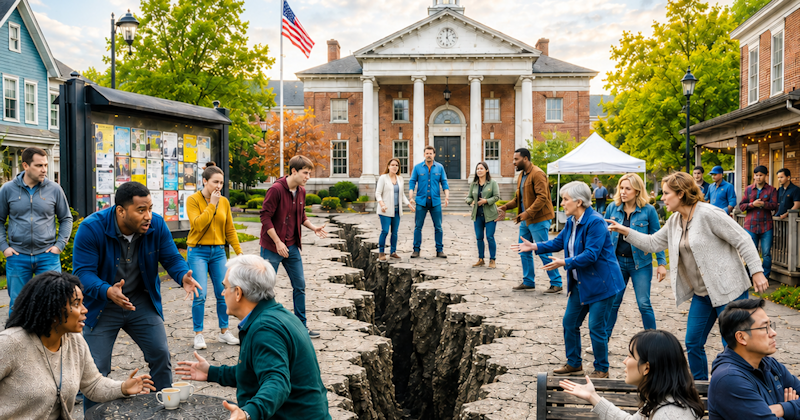
Around the world, we tend to notice democratic decline once it reaches formal politics. Elections lose legitimacy, legislatures become dysfunctional, constitutional rules are manipulated, and public trust collapses. Hyper-polarization may already be visible by then, but even polarization is often treated as the starting point, as a problem of attitudes and beliefs, rather than a symptom of civic culture that has been weakening for years.
Democratic institutions may begin losing their foundations before their formal breakdown is evident. The earlier warning signs may appear in the civic conditions that make self-government possible. Building on Beyond Intractability’s framing of hyper-polarization as a complex, self-reinforcing conflict system, this essay adds a community-level diagnostic. It asks what happens locally before that system hardens nationally. My argument is that civic fragmentation may be one of the conditions that allows polarization to harden.
The Pattern
Across very different contexts, I have encountered a recurring dynamic. Civic fragmentation may first appear as grievance without shared language, organizations working in parallel, and people transferring responsibility to leaders and institutions for problems they no longer believe they can address together. By the time we can point to a stolen election, a captured legislature, or a purged court, the civic foundations beneath democratic life may have been weakening for years.
Institutions and civic life shape one another. Douglass North described institutions as the “rules of the game”: structures that shape incentives and, over time, influence behavior and expectations. That insight matters. But the causal relationship also runs in the other direction. Relationships, norms, and civic practices help determine whether institutions can function legitimately and effectively in the first place.
Tocqueville described the associational habits through which citizens learned to act together without waiting for a central authority. Putnam later argued that similar institutional designs produced different results partly because they rested on different traditions of horizontal civic association. North, Tocqueville, and Putnam approach the question differently, but they point toward a common insight: democratic institutions cannot sustain themselves indefinitely without the civic habits on which they depend.
What Communities Taught Me
The pattern is not abstract. The American experiment was never sustained by institutions alone. It has always depended on what people are willing and able to do with one another in the places they share. Democracy is not only a constitutional arrangement or an act performed at the ballot box. It is a practice people learn by deciding what matters, listening across differences, making decisions, taking responsibility, and staying involved long enough to see what those decisions set in motion. This is how democratic strength is built: not in the absence of conflict, but in a community’s capacity to address conflict without losing the relationships, common purpose and sense of possibility needed to move forward.
The reforms that widened American democracy were often built civically before they were secured institutionally. People came together around shared aspirations. They formed associations, developed leaders, organized, modeled alternatives, and created examples that others could recognize and join. Institutions eventually responded, but the public will that made change possible was built first among people. A country can inherit institutions. It cannot inherit indefinitely the habits of self-government. Each generation must practice them again.
Civic erosion begins when that sense of ownership disappears from public life. In communities across the country people could readily describe what was wrong. They could also articulate the future they wanted for their children, their neighborhoods, and the places they called home. But they did not always have trusted ways to find one another, develop a common language for those aspirations, and decide what they were prepared to act on. (Harwood et al., 2024)
Organizations were active, but much of their work remained parallel (Harwood & Conroy, 2024). Leaders kept showing up, yet responsibility continued to circulate through separate networks and familiar circles. The same people carried the load, while many others remained on the edge of public life - concerned, observant, and unsure where or how to enter. That was not apathy. The civic will was there. What was missing was a shared pathway for acting together.
When those practices weaken, people begin to outsource their agency. They wait for elected leaders to produce a different future, then direct their frustration at those leaders when the future they envisioned does not arrive. Leaders must be held accountable - but accusation alone is not a civic strategy, and a different politics will not emerge simply because citizens demand better leaders. It also depends on whether communities begin modeling a different kind of public life.
A different kind of public life can be built. It often starts small: a youth program people want to keep alive, a dangerous road residents want fixed, a public space neighbors want reclaimed. Residents gather across familiar lines, choose one achievable step, act on it, and stay with the work long enough to see what changes. None of these wins solves everything, but each gives people something they can point to - proof that collective effort can still change conditions. That proof is what restores civic faith: the belief that people can act together and shape the places where they live.
What West Africa Reveals Under Greater Pressure
The comparison is not one of equivalence. A U.S. county and a Sahelian state face radically different pressures. But the higher-stakes cases in West Africa help reveal what can happen when prolonged insecurity and declining institutional legitimacy coexist with few credible channels through which citizens can exercise agency between elections.
The clearest case is Mali. Before the military seized power in August 2020, citizens had already spent months protesting disputed elections, corruption, deteriorating security, and the government’s inability to respond. The coup did not create that crisis of legitimacy. It entered a political environment in which many citizens had already lost confidence that the existing civilian order could act on their behalf. Visible public support for the overthrow suggested that some citizens experienced it not primarily as the loss of a democratic order worth defending, but as the removal of a government they believed had ceased to work.
That is what West Africa reveals under greater pressure. When people no longer believe civilian institutions can respond, and civic and political organizations have not built durable ways for them to act together between elections, public hope can migrate toward an actor that appears capable of decisive action. Military intervention may then be experienced not only as a constitutional rupture, but as a transfer of hope. People do not necessarily stop wanting accountable government. A coup is not the inevitable endpoint of civic erosion, but it can expose how far the connection between public will, collective action, and constitutional authority has already weakened.
The comparison does not show that civic fragmentation inevitably leads to military rule. It shows how prolonged institutional failure can become more dangerous when citizens lack durable civic and political channels through which to organize their will, demand accountability, and act between elections.
What National Measures Cannot See from the Ground
Existing democracy indices, including Freedom House and V-Dem, are indispensable for macro-level analysis. They capture important dimensions of participation, association, rights, and institutional performance. What they are less equipped to capture is how civic life actually functions inside communities: whether people can find one another, recognize a shared purpose, organize their will, and see that collective action can change something.
Bermeo’s analysis of contemporary democratic backsliding shows how decline increasingly proceeds through executive aggrandizement and manipulation from within formal institutions rather than through their immediate destruction. Institutions can therefore appear procedurally intact even as their democratic substance weakens.
But this leaves a vital upstream question: why do these legal and executive manipulations sometimes encounter so little organized public resistance? Part of the answer may lie in the civic ecosystem. When horizontal trust and shared agency have already fractured, the public’s capacity to coordinate in defense of democratic institutions weakens.
Institutions rarely weaken in isolation. Their deterioration may follow or accompany the fragmentation of trust, relationships, norms, and public practices on which they depend. An early-warning system built on that premise would not track only what the state is doing. It would also examine whether civic relationships, shared language, leadership pathways, and experiences of agency are expanding or contracting.
The issue is not simply whether fragmentation exists; every community contains divisions. The more revealing question is whether people are becoming more or less capable of working across those divisions over time.
If civic fragmentation is an upstream condition of hyper-polarization, some of the earliest warning signs may be found not in election results or national opinion surveys, but in the ordinary organization of community life.
Are residents able to describe what they want together, or only what separate groups oppose? Are organizations connected around shared aspirations, or working through parallel networks? Is public responsibility widening, or are the same people carrying the civic load? Can residents point to examples where collective action changed a real condition? Are there recurring places where people work through disagreement before it becomes a crisis? None of these conditions on its own predicts democratic breakdown. Taken together, however, they reveal whether a community still possesses the relationships, shared language, and sense of agency needed to address conflict constructively.
What This Changes About Intervention
For practitioners, then, the question is not only whether opposing groups are willing to talk. It is whether the community is rebuilding the capacity to act, learn, and remain in relationship after the conversation ends.
Dialogue remains important, but that alone cannot repair a civic culture in which people no longer experience themselves as capable of shaping public life. The work is to help communities move from expression to shared public work and through that work, build repeated experiences of shared agency: finding one another, naming an aspiration they hold in common, working through real differences, acting on something concrete, and making the result visible.
Small wins matter for this reason. A changed school practice, a safer road, a reclaimed public space, or a budget decision shaped by organized residents does more than solve one problem. It gives people evidence that public action organized around a common aspiration can change something. That evidence becomes a civic resource others can recognize and build upon.
Hyper-polarization becomes harder to interrupt when people lose the experience of working together and seeing tangible results. When civic life thins out, politics starts doing too much work. It gives people a place to belong, a language for their frustration, someone to blame, and a sense of power. Grievances that communities have not worked through together get pulled into partisan conflict.
The answer is not to retreat from politics. It is to stop treating politics as the only place where public life happens. A healthier politics becomes possible when people have practiced a different kind of public life first: seeing one another clearly, working through disagreement, acting on shared concerns, and proving that collective effort can change conditions.
This is the civic layer that early-warning systems must also examine: not only whether an election has been stolen or polarization has hardened, but whether people, in the places where they live, are still practicing the habits that make self-government possible.
Hyper-polarization and institutional failure are not identical. But both can reflect the same deeper problem: people losing the capacity to work through conflict, exercise agency, and shape public life together.
———————
References
Bermeo, N. (2016). On democratic backsliding. Journal of Democracy, 27(1), 5–19
Beyond Intractability. (n.d.). Constructive Conflict Initiative framing papers. https://www.beyondintractability.org/constructive-conflict-initiative-framing-papers
Freedom House. (n.d.). Freedom in the World.
Harwood, R. C., & Conroy, J. P. (2024). Building a Better Owensboro: A New Path Forward for Owensboro-Daviess County. The Harwood Institute for Public Innovation and Greater Owensboro Leadership Institute.
Harwood, R. C., Conroy, J. P., Prihoda, M., & Dasylva, O. (2024). DeSoto County Coming Together: Unleashing the Community’s Potential. The Harwood Institute for Public Innovation and The Patterson Foundation
North, D. C. (1990). Institutions, institutional change and economic performance. Cambridge University Press.
Putnam, R. D., Leonardi, R., & Nanetti, R. Y. (1993). Making democracy work: Civic traditions in modern Italy. Princeton University Press
Tocqueville, A. de. (2000). Democracy in America (H. C. Mansfield & D. Winthrop, Trans. & Eds.). University of Chicago Press.
V-Dem Institute. (n.d.). The V-Dem dataset.
Lead Graphic Credit: ChatGPT
Please Contribute Your Ideas To This Discussion!
In order to prevent bots, spammers, and other malicious content, we are asking contributors to send their contributions to us directly. If your idea is short, with simple formatting, you can put it directly in the contact box. However, the contact form does not allow attachments. So if you are contributing a longer article, with formatting beyond simple paragraphs, just send us a note using the contact box, and we'll respond via an email to which you can reply with your attachment. This is a bit of a hassle, we know, but it has kept our site (and our inbox) clean. And if you are wondering, we do publish essays that disagree with or are critical of us. We want a robust exchange of views.
About the MBI Newsletters
Two or three times a week, Guy and Heidi Burgess, the BI Directors, share some of our thoughts on political hyper-polarization and related topics. We also share essays from our colleagues and other contributors, and every week or so, we devote one newsletter to annotated links to outside readings that we found particularly useful relating to U.S. hyper-polarization, threats to peace (and actual violence) in other countries, and related topics of interest. Each Newsletter is posted on BI, and sent out by email through Substack to subscribers. You can sign up to receive your copy here and find the latest newsletter here or on our BI Newsletter page, which also provides access to all the past newsletters, going back to 2017.
NOTE! If you signed up for this Newsletter and don't see it in your inbox, it might be going to one of your other emails folder (such as promotions, social, or spam). Check there or search for beyondintractability@substack.com and if you still can't find it, first go to our Substack help page, and if that doesn't help, please contact us.
If you like what you read here, please ....





