

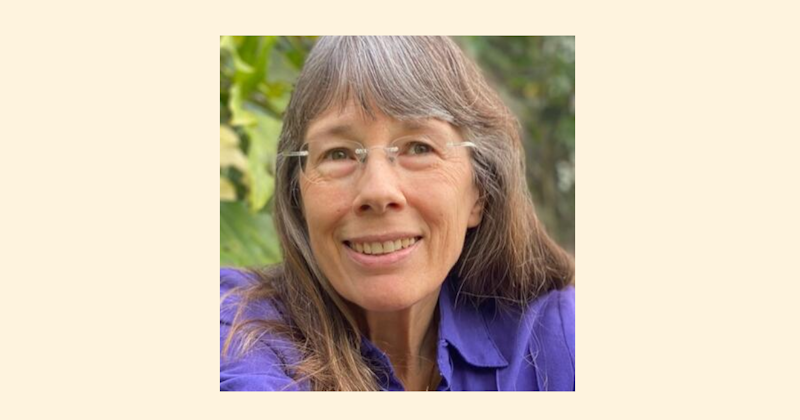
Joan Blades, Co-Founder of Living Room Conversations on the Value of Bridging
Newsletter # 427 - February 23, 2026

Heidi Burgess and Guy Burgess
Joan co-founded MoveOn with her husband in 1998.
[MoveOn started as] a one-sentence petition midway in the Clinton impeachment scandal. "Congress must immediately censure the president and move on to pressing issues facing the nation." You could love Clinton or you could hate Clinton, and you could agree that that was what was best for the nation. And it went viral in '98 when we sent it to under 100 of our friends and family. Within a week, we had 100,000 people. That was unheard of at that time. This was very early. And that's how I got into politics.
I noted that going from 100 to 100,000 in a week, before social media was "a thing," was quite remarkable. Joan explained:
We were six months into it. Everybody was sick to death of hearing about Monica Lewinski and Clinton. Everybody thought it was just not acceptable. But it was also clear that it was political theater. He wasn't going to be removed from office. So censure him and then move on to pressing issues facing the nation. We believed, at that time, that our Congress had a very important job to do. ...And we thought they still could do it back then. It was very exciting. We believed they'd get back to work. So that's how I got into this. On the initial MoveOn petition, we had Democrats, Republicans, independents, Green Party, you name it. This was a gathering place where a lot of people could agree.
After an election where we'd gotten millions of people to engage and get political for the first time in their lives, and pundits agreed that impeachment was unpopular, the House voted to impeach two weeks later. ...But it felt irresponsible to walk away at that point. ...
As soon as you get involved in elections, that's an adversarial process. And I live in Berkeley. It is a natural place for me to be a progressive. That was okay, though my passion lies in finding that place where people can work together, because the concept of power-with is so much stronger than power-over. Power-over, you win a battle. But there's always the back and forth that is just this incredible long-term drain. We need to be in relationship to be able to succeed.
MoveOn's next viral moment was actually another time when there was broad agreement. It was the "Let the Inspections Work Campaign" leading up to the Iraq war. [The campaign was designed to oppose a preemptive U.S. military strike against Iraq and instead support the efforts of UN weapons inspectors, led by Hans Blix, who were searching for weapons of mass destruction (WMDs).] There was an around-the-world vigil that had the New York Times reporting that perhaps there were still two superpowers, the US and world public opinion. It still breaks my heart that that campaign did not succeed [because George W. Bush initiated a preemptive strike on Iraq anyway.]
But that is where I think we should be able to succeed —when we are aligned with each other and tapping into each other's best values.
Joan then founded another advocacy organization, MomsRising, to advocate for mothers who were traditionally being discriminated against in terms of hiring, wages, and advancement.
She also get very concerned about climate change. Why, she wondered, aren't conservatives concerned about climate change too?
I live in Berkeley. I had to be very intentional about this. I was part of a group called Reuniting America that brought together leaders from across the political spectrum. And it was really informative. I had a lot more understanding, and I made friends with people who see things very differently than me. It was a good experience. No, they didn't totally change their minds about things, nor did I totally change mine. But we found some things we could work on together. And I understood the obstacles better.
By 2008, it was harder to have a conversation about climate with someone on the right, which was actually the inspiration for the Living Room Conversations. Because I deeply believe that the grassroots are the most important. They are the foundation upon which our leaders stand. And we have to create the space where they can lead. FDR was famous for saying, "You've convinced me. Now make me do it," or something close to that. That's what we've got to do, right? It's up to us, ultimately. We have more power than we realize.
I wanted everybody to be able to have conversations with people that didn't see things the same way. I worked with conservative and independent partners that are experts in dialogue to put together a simple format where people can have an intimate conversation with four to six people on a topic that is polarized. I rapidly learned that you could have a conversation about energy and the environment, not energy and climate, because the people who don't believe in climate won't come to that [second] conversation.
As time progressed, though, I came to understand that it doesn't matter that much what people talk about, so long as they are gaining connection and affection for each other.
I asked Joan how they get people to come to these conversations when most people are afraid of talking to people who think differently than they do. We've all been burned in the past by toxic conversations, I observed, so most people try to avoid such conversations if at all possible. Joan responded:
There's a beautiful thing about intentionality. The Living Room Conversations start with a set of conversation agreements about respect and listening, being curious, taking turns. Basically, everything you learned in kindergarten. And people know how to do that.
We have seen so much bad conflict. That's what the media focuses on. When we think about conflict in our families, we think about the bad conflict ,more often than not. But workplaces know that conflict is human and that when you have good conflict, when you have conflict that's healthy, you have better decisions, you have better relationships, you have a much stronger organization.
Healthy conflict is something we're not focused on, because our brains go to the fear and shock and all the things that send us to anger. But the reality is that conflict is human, and it's great when we do it in a way that's healthy. One of my favorite conversation guides, in fact, is on healthy conflict because getting to sit with four or five other people and talk about your experiences with healthy conflict reminds us all in a really deep way that we have choices. We can do this in a way that doesn't take us into that more destructive area. Now, we've had a lot of bad role models out there, and we still do. But we can make choices.
When I asked Joan if it was easy to convince people of that, she said, "Heck no!" But she then pointed out that lots of organizations are helping to do that—libraries and faith communities, for example.
Libraries have had to redefine themselves over the last 20 years, right? They're community places. And so we have lots of libraries that have monthly Living Room Conversations. And the patrons often help them decide which topic. We have over 150 topics. Faith communities are another example. Faith communities, are trying to stay together, and some of them are in areas where there are really significant political differences between their congregants.
She shared stories about particular communities and faith organizations which have been very successful at holding living room conversations, and how beneficial it has been to the participants. "It causes us to be more humble about our own viewpoint and appreciative that others might see things differently."
All of Living Room Conversations Guides are free, although you need to sign up to get some of them (signing up is also free). If you are a large organization and want to hold a large conversation, LRC offers a license, which comes with training on how to do conversations with large groups. Training is not needed, Joan said, for actual living room conversations with just a few people...that's easy, if you follow the guide. "And actually, it's a fun thing to do," she observed. She talked about a conversation that she had with a co-founder of the Tea Party Patriots—which was a really fun conversation for her.
I learned so much in that conversation with Mark and his friends. And we all did together. We found we were in complete agreement about three very important aspects of criminal justice reform, which gave us a platform on which to speak together in some contexts ——about too many people in prison, the war on drugs, it's not a success, we've got to use evidence-based practices.
There's so much common-sense action that we don't take because of our divisions. It's going to be such a gift to us all, if we figure out how to work on the things we agree on, because we're not doing that right now.
Living Room Conversation guides can be used face-to-face or with video chats, such as Zoom.
It's different when it's done on Zoom. It's not a community project you're probably going to be working on. But if it's technology and relationships, it's very appropriate. And there's so many good conversations to have. It takes you deeper than you probably would go otherwise. And it's a way to get to know people that you're already close to in a more meaningful way, depending on the topic you choose. ...
Who do you miss that you don't get to talk to all the time? There was one mom here in the Bay Area whose mother was in another state during COVID and her nephews were in yet another place. And she hosted zoom-based living room conversations with her mom, her mom's friends, and her nephews for a year or more. And her mother was like, "When can we do it again?" And she feels like she got to take care of her mother and get to know her nephews in a way she never would have, if she hadn't done that. So you can make it a way to stay in touch with people that you want to be in touch with.
I observed that this seems like a great way to start overcoming the loneliness epidemic that we're hearing so much about. And it might also be a way to help people feel less hopeless and impotent. Guy and I used to be often asked "what can I do?" We don't hear that nearly as much anymore — instead we hear "I feel so impotent. The world is going to hell, and there is nothing I can do." We all feel like victims, and all we can do is watch everything disintegrate. I wondered if holding a living room conversation can help give people a sense of hope, of agency. Joan replied:
The good news is most people do have some community. ...
We have over 150 guides. One of them is hope. So as one piece of advice, go on our website—LivingRoomconversations.org. Find yourself a conversation guide that interests you. Find a few people to have this conversation with. Ideally, people with different points of view, but you could start easy and just go with friends.
One of the best things to do is co-host if you want different viewpoints. Then you get to meet a couple of people, and they get to meet a couple of people. What is an issue that is really close to your heart? What does someone else want to talk about as well?
We also talked about LRC's work trying to assure trustworthy and trusted elections, which I noted were slightly different things. Joan replied:
They are very different. We've had a campaign against trust in this country for a number of years now. And it's far easier to break trust than it is to build trust. So we've got serious work to do. The good news is trustworthy elections is a shared goal for almost everybody. There are some malignant forces that are trying to undermine elections. But citizens want trustworthy elections across the political spectrum.
Do they define that in the same way, I asked?
The interesting thing is that, I think, in general, they do define it in the same way if you look at the Braver Angels' three principles: (voting should be easy/cheating should be hard; every person should have an equal say in who governs them; and candidates must accept losing). But they're fearful of different ways of cheating. There's this story on the right about how the left cheats and a story on the left about how the right cheats. We need to address both those stories.
One of the very best ways to address those stories is to go local and to really understand our local election processes. Because we have local control and power. And we want everybody to have local pride.
We can see this train coming. We need to step up right now and make sure it stays on the tracks. I do not want to be in November going, "Oh, we should have done something." We know the left and the right are hearing these stories about how the election is going to be stolen. We need to make sure that every community says, "We're going to do it right, and this is how it's done." And most people have more trust in their local elections than they do nationally.
We can do this in tens of thousands of communities so they can say, "We do it well here." And they can get to know each other better, making sure that they know their local practices. And if they have anything they think is less than perfect, they can try and make it better. All human endeavors are flawed, but they shouldn't be very flawed. And the beautiful thing is we also know that we can connect people across the country.
Joan talked about a national conversation on political violence as a model:
With AllSides and Newsweek, we had over 600 people have a conversation about Political Violence and the Community, a Living Room Conversation. And people were mismatched around the country. And then there was an analysis done where everyone's identity was not in it, but it showed what people talked about. It's amazing what we can do with technology now.
So [similarly, with the trustworthy election topic] we can have a community in rural Kentucky talking to a community in New York or California or wherever, by video, after they've done their local [election] work and they're going, "We're good." And that human connection, when they talk to each other, is so important. It can be just six people or it can be 600 people from those communities. Then we can talk to each other and we can say, "This is how we're doing. This is why we feel good about it." And if there are any concerns, we can attempt to address them. But we must address those now, not in November. We've got months and months to do the right thing.
Near the end of our conversation, I circled back to the topic I had been wondering about from the beginning. Did Joan get pushback from her progressive friends and colleagues when she started to do the cross- or transpartisan work? Was she accused of "fiddling while Rome burns," as David Beckemeyer has put it, and both he and we have written about (and are about to publish a lot more on that topic.). I found Joan's answer to be particularly perceptive and compelling:
I'm still on the board of MomsRising, and I'm proud to be a progressive. I'm going to vote for people that represent my values. We still fight the fight when it comes to the election. But if we're not doing peacebuilding at the same time— I've been seeing this wrecking ball go back and forth now for decades. We do not win the long-term battle. In the long-term, we don't ever have peace. I'm a climate person. This is insane what's happening. We are now at a point where I just want to have an energy conversation because clean renewable energy is actually much more affordable than oil and gas. But to be restoring coal — it's pure partisan craziness in my mind.
I don't want to be playing this game of power over, so I'm not going to make you feel horrible. I want it to be understanding that we have to figure this out together. The power-with versus power-over is such an important concept. And to think you can only do one — and not be working on the peacebuilding at the same time — is missing the long view. We have to think long-term as well as short-term.
To read more about how Joan, Living Room Conversations, and partner organizations, do that, please go to our full discussion.
Please Contribute Your Ideas To This Discussion!
In order to prevent bots, spammers, and other malicious content, we are asking contributors to send their contributions to us directly. If your idea is short, with simple formatting, you can put it directly in the contact box. However, the contact form does not allow attachments. So if you are contributing a longer article, with formatting beyond simple paragraphs, just send us a note using the contact box, and we'll respond via an email to which you can reply with your attachment. This is a bit of a hassle, we know, but it has kept our site (and our inbox) clean. And if you are wondering, we do publish essays that disagree with or are critical of us. We want a robust exchange of views.
About the MBI Newsletters
Two or three times a week, Guy and Heidi Burgess, the BI Directors, share some of our thoughts on political hyper-polarization and related topics. We also share essays from our colleagues and other contributors, and every week or so, we devote one newsletter to annotated links to outside readings that we found particularly useful relating to U.S. hyper-polarization, threats to peace (and actual violence) in other countries, and related topics of interest. Each Newsletter is posted on BI, and sent out by email through Substack to subscribers. You can sign up to receive your copy here and find the latest newsletter here or on our BI Newsletter page, which also provides access to all the past newsletters, going back to 2017.
NOTE! If you signed up for this Newsletter and don't see it in your inbox, it might be going to one of your other emails folder (such as promotions, social, or spam). Check there or search for beyondintractability@substack.com and if you still can't find it, first go to our Substack help page, and if that doesn't help, please contact us.
If you like what you read here, please ....





