
Frames, Framing and Reframing
By
Sanda Kaufman
Michael Elliott
Deborah Shmueli
Original Publication September 2003, updated in June, 2013 and again in June, 2017 by Heidi Burgess

What Frames Are
|
|


Frames are cognitive shortcuts that people use to help make sense of complex information. Frames help us to interpret the world around us and represent that world to others. They help us organize complex phenomena into coherent, understandable categories. When we label a phenomenon, we give meaning to some aspects of what is observed, while discounting other aspects because they appear irrelevant or counter-intuitive. Thus, frames provide meaning through selective simplification, by filtering people's perceptions and providing them with a field of vision for a problem.
Frames can significantly affect the intractability of a conflict by creating mutually incompatible interpretations of events. Because frames are built upon underlying structures of beliefs, values, and experiences, disputants often construct frames that differ in significant ways. A simple example is attitudes towards abortion in the US. "Pro-life" advocates believe abortion is murder of an innocent, unborn child which has as much right to live as anyone else--thus they see the fetus as a person, and abortion as a willful act that murders a person. "Pro-choice" advocates, however, do not see the fetus as a "person" with human rights--not until it becomes "viable" outside the womb, at any rate. Before then, they focus on the rights of the mother, asserting that she should have ultimate control and "choice" about her medical decisions and what happens to her body.
Frames often exist prior to conscious processing of information for decision-making[1] and affect subsequent individual decisions.[2] Thus, disputants are separated not only by differences in interests, beliefs, and values, but also in how they perceive and understand the world, both at a conscious and pre-conscious level.[3]
Framing involves both the construction of interpretive frames and their representation to others. Disputants may use framing not only as an aid to interpreting events, but also to promote strategic advantage.[4] Framing can be useful for rationalizing self-interest, convincing a broader audience, building coalitions, or lending preferentiality to specific outcomes. As such, many factors affect how people frame a conflict, which, in turn, influences the direction the conflict takes.[5]
This essay explores the nature of frames and the framing process. It seeks to
- clarify the basic concepts,
- present an overview of what is known about frames and framing and their impact on conflict dynamics,
- explore the forms of framing that are most significant to intractable conflicts,
- examine the potential for reframing and frame changes as part of a process of reconciliation or conflict resolution, and
- direct the reader to other web- and print-based resources that can provide more detail.
Definitions
Differing conceptual frames held by the parties involved in a dispute form the basis on which they act. Each party to a conflict has its own perception and understanding of their agenda, the relevance of various issues, their priorities, and the opportunities and risks involved with different choices. This assemblage of factors can be considered as a set of lenses, or filters, through which the various parties view the conflict, and is called the frame or conceptual frame.
In the English language, the word "frame" can be used both as a verb (to frame) or as a noun (a frame). As a noun, frame denotes the boundary within which the whole picture is displayed (similar to a frame placed around a picture or painting), and is used as a tool for interpreting and understanding the perceptions and underlying objectives of the various actors in the conflict. As a verb, framing refers to the creation of frames, either from a simple reading of the situation or through a deliberative, analytic, or strategic process.
The concept of frames has been developed as a tool for analysis in various fields, including psychology and sociology,[6] business management,[7] artificial intelligence,[8] decision-making,[9] negotiation,[10] and environmental conflict management.[11] Relevant to understanding intractable conflict are definitions given by such scholars as Minsky,[12] Tannen,[13] and Gray,[14] for whom frames are "cognitive structures held in memory and used to guide interpretation of new experience." Furthermore, "parties rely on these mental structures to interpret or make sense of ongoing events."[15] Frames are also defined as "collections of perceptions and thoughts that people use to define a situation, organize information, and determine what is important and what is not."[16] We create frames to name a situation in which we find ourselves, to identify and interpret specific aspects that seem key to us in understanding the situation, and to communicate that interpretation to others.[17]
| "A riot is at bottom the language of the unheard." -- Martin Luther King, Jr., American civil rights leader, 1967 "[Rioters] are lawbreakers, destroyers of constitutional rights and liberties and ultimately destroyers of a free America." -- Lyndon B. Johnson, American president, 1965 |
Why are Frames Important?
An essential element in conflict resolution is an understanding of how frames affect conflict development. In the context of a conflict, we create frames to help us understand why the conflict exists, what actions are important to the conflict, why the parties act as they do, and how we should act in response.[18] During the evolution of a conflict, frames act as sieves through which information is gathered and analyzed, positions are determined (including priorities, means, and solutions), and action plans developed. Depending on the context, frames may be used to conceptualize and interpret, or to manipulate and convince.
Putnam and Holmer[19] hold that framing and reframing are vital to the negotiation process and are tied to information processing, message patterns, linguistic cues, and socially constructed meanings. Knowing what types of frames are in use and how they are constructed allows one to draw conclusions about how they affect the development of a conflict, and can be used to influence it. Thus, analyzing the frames people use in a given conflict provides fresh insight and better understanding of the conflict dynamics and development. With such insight, and with the help of reframing, stakeholders may find new ways to reach agreements.
The Sources and Forms of Frames
Many factors influence frames and their formation. Intractable disputes are usually associated with a complex and reinforcing set of frames about oneself, the "others," risks, what information should apply to the situation, and how decisions should be made. The frames of most importance to intractability usually include identity, characterization, power, conflict management/process, risk/information, and loss versus gain. Their forms and most common sources are as follows:
|
|

- Identity frames: Disputants view themselves as having particular identities in the context of specific conflict situations.[20] These identities spring from the individuals' self-conception and group affiliations. One might frame oneself as a Hutu or a Tutsi, a Muslim or a Christian, a man or a woman, or a Republican or Democrat. The more central the challenge to one's sense of self, the more oppositional one is likely to act. Typical responses to threats to identity include ignoring information and perspectives that threaten the core identity, reinforcing affiliations with like-minded individuals and groups, and negatively characterizing outsiders.
- Characterization frames: Disputants view others in the conflict as having particular characteristics. Closely related to stereotyping, characterization frames may be either positive or negative. Parties to intractable conflicts often construct characterization frames for others that significantly differ from how the other parties view themselves. Such characterizations often undermine the others' legitimacy, cast doubt on their motivations, or exploit their sensitivity. For example, many Americans characterize Al Queda as "terrorists," yet they most certainly do not see themselves that way. Rather, they see themselves as freedom-fighters, or jihadi warriors fighting for the protection of Islam. Characterization frames are also often linked to identity frames, serving to strengthen one's own identity while justifying your actions toward the other (e.g., for me to be a liberator, my opponent must be an oppressor).
- Power frames: Because intractable conflicts are often imbedded in struggles to alter existing institutions or decision-making procedures, disputants' conceptions of power and social control play a significant role in conflict dynamics. Power frames help the disputant determine not only which forms of power are legitimate (e.g., governmental, legal, civil disobedience) but also the forms of power that are likely to advance one's own position (e.g., authority, resources, expertise, coalition-building, threat, voice). For instance, some people may see money as the best way to "buy influence," while other people might rely more on technical expertise or personal charisma to sway people's views..
- Conflict management or process frames: Conflict over how best to manage or resolve differences is central to many intractable disputes. Depending on disputants' identity, characterization of other disputants, perceived power, and perception of the available options, conflict frames may impel parties to seek very different remedies in response to common problems. These remedies may range from actions as disparate as violence, civil disobedience, litigation, and negotiation. Because of the wide complexity of possible actions and the uncertainty of their consequences, groups with shared interests and values may draw significantly different conclusions as to the best course of action within a particular dispute..One side, for instance, may be willing to sit down with a mediator and negotiate, while the other, thinking that it has the upper hand, may refuse negotiation, preferring litigation or violent action.
- Risk and information frames: Intractable disputes often involve expectations about future events, in which the events are risky and the likelihood of the events occurring is uncertain.[21] In such conditions, disputants often construct risk and information frames that yield highly variable assessments about the level and extent of a particular risk. Additionally, these frames indicate to the disputant which sources of information are reliable and which are not. Risk and information frames depend not just on the disputant's interests, but also on the disputant's training, expertise, level of exposure to the risk, familiarity with the risk, potential for catastrophic impacts associated with the risk, and degree to which the risk is dreaded. People who are used to working and traveling in war-torn areas, for example, have a far different assessment of the risks of such activities than people who don't do that (who thus are more likely to see the risk of doing so to be unacceptably high). Likewise, engineers who understand the technical aspects of hydraulic fracturing (fracking) are likely to access the risks of that process differently than "ordinary" people who live near the wells who have read popular media stories about the dangers of fracking--but also differently from the people working on the wells who simply want a job, and are much less worried about the impacts of their work than on the money it puts in their pockets.
- Loss versus gain frames: In intractable disputes, it is common for most parties to the conflict to focus on threats of potential loss rather than on opportunities for gains. People tend to react differently to a proposed action when its expected consequences are framed in terms of losses as opposed to gains, where preventing a perceived loss is often more salient and more highly valued than capturing a commensurate gain.[22] Going back to the fracking example mentioned above, psychology tells us that most people are more likely to focus on the dangers of fracking (the potential loss of safe drinking water, clean habitat, and quiet) to be more significant than the gains that can be obtained from fracking--reduced reliance on foreign oil, and improved economy, and more jobs.
Many other types of frames can be constructed, but these six categories stand out as particularly applicable to intractable disputes.
Reframing
Within processes of reconciliation, negotiation, or joint problem solving, the explicit management of frames, and the framing process may lead to important shifts in both the frames themselves and in their impact on the conflict dynamics. This purposive management of frames is called reframing. Use of frame analysis and reframing processes have the following goals:
- to clarify or "refresh" the perception of the issues in dispute (in order to promote more productive information exchange and listening to ideas not previously considered, and to expand the framework of discussion and explore means of action or solutions not yet attempted);
- to sharpen the parties' understanding of their interests and how the modes of action they have chosen serve those interests (in order to examine potential processes for managing conflict more productively and to reconsider patterns of relationships among stakeholders);
- to identify those subjects which the involved parties view differently, even when the basis for the divergent frames are more fully understood (in order to identify opportunities for trade-offs based on clearly understood differences); and
- to identify differences which cannot be bridged (in order to more fully appreciate conflict dynamics and to evaluate the potential for conflict reduction processes that do not violate these intractable differences, to determine the degree of importance attributed to these intractable differences in frames, and to seek ways to address them).
Thus, reframing, stemming from stakeholders' understanding of their own as well as others' expressed frames, may pave ways for resolving, or at least better managing, a dispute.
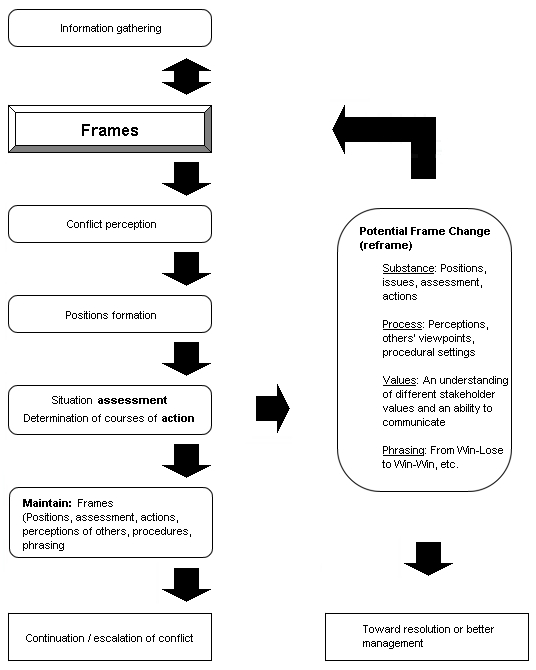
Figure 1: Frames and their role in conflict development
Figure 1 illustrates the roles frames and framing play in the dynamics of conflict development. It demonstrates how a frame change (or reframing) may cause a shift in conflict development, towards conflict management and/or resolution. Types of frame categories are numerous and coined differently by researchers in various fields. The categories cited in this diagram are: substance (reframing that affects how one views the world today or potential future states of the world), process (reframing that affects how one interacts with others in the dispute), values (reframing that allows parties to clarify the relationship between values and interests for both themselves and for other parties), and phrasing (the language used by disputants to communicate with one other).
Frame Analysis and Reframing as Conflict Management Tools
Frame analysis can be used by both third party interveners and by individual stakeholders and conveners to better understand conflict dynamics. Frame analysis has been used both retrospectively (to understand past conflicts) and prospectively (as a tool for better managing an existing conflict). Retrospectively, it seeks to better understand conflict dynamics in order to glean lessons for the future. Prospectively, it advances consensus building in both the conflict assessments and intervention stages.
Analytic techniques for frame analysis include interviewing the various stakeholders to ascertain their perceptions and interpretations, feeding back to the parties the resulting analysis, and then exploring with the parties the meaning and impact of these frames on the conflict dynamics. Particularly within the framework of conflict assessments, [23] frame analysis and the resulting understanding of frames can help the stakeholders to better grasp the conflict, including the factors and contexts that can lead to changes within a frame or changes to the frames themselves. In this sense, framing becomes a formative analytic technique.
In intractable conflicts, frames are often quite stable over time, even when specific individuals move in and out of the conflict. This stability comes both because various frames held by an individual tend to be self reinforcing, and because frames are often shared within a community and therefore are socially reinforced through story-telling and shared perspectives. Yet research into intractable conflicts suggests that in at least some conflicts, frames can be altered over time through intentional interventions, and that the shift in frames helps to render disputes more tractable.[24]
At the same time, research shows that reframing is often not easy for parties. It requires taking on new perspectives, and often requires some degree of risk-taking on the part of the parties. As such, reframing works best when changes in the context of the dispute can be made, such that incentives to consider new perspectives increase, or in the context of careful and constructive dialogue, with a strong focus on improving communication and building trust.
A number of strategies and techniques exist in the use of dialogue to reframe intractable conflicts. These include:[25]
- Reducing tension and promoting the de-escalation of hostility: by using techniques such as listening projects, study circles, and some forms of mediation which seek to reduce tension by creating forums that promote more effective communication around a set of limited objectives. The forums focus explicitly on improving communication and reducing escalatory cycles that are often associated with mutually-incompatible frames.
- Perspective taking: techniques such as acknowledging critical identities, imaging of identities and characterizations, narrative forums, and listening circles allow disputants to understand the conflict and its dynamics from the perspective of other disputants. These approaches are particularly geared toward better understanding of identity and characterization frames, in order to see oneself more objectively and the other party in a more positive light. They seek to enable disputants to see the potential validity and credibility of other perspectives, and to examine the interplay between one's own frames and those of other disputants.
- Establishing a common ground as a basis for agreement: by using techniques such as visioning exercises and common-ground search processes which enable reframing around a smaller set of issues. Common ground processes are used in highly divisive issues (such as abortion and ethnic disputes) and seek to explore areas of agreement and possible joint action between parties who normally focus on their differences, in order to open up communication between the parties. Search processes seek to identify desired futures in order to shift the focus from a short-term perspective to a long-term one.
- Enhancing the desirability of options and alternatives: Several approaches exist that may enhance the desirability of alternative options when presented to parties with divergent frames. For a disputant to examine options from the perspective of other parties, he or she must understand the other parties' frames, and be able to view options from other perspectives. Third-party interveners are often helpful in this regard. In addition, seeking to reframe perceptions of losses as gains can enhance the openness and creativity of parties to a dispute.
Conclusion
Frames play a significant role in perpetuating intractable conflict. As lenses through which disputants interpret conflicts, frames limit the clarity of communication and the quality of information, as well as instigate escalatory processes. These frames, imbedded in personal, social, and institutional roles, are often quite stable over time, even through the ebb and flow of many dispute episodes. As such, they contribute to the intractability of the conflict. In addition, frames interact, often in ways that tend to reinforce the stability of other frames. Yet, in at least some intractable conflicts, changes in the context of the dispute or purposive interventions designed to alter frames have led to reframing that, in turn, has increased the tractability of the conflict. Strategies to accomplish this reframing include frame analysis and the construction of forums designed to enhance communication, understanding, and trust.
 Current Implications
The day before I wrote this, James Comey, former head of the U.S. Federal Bureau of Investigation testified at a hearing of the Senate Ingelligence Committee about his relationship with and past interactions with President Donald Trump. The intepretation of what he said, and the implications of his testimony are a stark an example of framing differences.
Consider this June 9, 2017 New York Times story by Carl Hulse, entitled "Trump's Interactions with Comey: Criminal or Clueless?" (Accessed at http://nyti.ms/2s5WZUD). The title alone describes the two frames: Trump acted criminally, or just that he acted stupidly.
"Speaker Paul D. Ryan sought to excuse President Trump's overtures to James B. Comey, the former F.B.I. director, about pulling the plug on an investigation as a stumble by a political novice unfamiliar with the strict conventions of the capital....
To Mr. Comey, it was the opposite: When Mr. Trump pressed him on the inquiry...the presdient was fully aware he was nearing if not overstepping a legal boundary into possible obstruction of justice.
Mr. Comey suggested very strongly that Mr. Trump's acute sensitivity to his behavior was why he cleared the Oval Office of other high-level officials, including Attorney General Jeff Sessions and Vice President Mike Pence before one particularly delicate discussion."
As another example of divergent framing of the same event, many on the Political Left felt Comey's testimony proved the President obstructed justice. "If one believes James. B. Comey's account of his encounters with President Trump, it could present a prosecuable case of obstruction of justice, several former prosecutors said Thursday." (Charlie Savage, "Did Trump Obstruct Justice? A Legal Debate." New York Times, June 8, 2017. Accessed at http://nyti.ms/2rJZU4P.)
Trump himself asserted that this was simply a "politically motivated proceeding." In a talk at the White House on Friday, Trump said "Yesterday showed no collusion, no obstruction....That was an excuse by the Democrats, who lost an election they shouldn't have lost."
Indeed, framing has been core to the conflicts between Trump supporters and Trump opponents since the beginning of the campaign. Is America a mess that needs to be "cleaned up" so that we can "make America great again?" Or does "make American great again" mean taking it backwards to a simpler time when the country was more isolated from outside influence, racially whiter, and less accepting of non-fundamentalist Christian values? Is climate change the existential challenge of our times, or is it a hoax, perpetrated by purveyors of alternative energy, in an attempt to increase their fortunes at the cost of traditional energy sources such as coal and oil?
Frames not only involve interpretation of events or facts, they also encompass entire world views. George Lakoff has long made the distinction between "strict father" and "nurturing parent" cultures that not only shape the way people raise children, but also the way they interact with their peers and the expectations they have for the role of government in society. Lakoff has even associated these frames with the popularity of Trump. (See George Lakoff, "Why Trump" at https://georgelakoff.com/2016/03/02/why-trump/.)
--Heidi Burgess, June 9, 2017
Back to Essay Top
[1] Gray, B. and A. Donnellon, 1989. "An Interactive Theory of Reframing in Negotiation," unpublished manuscript. Pennsylvania State University, College of Business Administration.
[2] Sheppard, B.H., K. Blumenfeld-Jones and J.W. Minton, 1987. "To control or not to control: Two models of conflict intervention," unpublished manuscript sited in Pinkley, 1990).
[3] Elliott, M., Gray, B., & Lewicki, R., 2003. Lessons learned about the framing of intractable environmental conflicts. In R. Lewicki, B. Gray, & M. Elliott (Eds.), Making sense of intractable environmental conflicts: Concepts and cases (pp. 409-436), Washington, D.C.: Island Press.
[4] Kaufman, S. and J. Smith, 1999. "Framing and Reframing in Land Use Change Conflicts," Journal of Architectural and Planning Research, Vol.16, no.2, Summer, pp. 164-180.
[5] Elliott, M., Kaufman, S., Gardner, R., and Burgess, G., 2002. "Teaching conflict Assessment and frame analysis through interactive web-based simulations " The International Journal of Conflict Management, 13:4, pp. 320-340.
[6] e.g. Taylor , D.E., 2000. "The Rise of the Environmental Justice Paradigm. Injustice Framing and the Social Construction of Environmental Discourses," American Behavioral Scientist. 43 (4), pp. 508-580; and Gonos, G., 1997. "Situation" versus "frame": The "interactionist" and the "structualist" analyses of everyday life," American Sociological Review, 42, pp. 854-867.
[7] Watzlawick, P., J. Weakland, and R. Fisch, 1974. Change, Principles of Problem Formation and Problem Resolution, Norton & Company, Inc.; and Goldratt, E.M., 1990. What is this thing called Theory of Constraints and how should it be implemented?, Corton-on-Hudson, NY: North River Press, Inc.
[8] e.g., Minsky, M., 1975. "A Framework for Representing Knowledge," in Winston, P.H.( Ed.), The Psychology of Computer Vision, New York, NY: McGraw Hill, pp. 177-211.
[9] e.g., Kahneman, D. and A. Tversky, 1979. "Prospect Theory: An Analysis of Decision Under Risk, Econometrica 47, pp. 263-289.
[10] e.g., Neale, M.A. and M.H. Bazerman, 1985. "The Effects of Framing and Negotiator Overconfidence on Bargaining Behaviors and Outcomes," Academy of Management Journal 28, pp. 34-49; Gray, B., 1989. Collaborating: Finding Common Ground for Multiparty Problems, San Francisco, CA: Jossey-Bass Inc. Publication; and Pinkley, R.L., 1990. "Dimensions of Conflict Frame: Disputant Interpretations of Conflict," Journal of Applied Psychology 75, pp. 117-126.
[11] Lewicki, R., Gray, B., & Elliott, M., 2003. Making sense of intractable environmental conflicts: Concepts and cases, Washington, D.C.: Island Press; Kaufman and Smith, 1999, op cit.; and Vaughan, E. and M. Seifert, 1992. "Variability in the Framing of Risk Issues," Journal of Social Issues 48 (4), pp. 119-135.
[12] Minsky, 1975, op cit.
[13] Tannen, D., 1979. "What's in a Frame? Surface Evidence of Underlying Expectations," In Freedle, R. (ed.), New Dimensions in Discourse Processes, Norwood, NJ: Albex, pp. 137-181.
[14] Gray, B., 1997. "Framing and Reframing of Intractable Environmental Disputes," in Lewicki, R., R. Bies, and B. Sheppard (Eds.), Research on Negotiation in Organizations, 6, p. 171.
[15] Gray 1997, ibid.
[16] Lewicki, R, Saunders, D, and Minton, J., 1999. Negotiation. Burr Ridge, IL: McGraw-Hill Higher Education.
[17] Buechler, S., 2000. Social movements in advanced Capitalism. New York: Oxford University Press.
[18] Gray, B., 2003. Framing of environmental disputes. In R. Lewicki, B. Gray, & M. Elliott (Eds.), Making sense of intractable environmental conflicts: Concepts and cases (pp. 11-34), Washington, D.C.: Island Press.
[19] Putnam, L. and M. Holmer, 1992. "Framing, Reframing, and Issue Development", in Putnam L. and Roloff, M.E. (Eds.), Communication and Negotiation, Newbury Park, CA: Sage, Vol. 20. pp.128-155.
[20] Rothman, J., 1997. Resolving Identity-Based Conflict in Nations, Organizations, and Communities, San Francisco, CA: Jossey-Bass Publishers.
[21] Heimer, C.A., 1988. "Social Structures, Psychology and the Estimation of Risk," Annual Review of Sociology 14, pp. 491-519.
[22] Kahneman & Tverski, 1979, op cit.; Tversky, A. and D. Kahneman, 1981. "The Framing of Decisions and the Psychology of Choice," Science 211, pp. 453-458; Schweitzer , M.E. and L.A. DeChurch, 2001. "Linking Frames in Negotiations: Gains, Losses and Conflict Frame Adoption." International Journal of Conflict Management, Vol. 12 No. 2, pp. 100-113.
[23] Shmueli, D. and M. Ben Gal, 2000. "Reframing of Protracted Environmental Disputes", interim report to the Israeli Ministry of Environment, March (Hebrew); Shmueli, D. and M. Ben Gal, 2001. "Conflict Assessment to Promote Dialogue between the Stakeholders involved in the Dispute Surrounding the Treatment and Discharge of Industrial Wastes in the Lower Kishon Basin," draft June, final November (Hebrew); and Shmueli, D. and M. Ben Gal, forthcoming. "The Potential of Framing in Managing and Resolving Environmental Conflict." In E. Feitelson, G. de Roo and D. Miller (Eds.), Advancing Sustainability at the Sub-National Level, Ashgate Press.
[24] Elliott, M., Gray, B., & Lewicki, R., 2003. Lessons learned about the framing of intractable environmental conflicts. In R. Lewicki, B. Gray, & M. Elliott (Eds.), Making sense of intractable environmental conflicts: Concepts and cases (pp. 409--436), Washington, D.C.: Island Press at 420.
[25] ibid, at 425-434.
Photo credits for social media post: Small Frame: https://upload.wikimedia.org/wikipedia/commons/6/6e/Oil_paintimg_frame_Wellcome_L0067851.jpg attribution: See page for author [CC BY 4.0 (http://creativecommons.org/licenses/by/4.0)], via Wikimedia Commons ; Large frame: https://pixabay.com/illustrati
Use the following to cite this article:
Kaufman, Sanda, Michael Elliott and Deborah Shmueli. "Frames, Framing and Reframing." Beyond Intractability. Eds. Guy Burgess and Heidi Burgess. Conflict Information Consortium, University of Colorado, Boulder. Posted: September 2003 <http://www.beyondintractability.org/essay/framing>.