

Measuring the Many Dimensions of Citizenship
Newsletter # 487 - Sept. 9, 2026
By Heidi and Guy Burgess

Between the Civic Scholar Courageous Citizenship Collection which Harry Boyte and we announced in Newsletter 484, and the other BI posts on Courageous Citizenship, we have been writing a lot about citizenship lately. However, we want to share one more piece before we move on to other topics.
After reflecting on Harry's distinction between "civic" and "civil" citizenship, which we wrote about in Newsletter 424, we want to report on a recent email string we had with Harry and others, talking about the controversy over the word "citizen," and Guy's idea of a "citizenship index." We'll explain more about both topics below.
Should We Stop Using the Word "Citizen?"
In January, 2026 we interviewed Harry about (among other things) what the word "citizen" has come to mean in comparison to what it used to mean. Harry explained that
There are two distinct meanings of the words "citizen" and "citizenship." The one that is most used today is a strictly legal definition. A person is either a legal citizen of the U.S. or one is not.
Political theorist James Tulley calls this “civil citizenship.” It is government-centered and defined by legal status. One enjoys certain rights as a formal legal member of a polity. But it's not empowering, really.
Harry also calls this "vertical citizenship" — it is the relationship between citizens on the bottom, and the government on the top. And the rights a person has are very much dependent upon whether a person is a citizen or not. Again quoting Harry,
Given the Trump administration's aggressive and cruel push to deport illegal immigrants, this distinction has become highly salient on both sides of the partisan divide. Many people (especially those on the Left) are trying to hide or ignore the distinction, believing that all people should be treated the same way, regardless of whether they are legal citizens or not. As a result, many school districts, city offices, churches, and other private sector entities are eliminating the word "citizen" from their websites and materials, replacing it with the word "individuals" or "residents." Those terms are seen to be more "inclusive," while "citizen" is now seen by some as being "racist."
Harry went on to assert that this is a very unfortunate narrowing of the concept of "citizenship," which completely ignores the second meaning of the term which he calls "civic" or "horizontal citizenship."
The [former] is vertical, involving the individual's relations to the state. The second is among citizens — what people actually do to build a better community and create a democratic society. It's the activities of citizenship... including [he later said] such things as volunteering, engaging in acts of kindness, ...that's the communitarian strand of civic citizenship. We also stress work and work sites and institutions which are created by work at sites of citizenship. I saw this in practice in the civic preachers and teachers and business people and truck drivers and sharecroppers of the [civil rights] movement. We developed a conceptual language around the work of citizenship. (From Newsletter 424.)
Recently Harry emailed us, along with a number of others, saying that those of us who care about the second meaning of the word "citizen" — civic or horizontal citizenship — "have a lot of work to do." He shared a recent article by Kate Reed Petty, entitled "Is it Time to Retire the Word “Citizen?” Harry claimed (and we agree) that Petty raised a fairly weak defense of the word "citizen," saying that the problems with the word are such that we might need a new word for the concept. But then, Petty added:
we’ll need to use it frequently, to imbue it with the resonance, dignity, and responsibility that “citizen” implies now. For a while, that new word will sing; eventually, it will become problematic, too, and we’ll have to find another new one. The work of editing is like the work of social change itself. Because we live in a world where the things we don’t name are the things we lose first.
Guy observed that since it takes time for new words to permeate through a society, this kind of continuing effort to get us to switch to new terms risks undermining the common vocabulary that societies need to talk through critically important issues like "citizenship" and "democracy."
A related and even more important idea is raised by the last sentence in Petty's quote. In the string of emails that followed Harry's opener, Heidi wrote
I think "citizen" falls into the same category as "democracy" and "peace." We [Guy and I] have been advised to avoid these words many times because they are viewed negatively by so many people. After considerable discussion, we have concluded that all three words are far too important to stop using. Rather, we need to continuously use and vigorously defend the use of these terms. We need to help skeptics understand why these concepts are so critically important. And, to do that, we also need to be open and honest about past misuses of these ideas.
We learned in graduate school about the Whorfian hypothesis. (I just learned from Gemini that it is also called the Sapir-Whorf hypothesis). As it was taught to us, it says that people can't have an idea if they do not have a word for it. Gemini elaborates: "it proposes that the structure of a language shapes the way its speakers think, perceive, and understand the world. "
So if we abandon the words "citizen," "democracy," and "peace," we will not only lose the words, we will lose the ability to think and talk about these ideas, as well as the desire to work toward them. We hope we can all agree that would be a catastrophe.
Charles Heckscher, a Distinguished Professor Emeritus at Rutgers University and Director of the Center for the Study of Collaboration in Work and Society, added
The mania for inventing new words only makes things worse — it's dismissed by one side or the other as empty posturing, rather than leading to serious discussion and increased understanding. As Harry says, we have work to do; changing the word is just a way of avoiding the work.
... rights are also important - 100% responsibility is not the target. Rights were certainly crucial in the initial conceptualization of citizens as opposed to subjects - viz the Declaration of Independence (certain "unalienable rights").
Citizenship Indexes
In the same email exchange, Heidi noted that Guy had been talking about developing a "citizenship index." The goal of the index was to try to build on Harry's distinction between vertical and horizontal citizenship in ways that would shed light on many dimensions that determine what "citizenship" means in various contexts and to different people. Although Guy was originally thinking of one index, it turns out Heidi was thinking of another. And after reading and reflecting on other peoples' comments, we ended up identifying four different citizenship indexes that we think are worth considering, since each highlights a different aspect of citizenship. (You can click on each diagram to see a bigger version.)
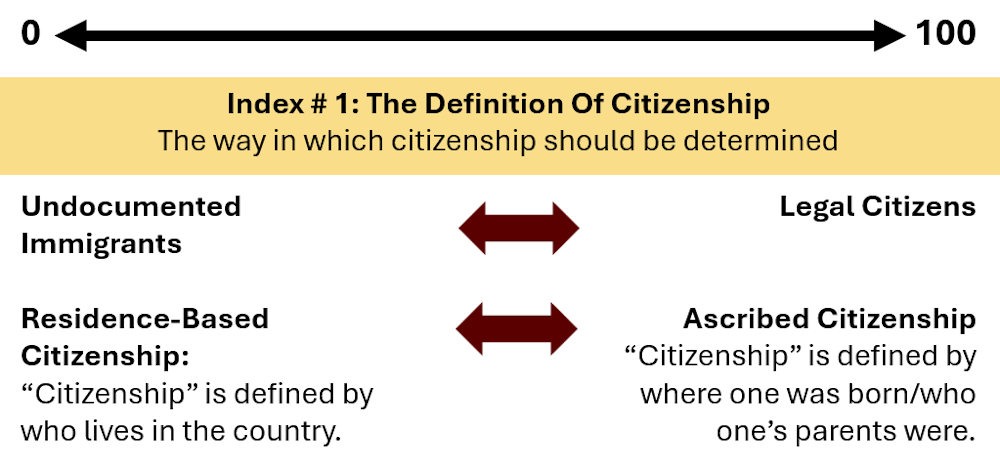
The first index is designed to highlight the differing factors that people use to determine who should and should not be considered a legal citizen (with all the privileges and obligations that accompany citizenship). This index, like all the others, runs along a continuum from 0 to 100.
On the left end (with a score of "0") are undocumented immigrants. The ones closest to "0" are those who came into the country illegally by sneaking across the border. Slightly further to the right (at 20 perhaps) are people who came in legally with visas, but who have overstayed their visas. Further toward the center are the people called "dreamers" who were brought into the country illegally as children, but who (oftentimes) know no other home, so have a moral, if not legal, right to stay. Close to the center are people who have come with legal visas and while not citizens, do have the legal right to be in the country, at least for a specified period of time. Also near the center are immigrants who are at some stage in the process of becoming naturalized citizens. Farther to the right, at 90 perhaps, are "naturalized citizens" — people who immigrated to the United States and earned their citizenship by living in the country for a while, obtaining a "green card," applying to become a citizen, passing a citizenship test, and taking an Oath of Allegiance. And at the far right end, with a score of "100" are "ascribed citizens," also called "birthright citizens," who were given citizenship at birth, based on their place of birth and/or the citizenship of their parents. (So babies born abroad to American citizens are automatically granted U.S. citizenship, as are babies born in the U.S.)
Many people in the United States think of "citizenship" as only pertaining to the people who score at or near 100 on this index along with people who earned "naturalized citizenship." Others (particularly the many progressives who score closer to "0") think that everyone who lives in the United States should be considered "citizens" and treated as such. This index measures where people draw the "citizenship line."
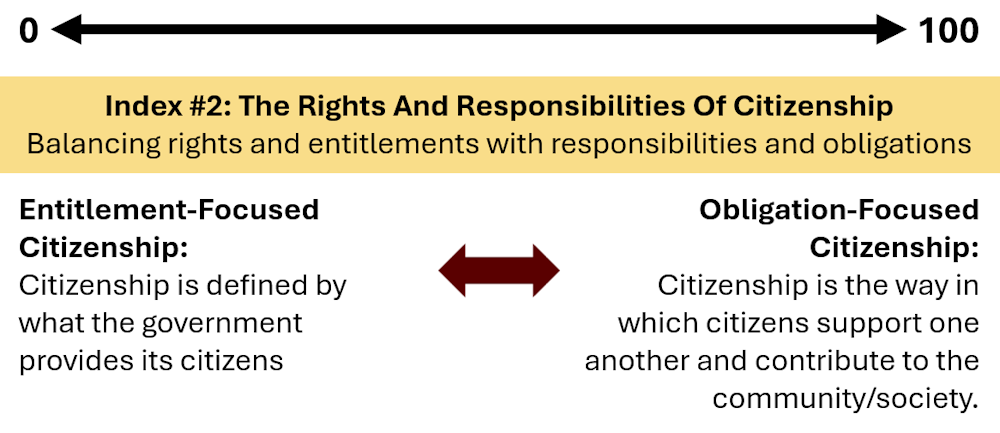
This index tries to shed light on the balance between what governments in a democracy owe their citizens and what citizens in a democracy owe each other (and their government). At one end of this continuum (with a score of 0) are individuals and groups who see citizenship solely in terms of political rights and economic entitlements. At this extreme, there is virtually no talk about the responsibilities that all citizens have to contribute toward the well-being of their community, or to help produce the economic output that makes entitlements possible. Citizens are just recipients of the government's protections and its largess.
The program of the Democratic Socialists of America (DSA) seems to come perilously close to describing such a political philosophy. Their big selling point is an expansive array of entitlements which they promise to their supporters (free transportation, free education, free healthcare, subsidized housing and groceries). They talk very little about what everyday citizens need to contribute to help make all this possible — it is just assumed that a tax on the super-rich can and will pay for it all. Unfortunately, the super rich aren't that rich, and they're very good at avoiding taxes. The DSA platform, however, sounds great, especially in a rich society like the United States. But, in practice, it is likely to fail because it makes unrealistic promises that, because they can't be fulfilled, will breed cynicism. By not asking for much in return for all their promised entitlements, it also undermines the willingness of people to make shared sacrifices to advance the common good and our willingness to help guarantee that others receive the same rights we demand for ourselves.
At the other end of the continuum (with a score of 100) are societies in which the government expects and demands that citizens contribute to the economy and to the preservation and expansion of the almost-always corrupt regime's power. In return, citizens are granted little or nothing in terms of rights and entitlements. At best, they aren't killed, or put in jail. This is the kind of citizenship that tyrants have long demanded.
Obviously, virtually all societies fall somewhere between these two extremes. A truly healthy democracy would score around 50. Societies that deviate too far from this sweet spot start running into real trouble. This, unfortunately, is something that we're starting to see in the United States, with many groups demanding ever more extravagant rights and entitlements, while neglecting accompanying responsibilities. We're also seeing other people veering toward the other end of the continuum, with blind support for quasi-authoritarian leaders and a lack of concern about the government's dysfunction and its violations of fundamental rights.
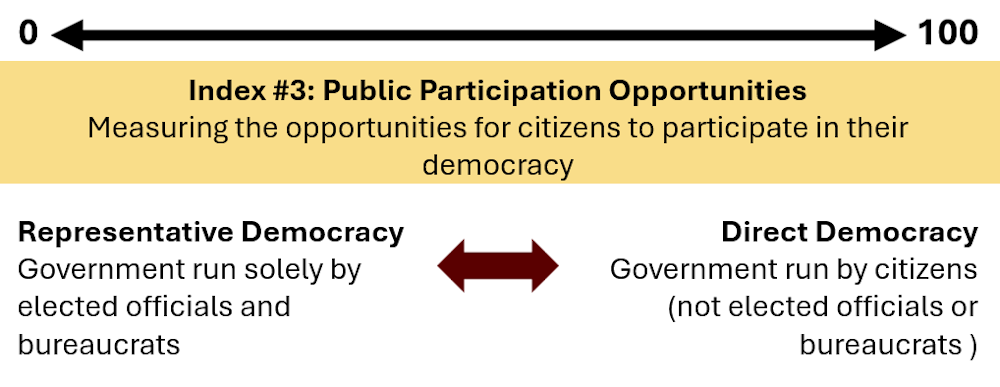
One participant in the email exchange highlighted a different continuum and a different potential index, which we will call Index #3. He emphasized that an individual's willingness to take on the responsibilities of citizenship was largely meaningless unless government and society were structured in ways that gave them meaningful opportunities to do so. There are many cases in which elected officials, in conjunction with a bureaucracy, believe that it is their job to run the government, and that the public just gets in the way. Such leaders may actively discourage citizen participation, or they may just not provide meaningful and accessible participation mechanisms.
Another factor that reduces public participation opportunities is the public's lack of adequate skills and knowledge, both about how governmental decision-making works, and also about the topics being discussed. Poor civic education, the death of local media, and the deteriorating levels of trust in all media are among the causes here. So, too, is the mutual distrust between citizens, who tend to distrust experts and expertise, and experts who don't think non-experts know anything worth considering in decision-making processes.
Successful democracy requires both a willingness and the ability to participate and opportunities to do so. So, Index #3 measures opportunities for meaningful civic involvement. It runs from "0" with no opportunity for the public to participate to "100" where society is run totally by citizens — a true direct democracy. In a today's very large and very complex societies, where everyday citizens can't possibly understand all the issues or have time to study them adequately, we are again looking for a sweet spot somewhere around 50.
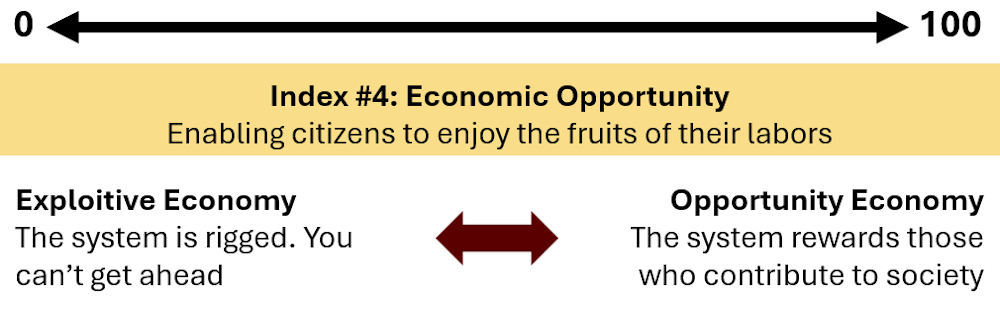
In thinking about the above dimensions of citizenship, it occurred to us that there was one other continuum worth highlighting — an Index #4. This is what we are calling the "economic opportunity" continuum. At one end of the continuum (with a score of "0") are people who believe that the system is fundamentally exploitive in ways that offer them no realistic opportunity to improve their lot in life. They see the system as rigged, and that anything they do to try better their situation will be taken away by powerful elites. (These are people who see themselves as living under the kind of kleptocracy that characterizes the authoritarian end of Index #2.) This is obviously tragic for people who see themselves (either rightly or wrongly) as living in this trap. It is also dangerous, because such individuals are more likely to see our democracy as worthless and evil and may simply want to destroy it. This is the extreme that produces violent nihilists.
At the other, much more positive, end of this continuum (with a score of "100") you have people who see themselves as having lots of meaningful opportunities to better themselves and their society. They believe that the system provides ample opportunities for industrious people who are willing to work hard and especially for those with creative ideas on how to make things better for others. Societies that have figured out how to operate at this end of the continuum are able to harness Adam Smith's invisible hand as a driver of all social and economic progress. This is what has made the combination of capitalism and democracy so vibrant and phenomenally productive.
This success, however, depends on giving people the freedom to enjoy the fruits of their labors. So, for this to work, society needs strong mechanisms to protect people who would otherwise find themselves on the exploited side of this continuum. It also can't make taxes so high that there is no point to work, or give away so many entitlements that there is no reason to work to try to get ahead because you'll do just as well if you do not make such efforts.
Putting This All Together
Democracies that work are those that have found a way to navigate to the sweet spot on each of these indexes.
- They have a balanced immigration policy that allows substantial numbers of people into the country, particularly those who can contribute to it in meaningful ways. But there are requirements for permanent citizenship, and not everyone is allowed to come or stay.
- They grant their citizens rights and entitlements, but those citizens also have responsibilities to contribute to the well-being of the society.
- Citizens are given opportunities to participate in government decision-making, and are provided sufficient education and opportunities to do so in a meaningful way. Further, the government should take citizen concerns seriously, but should not allow the desires of a few to overrule the benefit to many (as happens when a small group of citizens is allowed to veto anything new.)
- And lastly, successful democracies must protect citizens from exploitive business practices, while simultaneously allowing workers to enjoy the fruits of their labors without taxing them totally away, or providing so much for free that there is no reason to work.
Bottom line -- citizenship is a characterized by a multidimensional array of concepts, each of which highlight a different aspect of the larger effort to build a democracy that really works. Rather than throwing away or replacing the word, we should help people understand its many dimensions and do what needs to be done to hit the sweet spot on each of these indices.
————————
Lead Graphic drawn by ChatGPT.
Please Contribute Your Ideas To This Discussion!
In order to prevent bots, spammers, and other malicious content, we are asking contributors to send their contributions to us directly. If your idea is short, with simple formatting, you can put it directly in the contact box. However, the contact form does not allow attachments. So if you are contributing a longer article, with formatting beyond simple paragraphs, just send us a note using the contact box, and we'll respond via an email to which you can reply with your attachment. This is a bit of a hassle, we know, but it has kept our site (and our inbox) clean. And if you are wondering, we do publish essays that disagree with or are critical of us. We want a robust exchange of views.
About the MBI Newsletters
Two or three times a week, Guy and Heidi Burgess, the BI Directors, share some of our thoughts on political hyper-polarization and related topics. We also share essays from our colleagues and other contributors, and every week or so, we devote one newsletter to annotated links to outside readings that we found particularly useful relating to U.S. hyper-polarization, threats to peace (and actual violence) in other countries, and related topics of interest. Each Newsletter is posted on BI, and sent out by email through Substack to subscribers. You can sign up to receive your copy here and find the latest newsletter here or on our BI Newsletter page, which also provides access to all the past newsletters, going back to 2017.
NOTE! If you signed up for this Newsletter and don't see it in your inbox, it might be going to one of your other emails folder (such as promotions, social, or spam). Check there or search for beyondintractability@substack.com and if you still can't find it, first go to our Substack help page, and if that doesn't help, please contact us.
If you like what you read here, please ....





