

Anne Leslie: Reality is Rarely Either/or
Newsletter # 475 - July 27, 2026

Here is another very insightful article by our colleague, Anne Leslie, who is with IBM and has an amazingly impressive and daunting title — or maybe this is more a description of what she does. But next to her name on LinkedIn she writes: Cloud Risk & Digital Resilience Leader | NED & Board Advisor | Sovereignty, Cybersecurity, Post-Quantum Readiness, and Financial Services Risk Oversight.
I hardly understand a word of that, but Guy and I met Anne when all three of us were participating on a project on hybrid warfare called Project Seshat. That project brought together conflict resolution experts and security experts to figure out how we can better prevent, detect, and respond to hybrid threats. Since then we have learned a great deal from Anne.
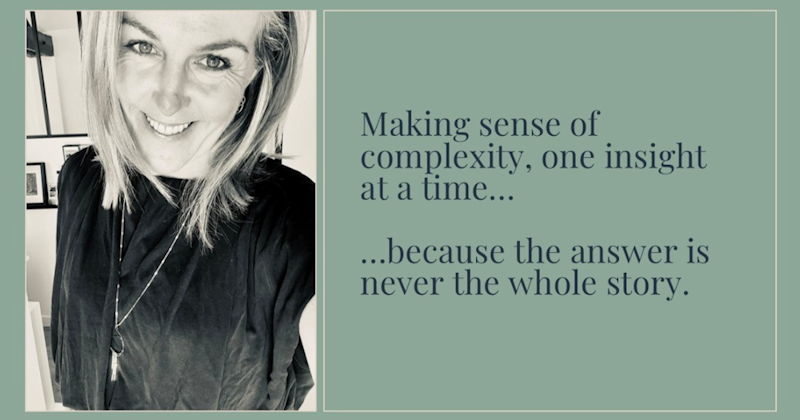
Anne has a newsletter called Fathoming 42, which she publishes on LinkedIn bi-weekly. As she explains in this recent article, which first appeared on Fathoming 42 on July 13 of this year, her newsletter has seemed to cover a wide range of topics. But it all boils down, she observes, to our tendency to oversimplify reality, and the trouble we get into when we do that. "Reality is never binary," she said. That seemed to me to be very appropos of David Eisner's last post, so I asked her if we could republish it here, and delightfully, she said “yes.” — Heidi Burgess
Reality is Rarely Either/or
by Anne Leslie
When I published the first issue of Fathoming 42, I began with a question about artificial intelligence, its place in society, and the extent to which technological progress can be reconciled with human dignity and fundamental rights. At the time, it seemed a reasonable point of departure for a newsletter that aimed to grapple with the consequences of living in an increasingly complex world.
Since then, however, the subjects have ranged rather widely. I have written about friendship and marriage, arguments and divorce, resilience and contentment, failure and recovery, regulation and sovereignty. Viewed purely through the lens of subject matter, the newsletter may appear to wander from one domain to another.
The longer I write it, the less I believe that is true.
What has become increasingly apparent to me is that these essays have all been attempts to examine the same underlying habit of mind: our tendency to reduce reality to choices between competing absolutes when reality itself rarely presents us with such clean distinctions.
Much of modern discourse is organised around binaries. We are encouraged to declare ourselves for or against, optimistic or pessimistic, progressive or conservative, regulated or free, resilient or vulnerable. The categories vary, but the structure remains remarkably consistent. Faced with complexity, we seek refuge in simplification.
The problem is not that distinctions are useless. The problem is that many of the distinctions we rely upon are false.
Technology can empower and diminish. Regulation can protect and constrain. Relationships can be sources of both joy and suffering. Failure can be destructive, but it can also be instructive. Resilience is not always admirable, nor is vulnerability always a weakness. Most things that matter contain tensions that cannot be resolved merely by choosing one side of an argument and dismissing the other.
Yet there is something deeply seductive about binary thinking. It reduces cognitive effort. It offers certainty where uncertainty exists. It provides identities to inhabit and narratives to defend. Above all, it allows us to avoid the discomfort that accompanies genuine complexity.
Reality, unfortunately, has little interest in accommodating our preference for simplicity.
The most capable leaders I have encountered, and the most contented people I know, are rarely those who possess unwavering certainty. More often, they are the people who can hold competing truths in mind without rushing to eliminate one of them. The strongest relationships are not those that avoid contradiction, but those that learn to navigate it. The most durable institutions acknowledge trade-offs rather than pretending they can transcend them.
Wisdom, I increasingly suspect, consists less in arriving at definitive answers than in resisting premature conclusions.
Many of the failures that interest me, whether personal, organisational, or societal, begin with a refusal to see things as they are. We become attached to categories that no longer explain reality. We confuse clarity with oversimplification. We mistake confidence for understanding. We insist upon coherence even when the evidence points towards ambiguity.
What follows is not insight but distortion.
The recurring theme of Fathoming 42 has therefore never been artificial intelligence, relationships, resilience, governance, or any of the other subjects that have occupied these pages. Those have simply been different vantage points from which to observe the same phenomenon.
The real subject has been complexity itself: the challenge of looking at the world without reducing it to caricature, the discipline of questioning false dichotomies, and the willingness to accept that reality is under no obligation to become simpler before we can understand it.
If there is a common thread running through every issue published so far, it is the conviction that understanding begins when we stop demanding that the world conform to our preferred categories and allow it, instead, to be exactly what it is.
Please Contribute Your Ideas To This Discussion!
In order to prevent bots, spammers, and other malicious content, we are asking contributors to send their contributions to us directly. If your idea is short, with simple formatting, you can put it directly in the contact box. However, the contact form does not allow attachments. So if you are contributing a longer article, with formatting beyond simple paragraphs, just send us a note using the contact box, and we'll respond via an email to which you can reply with your attachment. This is a bit of a hassle, we know, but it has kept our site (and our inbox) clean. And if you are wondering, we do publish essays that disagree with or are critical of us. We want a robust exchange of views.
About the MBI Newsletters
Two or three times a week, Guy and Heidi Burgess, the BI Directors, share some of our thoughts on political hyper-polarization and related topics. We also share essays from our colleagues and other contributors, and every week or so, we devote one newsletter to annotated links to outside readings that we found particularly useful relating to U.S. hyper-polarization, threats to peace (and actual violence) in other countries, and related topics of interest. Each Newsletter is posted on BI, and sent out by email through Substack to subscribers. You can sign up to receive your copy here and find the latest newsletter here or on our BI Newsletter page, which also provides access to all the past newsletters, going back to 2017.
NOTE! If you signed up for this Newsletter and don't see it in your inbox, it might be going to one of your other emails folder (such as promotions, social, or spam). Check there or search for beyondintractability@substack.com and if you still can't find it, first go to our Substack help page, and if that doesn't help, please contact us.
If you like what you read here, please ....





