

Dennis Wong Talks About Rotarian Peacebuilding
Newsletter # 437 - March 23, 2026

Heidi Burgess and Guy Burgess
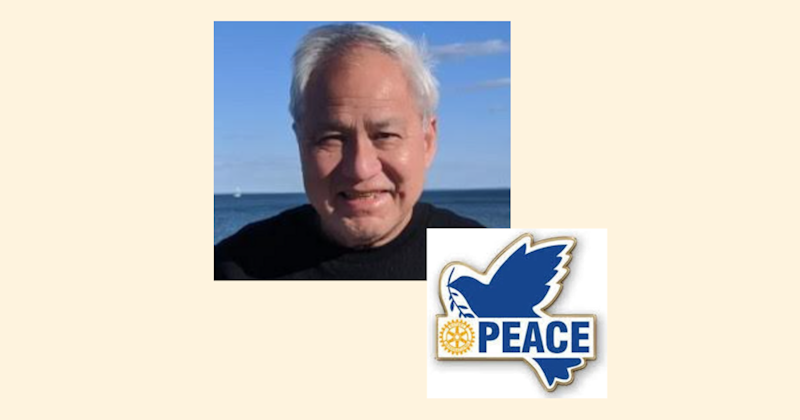
On February 19, 2026, I (Heidi Burgess) talked to Dennis Wong, a Rotarian Peacebuilder. Together with Al Jubitz, Dennis created the Rotarian Action Group for Peace. A retired businessman, Dennis lives in Connecticut and is working for peace at many levels from the personal to the global.
At the beginning of our talk, I asked Dennis, as I almost always do, to tell us about his background — how he came to be a Rotarian Peacebuilder.
He started his story saying he grew up in Hawaii.
I was born and raised in Hawaii, which is a background that is still with me. They talk about having the "Aloha spirit" and the idea of Ohana, which means family. In Hawaii, everyone is family — everybody's taken care of and no one is left behind. So that's kind of my background. I also like to say that in Hawaii, one of the amazing things, in addition to the weather, is the fact that everyone's a minority. There is no majority. And so I come from a little different, I guess, atmosphere. And I was born and raised there.
Hawaii also gave him a sense that character mattered. Wherever you go, he said, "there's good people and bad people, regardless of where you are. You know people that you can count on and people that you may not be able to count on."
After high school, Dennis got a Navy ROTC scholarship to go to Northwestern, where he got to meet many different people from all around the world. And he went on to get an MBA, both paid for by the navy, so he ended up being in the Navy for eight years -- starting just at the beginning of the American war in Vietnam. He said he loved the Navy, and he loved the people he worked with, but he was conflicted about what was going on with the war. So he decided to leave and go into business, where he's been until retiring a few years ago.
Dennis joined Rotary about 20 years ago, at the suggestion of a Northwestern alumnus. Rotary is a service organization, and Dennis started working on water projects and helping with inner city students and education, all big areas of interest in Rotary. But his interest in peacebuilding, conflict resolution and problem solving was growing, as those often became issues within Rotary and within his business experience.
Then about 12 years ago, I had an opportunity to meet up with a person from Portland, Oregon, Al Jubitz. And we shared a common idea: we thought that in all the services that we were doing, peace could be a major factor. So we put together a group within Rotary called Rotarian Action Group for Peace, with a focus on peace and moving forward. And in those 12 years, we've seen our efforts within Rotary growing.
I think it's the time for, possibly, a tipping point, and making it a real major thing within Rotary. Stepping back, Rotary has been known for its work to eliminate polio. And it's been at it for about 40 years. And also, I think it is a model, an interesting effort, where Rotary has made an effort, a big idea, to eliminate polio, which would be the second disease that is completely eliminated from the world — with the first being smallpox. Rotary has made a commitment with a lot of talent, time, and treasury to address this issue of polio. Al Jubits and I thought that basically the next big idea for Rotary could be peace. So that's where we are right now.
I (Heidi) asked Dennis how he defined "peace" and he acknowledged it is a term that means different things to different people. He drew a lot of his ideas, he said, from Johan Galtung and John Paul Lederach, two well-known peacebuilders. He also cited Simon Sinek's book Start with Why, which stresses the importance of purpose and clarity, and Bent Flyvbjerg on How to Get Big Things Done Out of this, Dennis developed his own definition of peace:
World peace is where every person, every community, and every nation can live in safety, dignity, and well-being, which basically, in many ways, is the consensus values of peace and the benefits of peaceful societies.
He includes the benefits of peaceful societies in this definition because he thinks that people don't always understand how they are going to benefit from peace. So he's been trying to help people get a better vision of what peace can mean for them, and why it is worth working for. He's also been involved in a Rotary group that has been trying to work toward a world without nuclear weapons. But he thinks maybe that is starting in the wrong place. "If we have world peace," he noted, "then we wouldn't need nuclear weapons."
I asked Dennis how Rotarian Peacebuilding was different from what other peacebuilders do. Rotary Peacebuilding, he said, incorporates Rotary's mission, vision, values, principles, and practices into their work. He didn't explicitly spell out what each of them were, but I looked them up online:
- Rotary's mission is to "provide service to others, promote integrity, and advance world understanding, goodwill, and peace through our fellowship of business, professional, and community leaders."
- Their vision states that "Together, we see a world where people unite and take action to create lasting change — across the globe, in our communities, and in ourselves.
- Rotary has five core values: service, fellowship, diversity, integrity, and leadership.
- Their principles are rooted in Rotary's Four Way Test. In all interactions, Rotarians ask: Is it the truth? Is it fair to all concerned? Will it build goodwill and better friendships? Will it be beneficial to all concerned?
- Rotary's practices derive from the earlier four -- they do service projects in an effort to promote peace, fight disease, and support communities locally, around the world. (Rotary has over a million members in over 45,000 clubs around the world.)
If you listen to our whole conversation, it is very apparent how he has taken all of these ideas to heart and incorporated them into everything he does. He also emphasized the importance of creating and sustaining a sense of belonging, hope and trust, that's needed for a real and flourishing peace.
I asked him how they can do that in the context of the United States which is so deeply divided. Dennis responded:
Well, you've got to try, that's one thing. You've got to work at it. And you've got to be creative. I go back to the Rotary mission. Can our shared mission and vision help people as far as our purpose? Our mission is to advance understanding, goodwill, and peace, for people getting together. And also our vision is the fact that together, we see a world where people unite to create lasting change across the globe and in our communities, even in ourselves.
I think the purpose, regardless of where you are, the extremes or in the middle, everyone wants safety. That's a key thing that I think everybody would agree that they would like to have. Everyone wants personal safety, dignity, feeling valued, being respected. And also the idea of well-being. Everyone wants to live a decent life, be healthy. I think those are the things, as far as in broad terms that we all agree on.
Now, what we disagree on is how we get there. But at least if we have a goal as far as living in safety, dignity, and well-being, then we can debate how best to get there or how we can get as far as we can.
Right now, he observed, we seem to be stuck in a zero-sum game. But if we can be more creative, we might find new ways in which everyone can benefit.
Our conversation then turned to the Rotary Four Way Test. Sanda Kaufman and we had commented in Newsletter 422, that the first two principles listed in the four way test: "Is it the truth?"and "Is it fair to all concerned?" would be very hard to agree on, and often, actually create conflict, rather than help resolve it. Dennis said that's why he usually turns the four way test upside down, asking the last two questions first.
I start out with, "will it be beneficial to all concerned?" And then, "will it build goodwill and better freindships?" Because one of the things about building goodwill and better freindships is, I know from the business side, that you'd rather do business with people you like, than people you don't like. And so this building of relationships, the idea of belonging, the idea of trust — is very, very important if we want to get ahead. ...
We know some of the approaches [to help build trust]: listening and empathy, which are good. ...We should try to develop a peaceful identity; a trustworthy identity, so that what we're trying to do is the best for all concerned. Also, we should practice what we preach, — leadership by example. Too often people, leaders especially, say "do as I say, not as I do." That is our problem here in the United States, and around the world, with some of our leaders. What they say and what they do are completely different. So people don't find them trustworthy. So that's some of the things that we've got to address.
Dennis agrees that fairness and truth are harder to agree on, but they become easier if you've already established a track record of success with the other two. If people feel like the outcome will benefit them personally, and they have developed good relationships with the other side, then working on fairness and truth will be easier. It opens up people's minds to new possibilities.
He also said that while it can be difficult to decide on "what's fair," it is much easier to agree on what isn't fair. (Heidi was amused with this observation, because over 30 years ago we edited a book entitled Justice without Violence. At the beginning of that project all the contributing authors got together with a few philosophers to decide how we would define "justice." After several hours of conversation that got nowhere, we decided we wouldn't try to define justice. But we could all fairly easily agree on what injustice was.
Dennis also agreed that people often have different definitions of truth and they back into their respective corners and defend those definitions. But, he said, "I think the truth becomes more apparent in the context of what we need to do or want to do for a better life for everybody. Also, we need to be flexible" -- we can't back into our corners and not be willing to budge.
Dennis talked about the theme Rotary adopted last year: "The Magic of Rotary."
The way the theme came about was that one of our leaders was involved with a water project in the Dominican Republic where they had dirty water. And so they installed a system with a water filter. To test it, at one end, they put in dirty water, it went through the filter, and out came clean water. And there was a boy there who was watching the process. And he saw the dirty water go through the system, and come out clean water. And he said "That's magic! That's magic!" So this is how I think, possibly, Rotary and what we do can be transformative. We can take division and polarization and transform it into some of our principles about belonging, about understanding, transform hate to hope and love.
And then also there is the idea of transforming fear. I go back to the idea of trust and peace. That's what I'm trying to, I guess, in my head. I'm trying to share my thoughts and with other people. And the Magic of Rotary, is what makes me a Rotarian peacebuilder. That's the difference. It's a mindset and the idea of certain principles about having a real purpose about world peace. And having an identity about being trustworthy and practicing what I preach. And then the idea of a commitment. As we've shown in Rotary, with our efforts in service and polio and health and education that we have some credentials. Rotary has a million people. Just think if you had a million Rotarian Peacebuilders around the world!
I asked if Rotary does particular peacebuilding projects in particular locations. Dennis pointed to two main activities. First is the Rotary Peace Fellows Program, that selects about 150 people from around the world to attend universities where they can hone their peacebuilding skills. The second major effort is what Dennis called "peace through service." This involves service programs that help people lead a better life, which is a component of Dennis's definition of peace.
Dennis is trying to encourage Rotary to increase their focus on peace. He is hoping to convince Rotarians that "peace is the ultimate Rotary service," instead of clean water, instead of other things.
How effective my campaign is, and does it make sense to a lot of different people who have been used to, saying, 'I do service. I do clean water. I do education, etc.,' I don't know. I'm trying to put a greater emphasis on peace as being able to amplify or leverage whatever else we're doing. I think that's what I see as a possibility moving forward.
He said he wants to see peace as their "BHAG" — their "Big, Hairy, Audacious, Goal. And he pointed out, you don't need a masters degree to be a peacebuilder. all you need is a smile. "Keep smiling and say your a peacebuilder. And that I think that leads to other things."
At the end of our conversation, Dennis said that he wanted to leave me and our viewers with three things.
- Have a clear purpose.
- Be trustworthy.
- Lead by example -- practice what you preach.
In my mind, those three things are key. And being a Rotarian helps build those three things.
After reviewing the transcript, Dennis asked that I add one more sentence at the end: "Please consider joining me as a Rotarian Peacebuilder for world peace."
You can watch/listen/read more about Dennis and Rotary Peacebuilding in the full interview.
Please Contribute Your Ideas To This Discussion!
In order to prevent bots, spammers, and other malicious content, we are asking contributors to send their contributions to us directly. If your idea is short, with simple formatting, you can put it directly in the contact box. However, the contact form does not allow attachments. So if you are contributing a longer article, with formatting beyond simple paragraphs, just send us a note using the contact box, and we'll respond via an email to which you can reply with your attachment. This is a bit of a hassle, we know, but it has kept our site (and our inbox) clean. And if you are wondering, we do publish essays that disagree with or are critical of us. We want a robust exchange of views.
About the MBI Newsletters
Two or three times a week, Guy and Heidi Burgess, the BI Directors, share some of our thoughts on political hyper-polarization and related topics. We also share essays from our colleagues and other contributors, and every week or so, we devote one newsletter to annotated links to outside readings that we found particularly useful relating to U.S. hyper-polarization, threats to peace (and actual violence) in other countries, and related topics of interest. Each Newsletter is posted on BI, and sent out by email through Substack to subscribers. You can sign up to receive your copy here and find the latest newsletter here or on our BI Newsletter page, which also provides access to all the past newsletters, going back to 2017.
NOTE! If you signed up for this Newsletter and don't see it in your inbox, it might be going to one of your other emails folder (such as promotions, social, or spam). Check there or search for beyondintractability@substack.com and if you still can't find it, first go to our Substack help page, and if that doesn't help, please contact us.
If you like what you read here, please ....





